
BY:SpaceEyeNews.
The 3I/ATLAS methanol discovery raises an intriguing question: what kind of planetary system produced this chemically unusual visitor? Astronomers found exceptionally high methanol levels relative to hydrogen cyanide in gas surrounding the interstellar comet. They also uncovered evidence that floating icy grains contribute to those emissions.
Together, these findings offer more than a list of ingredients. They connect the comet’s chemistry with the processes releasing its gas. That combination helps researchers investigate material from another star system, while testing how closely it resembles familiar comets.
How ALMA Measured 3I/ATLAS Methanol
Reading the escaping gas
Nathan Roth and his colleagues used ALMA’s Atacama Compact Array in Chile to examine the comet during 2025. Their observations covered its approach toward the Sun, when increasing warmth encouraged its ice to release gas.
The team studied molecular signals at submillimeter wavelengths. Methanol and hydrogen cyanide produce distinctive emission signatures, allowing astronomers to distinguish them within the surrounding cloud, or coma.
These measurements reveal which molecules escape and help researchers estimate their production rates. However, they do not directly measure every ingredient stored inside the nucleus. That distinction matters when interpreting the comet’s unusual chemistry.
A discovery with an earlier timeline
NRAO announced the findings in March 2026. ScienceDaily’s September coverage revisits that research, rather than describing observations made during a new solar approach. The study appears in The Astrophysical Journal Letters.
Why the Methanol Ratios Stand Out
The official announcement summarizes methanol-to-hydrogen-cyanide ratios of approximately 70 and 120. The published research gives central estimates of 79 and 124, with uncertainties. Both descriptions point to the same result: unusually strong methanol production relative to hydrogen cyanide.
For the radio observations compared in the study, only the unusual solar system comet C/2016 R2 showed greater enrichment. This makes 3I/ATLAS exceptional within that comparison, without making it chemically unique in every respect.
What those numbers actually mean
A production ratio compares how many molecules of each substance enter the gas over time. It does not describe the percentage of the entire comet made from methanol.
Likewise, a ratio near 120 does not mean the comet contains 120 times more methanol than an average comet. Hydrogen cyanide provides the reference for this particular measurement.
The result therefore concerns a relationship between two molecules. Researchers need other measurements to build a broader picture of the comet’s composition.
Icy Grains Behave Like Mini-Comets
ALMA also helped the researchers investigate where the gases originate. Hydrogen cyanide appeared consistent with release directly from the nucleus. Methanol showed evidence of an additional source within the surrounding coma.
The proposed explanation involves small icy grains that leave the central body. Sunlight then warms those grains, allowing their ice to turn directly into gas.
Each grain can consequently release more methanol after separating from the comet. Calling them miniature comets captures their behavior: detached pieces of icy material continue responding to solar heating.
This also makes the grains part of the chemical investigation. Understanding their contribution helps scientists avoid treating the whole coma as a simple sample of the nucleus. The location of an emission carries information alongside its strength.
Why the extra source matters
This process changes how astronomers interpret the surrounding gas. Material detected away from the nucleus may have escaped from traveling grains, rather than directly from the surface.
Similar activity occurs in some solar system comets. The notable advance here concerns tracing these processes in an interstellar visitor.
Still, the research includes an observational limitation. Weak signals on the smallest spatial scales prevented the team from definitively excluding a nucleus-only methanol source. The icy-grain explanation has supporting evidence, but the observations do not settle every detail.
What the Chemistry Suggests About Its Origins
The 3I/ATLAS methanol findings suggest that its ice formed under different conditions, or experienced different processing, from most familiar comets. Those possibilities concern both its original environment and the changes its material later underwent.
Methanol alone cannot reconstruct that entire history. Nevertheless, its abundance adds another useful constraint when researchers compare possible explanations.
Webb adds another chemical clue
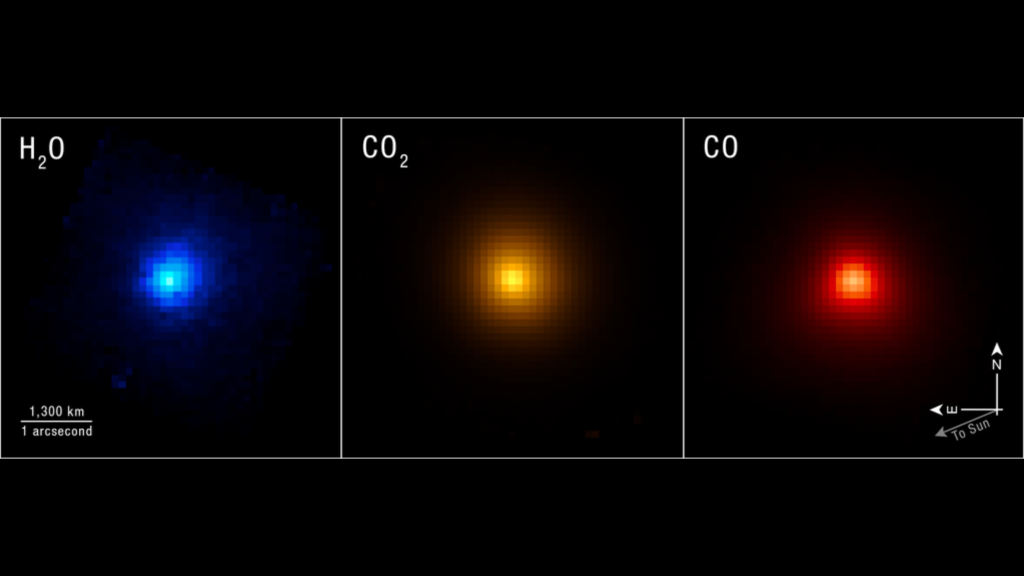
Earlier James Webb Space Telescope observations revealed a coma dominated by carbon dioxide while 3I/ATLAS remained farther from the Sun. That result already distinguished its activity from many solar system comets.
The Webb research considered several explanations, including an intrinsically carbon-dioxide-rich nucleus and conditions that suppressed water release. It also discussed formation location and radiation exposure as possible influences.
ALMA contributes a different molecular comparison and information about gas release. Together, these observations let scientists examine both the available ingredients and the processes controlling what becomes visible.
They do not identify a specific parent star. Nor does the methanol ratio alone establish an exact formation temperature or age.
What This Discovery Can Tell Us
Interstellar comets provide rare opportunities to compare material from different planetary systems. Scientists can examine their emissions using the same methods they apply to nearby comets.
Such comparisons help separate familiar physical behavior from unusual chemical proportions. In 3I/ATLAS, both aspects matter: recognizable ice activity accompanies an exceptional molecular ratio.
Organic chemistry also requires careful interpretation. Methanol is a simple organic molecule, but detecting it does not establish biological activity. This study investigates composition and outgassing, rather than evidence of life.
A central question remains how faithfully the escaping gases represent the stored ice. Heating, grain release, and different sublimation behavior can affect that relationship. Additional observations and comparisons can help researchers disentangle those effects.
3I/ATLAS Methanol Offers a Window Into Other Systems
The 3I/ATLAS methanol discovery connects unusual chemistry with evidence of activity beyond the nucleus. Its value comes from examining those findings together.
By following the gas and investigating its sources, astronomers gain a clearer view of material carried between stars. Future interstellar discoveries will help reveal whether this visitor’s chemical proportions are rare elsewhere, or simply unfamiliar within our own solar system.
Main sources:
- NRAO: ALMA Detects Extremely Abundant Alcohol in Interstellar Comet 3I/ATLAS
- Roth and colleagues: Methanol and HCN observations with ALMA
- Cordiner and colleagues: Webb observations of the carbon-dioxide-dominated coma
- ScienceDaily: Interstellar comet 3I/ATLAS is bursting with methanol