
BY:SpaceEyeNews.
The 70 Ophiuchi habitable zone could accommodate an Earth-mass planet in a system with two suns. New simulations show that such a world could maintain a stable orbit around the larger star. Its stellar companion would not necessarily disrupt that orbit.
Located about 16.6 light-years away, the system offers an intriguing target for future observations. However, astronomers have not confirmed any planets there. The finding establishes where a potentially habitable world could survive, leaving its existence an open question.
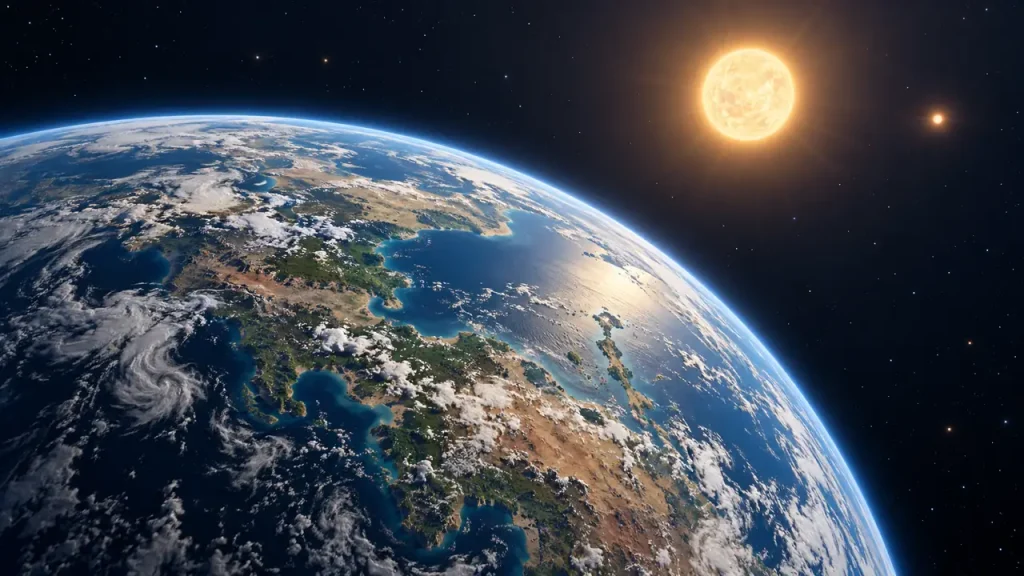
70 Ophiuchi Habitable Zone: A World With Two Suns?!
Why This Nearby Binary System Matters
70 Ophiuchi contains two stars, known as A and B. Their masses equal approximately 88% and 73% of the sun’s mass, respectively. Both stars are smaller and cooler than our sun.
Their proximity gives astronomers a compelling reason to investigate. Researchers also have extensive observations of the pair, allowing increasingly precise calculations of their motion.
The system has attracted planetary speculation for generations. In 1855, astronomer William Jacob proposed a planetary companion, although that claim did not withstand scrutiny. Today, improved instruments let scientists revisit the question with stronger evidence.
A University of Michigan-led team combined historical measurements with new observations. The resulting study, published in The Astrophysical Journal, examines both possible planetary signals and orbital stability. www.ipac.caltech.edu
How Scientists Tested a Hypothetical Earth
Refining the Stars’ Motions
Before testing possible planets, researchers needed an accurate picture of the stellar orbits. Their analysis brought together observations spanning roughly a century.
New measurements came from instruments including the Planet Finder Spectrograph on the Magellan Clay Telescope in Chile. Between 2023 and 2025, that instrument provided 499 measurements of the primary and 334 of the secondary.
These data helped refine the stars’ masses and motions. That stronger observational foundation allowed the team to explore possible planetary arrangements. arxiv.org
Placing a Planet in the Model
UC Riverside doctoral student Skylar D’Angiolillo conducted the dynamical modeling. She placed a hypothetical Earth-mass planet at different distances from the primary star.
The simulations followed the gravitational interactions between the planet and both stars. Researchers checked whether the planet maintained its orbit, moved toward a star, or eventually left the system.
Each trial explored a possible configuration rather than reconstructing a known planetary system. This approach separates the question of gravitational stability from the observational challenge of finding a small, faint planetary companion.
Repeating those tests revealed where stable motion remained possible. Crucially, the simulations tested orbital behavior. They did not detect a real planet or establish its surface conditions.
Stable Orbits in the 70 Ophiuchi Habitable Zone
The central result offers a reason to keep searching. An Earth-mass planet could maintain a stable orbit within the primary star’s habitable zone.
The study finds stable orbits around that star extending to approximately 2.5 astronomical units. One astronomical unit equals the average distance between Earth and the sun.
However, that figure describes the approximate stability limit, rather than the habitable zone’s outer edge. The habitable zone lies within the region where the modeled orbits remain stable. arxiv.org
One Main Sun and a Stellar Companion
In this scenario, the planet would orbit the larger star individually. The companion would influence its motion through gravity.
This arrangement differs from a planet circling both stars together. The distinction matters because those configurations create different orbital environments.
The result shows why a second star does not automatically exclude a potentially habitable planet. What matters is the system’s specific architecture and the planet’s location within it.
What the Planet Search Actually Ruled Out
Alongside the simulations, researchers searched the observations for evidence of planetary companions. They found no coherent planetary signals.
Variations in the stars’ measured motion instead matched stellar activity associated with rotation. Such changes can resemble the signal astronomers seek when searching for planets.
Nevertheless, the observations established useful limits. For planets orbiting in the binary’s plane, the analysis excludes Jupiter-mass companions within five astronomical units of the primary.
Those constraints do not eliminate every possible planet. Smaller worlds could remain below the search’s sensitivity.
Smaller Planets Remain Possible
The findings still allow Saturn-mass planets or smaller within suitable habitable-zone orbits around the primary. That possibility includes lower-mass worlds, although it provides no evidence that any exist.
These limits help researchers refine future searches. They identify which possibilities the observations exclude and which require more sensitive measurements. arxiv.org
What Future Observations Could Reveal
A Potential Target for New Missions
The 70 Ophiuchi habitable zone now has a stronger dynamical case for further investigation. Astronomers can use such modeling to assess promising systems before committing valuable observing time.
NASA’s planned Habitable Worlds Observatory aims to directly image potentially habitable planets and examine their atmospheres. The agency is developing technologies needed for that demanding task.
Planning documents place the mission in the 2040s. However, that timeframe remains a development goal rather than a guaranteed launch date. www.nasa.gov
Another concept, SHERA, would search for planets in binary systems through precise measurements of the stars’ relative positions. Researchers identify 70 Ophiuchi as a favorable target for that approach. www.ipac.caltech.edu
From Orbital Stability to Habitability
A future detection would begin a new investigation. Scientists would need to establish the planet’s orbit and physical properties before assessing its environment.
An Earth-mass world would not automatically share Earth’s atmosphere, climate, or oceans. Similarly, a habitable-zone location only indicates that surface liquid water might be possible under suitable conditions.
The current work addresses an earlier question: can a planet occupy that region without losing its stable orbit?
The Search for a World With Two Suns Continues
The 70 Ophiuchi habitable zone offers a scientifically grounded possibility for a nearby world with an unusual stellar setting. Better measurements have clarified the system’s architecture, while simulations show that stable planetary orbits remain possible.
The next challenge belongs to observations. Astronomers must determine whether a planet actually occupies that promising region. Until then, 70 Ophiuchi remains a compelling place to look for a world whose surroundings differ markedly from Earth’s.
Main sources:
- UC Riverside: An Earth-like planet with two suns?
- Research paper: A Century of Radial Velocity and Astrometric Monitoring of 70 Oph AB
- Caltech/IPAC: Suns set on hunt for giant planets in nearby binary system
- NASA: Habitable Worlds Observatory