BY:SpaceEyeNews.
February may be short, but February 2026 night sky events are packed into almost every week. You get a full Snow Moon at the very start, a modest meteor shower soon after, a remote-but-real annular “ring-of-fire” solar eclipse, and then a rare late-month moment when six planets share the evening sky.
This SpaceEyeNews guide keeps it practical. It tells you what to watch, when to look, and what you’ll actually need—naked eye, binoculars, or a small telescope. It also flags the few moments where safety matters.
February 2026 night sky events calendar (save this)
Here’s the quick “look up” schedule first. Then we’ll break each event down.
- Feb 1: Full Snow Moon (peak at 22:09 UTC)
- Feb 8: Alpha Centaurid meteor shower peak (best after midnight)
- Feb 17: Annular solar eclipse (ring-of-fire), with partial visibility in far-southern regions
- Feb 18: Moon–Mercury close pairing low in the west after sunset
- Feb 19: Mercury greatest eastern elongation (best evening window)
- Feb 19: Crescent Moon near Saturn (low western sky)
- Feb 23: Moon near the Pleiades (evening)
- Feb 28: Six-planet parade after sunset (Mercury, Venus, Saturn, Jupiter + Uranus, Neptune with optics)
Event 1: Feb 1 Snow Moon (Full Moon)
The timing that matters
The full phase peaks on February 1, 2026 at 22:09 UTC, according to the U.S. Naval Observatory moon-phase data.
Many “local time” articles also list it as 5:09 p.m. ET, which matches that UTC peak.
How to get the best view
Skip the exact minute if you want. The Moon looks “full” for more than one night. What does matter is moonrise, especially if you have a skyline view.
- Watch near sunset and catch the Moon lifting off the horizon.
- That’s when it can look bigger and warmer in color due to atmosphere.
- Use binoculars if you want extra texture on the lunar surface.
Quick photo tip
Try a simple two-shot plan:
- A wide photo at moonrise with buildings or trees for scale.
- A tighter zoom later, when the Moon climbs higher and brightens.
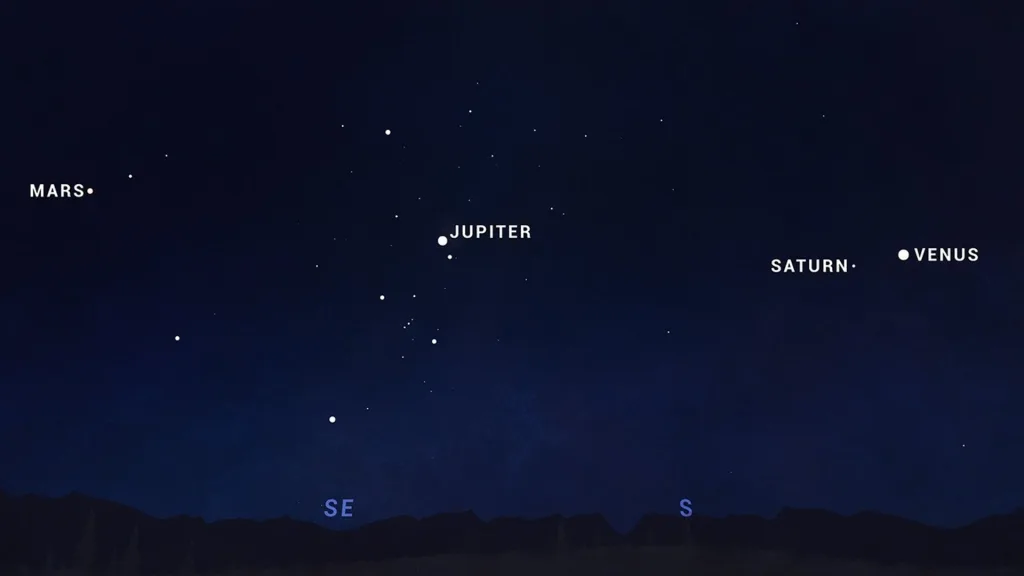
Planetary alignments and planet parades –Credit: NASA
Event 2: Feb 8 Alpha Centaurids (meteor shower)
What you should realistically expect
This is not a “storm.” It’s a modest meteor shower. Still, it gives February a real meteor peak to aim for.
The International Meteor Organization lists the α-Centaurids (102 ACE) peaking around February 8, and notes the maximum can vary slightly.
In-The-Sky.org also lists the shower as active from late January to late February, with the peak around Feb 8.
Where it works best
- Best odds: Southern Hemisphere, because the radiant sits near Centaurus.
- Some observers at lower northern latitudes may still catch a few, if the radiant rises enough.
How to watch (the simple way)
- Go out after midnight, and stay at least 20 minutes.
- Find the darkest sky you can. City lights cut meteor counts fast.
- Skip telescopes. Use your eyes and a wide view.
Event 3: Feb 17 ring-of-fire annular solar eclipse
What makes it “annular”
An annular eclipse happens when the Moon passes in front of the Sun but looks a bit smaller. The result is a bright ring around a dark center.
Where it’s visible in February 2026
On February 17, 2026, annularity is concentrated over Antarctica / remote southern regions, with partial eclipse visibility reaching parts of the far-southern globe.
If you want a quick check by location, eclipse maps and city tables are the easiest way to confirm visibility.
Solar safety rules (non-negotiable)
This is one of the few sky events where the wrong choice can hurt your eyes.
- Use certified solar eclipse glasses or a proper solar filter.
- Never aim binoculars or a telescope at the Sun without a correct solar filter system.
- If you’re unsure, don’t improvise. Use official eclipse safety guidance and proven equipment.
Event cluster: Feb 18–19 Mercury’s best evenings + Moon pairings
This is where February turns into a “short season” of western-horizon targets. Timing matters because these objects sit low and set early.
Feb 18: Crescent Moon meets Mercury
On Feb 18, the Moon and Mercury make a tight pairing in the evening sky. In-The-Sky lists a close approach the same day, with the Moon just one day old (a thin crescent).
How to actually see it:
- Pick a spot with a clean view to the west.
- Start looking as twilight fades.
- Expect a short window. They drop toward the horizon fast.
Feb 19: Mercury at greatest eastern elongation
This is your best February moment for Mercury. It’s when the planet reaches its greatest separation from the Sun in the evening sky.
EarthSky lists the elongation moment as 18:00 UTC on Feb 19, 2026, with Mercury about 18° from the Sun.
In-The-Sky also describes the same evening apparition and even notes Mercury shining bright (listed around magnitude -0.6 there).
Royal Observatory Greenwich also highlights Feb 19 as a key Mercury viewing date for 2026.
Practical viewing notes:
- Look soon after sunset.
- Don’t wait “until later.” Mercury sets early at this time of year.
- Binoculars help, but only use them after the Sun is fully down.
Feb 19: Crescent Moon near Saturn
The same night brings another clean visual: the thin crescent Moon near Saturn, low in the west after sunset.
This is a great “beginner-friendly” pairing:
- The Moon guides your eyes.
- Saturn looks like a steady point of light.
- A small telescope can show Saturn’s ring shape, if conditions cooperate.
Feb 23: Moon near the Pleiades (easy, photogenic, and fast)
Late February adds a crowd favorite: the Moon passing near the Pleiades star cluster.
National Geographic’s February sky guide highlights Feb 23 for this close pairing, visible after sunset and drifting westward through the evening.
Live Science adds that in some locations the Moon can even graze part of the cluster, with timing varying by region.
How to make it pop:
- Look high in the southwest after sunset.
- Use binoculars and you’ll see more of the cluster’s sparkle.
- Try a quick photo with a tripod. Keep exposures short to avoid star trails.
Feb 28: The six-planet parade (the headline event)
This is the big late-month story for February 2026 night sky events.
What NASA says you can see
In its 2026 astronomical events roundup, NASA specifically calls out February 28 as a night when six planets appear in the evening sky: Mercury, Venus, Neptune, Saturn, Uranus, and Jupiter.
NASA notes that four should be visible without optical aid (weather permitting), while Uranus and Neptune require binoculars or a telescope.
NASA’s “What’s Up” February 2026 skywatching article also frames the month as a planetary parade setup, with Jupiter high and Uranus/Neptune as optics-only targets near the lineup.
The easiest way to spot the parade
Use a simple scan order so you don’t get lost:
- Start west right after sunset: Mercury and Venus sit low and fade early.
- Check Saturn in the same general region, still low.
- Look higher for Jupiter. It’s usually the easiest bright planet in this set.
- Use optics only after the sky darkens: hunt Uranus and Neptune carefully.
What this event is (and what it isn’t)
A “planet parade” does not mean perfect straight-line stacking. It means multiple planets share the same broad evening sky window, spread along the ecliptic. NASA’s wording emphasizes visibility “shortly after sunset,” which is the key planning detail.
Bonus: Aurora potential you can verify in real time
Some February sky guides mention elevated aurora chances tied to solar activity. That can change night to night. The best approach is to check an official dashboard before you drive.
The NOAA Space Weather Prediction Center offers an Aurora Dashboard that predicts visibility for “tonight and tomorrow night,” plus short-term tracking.
It also publishes a separate Aurora 30-Minute Forecast product based on the OVATION model.
If you want this in your article layout, add a small callout:
- “Before you head out, check NOAA’s aurora dashboard.”
- “If you see a strong forecast, prioritize a dark northern horizon.”
Simple gear checklist for February 2026 night sky events
Keep this section short in your final post. It helps readers act.
- Naked eye: Snow Moon, Jupiter, Venus, Saturn (often), parts of the parade
- Binoculars: Mercury help, Pleiades detail, Uranus/Neptune attempts
- Small telescope (optional): Saturn rings, cleaner planet views
- Solar eclipse glasses / solar filter: required for eclipse viewing
Conclusion: February’s best “look up” nights
If you only pick three windows this month, make them these: Feb 1 for the Snow Moon peak, Feb 17 for the annular eclipse (even if you’re following it remotely), and Feb 28 for the six-planet parade.
Most importantly, treat February 2026 night sky events like short appointments. Mercury sits low and disappears fast. The planet parade rewards early timing. The meteor peak needs dark skies and patience. When you plan around those realities, February becomes one of the most satisfying skywatching months of the year.
Main sources:
https://www.yahoo.com/lifestyle/articles/9-night-sky-events-see-120000115.html
https://science.nasa.gov/solar-system/whats-up-february-2026-skywatching-tips-from-nasa/
https://www.nasa.gov/blogs/watch-the-skies/2026/01/16/most-notable-2026-astronomical-events-a-year-of-watching-the-skies/
https://aa.usno.navy.mil/calculated/rstt/oneday?date=2026-02-01
https://www.imo.net/files/meteor-shower/cal2026.pdf
https://in-the-sky.org/news.php?id=20260208_10_100
https://in-the-sky.org/news.php?id=20260218_20_100
https://earthsky.org/tonight/mercury-after-sunset-greatest-elongation-east/