
BY:SpaceEyeNews.
When a rover drives on another planet, it is not “remote control.” The distance adds delays, and every move needs careful planning. That is why this story matters: NASA confirmed that Perseverance completed the first drives on another world that were planned by generative AI—executed on December 8 and December 10, 2025.
This AI-planned drive on Mars is not a flashy gimmick. It signals a practical shift in how surface missions can operate when time, bandwidth, and human workload limit what is possible. And unlike many “AI in space” headlines, NASA and Jet Propulsion Laboratory shared concrete details about how they validated the plan, tested it, and kept it within operational limits.
Below is the clean, fact-checked story—what changed, how NASA made it trustworthy, and what it unlocks next.
The real problem: Mars driving is slow for a reason
Rovers do not drive like cars. Teams design rover routes to avoid hazards and protect hardware. NASA notes that human planners typically split routes into waypoints that are relatively close together to reduce risk. The challenge grows because Mars sits far enough away that real-time guidance is not possible, so teams must plan ahead and then wait for results.
That planning is skilled work. It also consumes time that could go into science—aiming instruments, scouting targets, and deciding what to sample next. Over long missions, the cost is not just minutes. It shapes what the mission can achieve each week.
Now layer on another reality: Perseverance works in rugged terrain. It drives near the rim of Jezero Crater, where the surface mixes rocks, ripples, slopes, and uneven ground that can slow progress.
So NASA’s question became simple and high-impact: can AI take on the route-planning burden while humans stay focused on goals and safety?
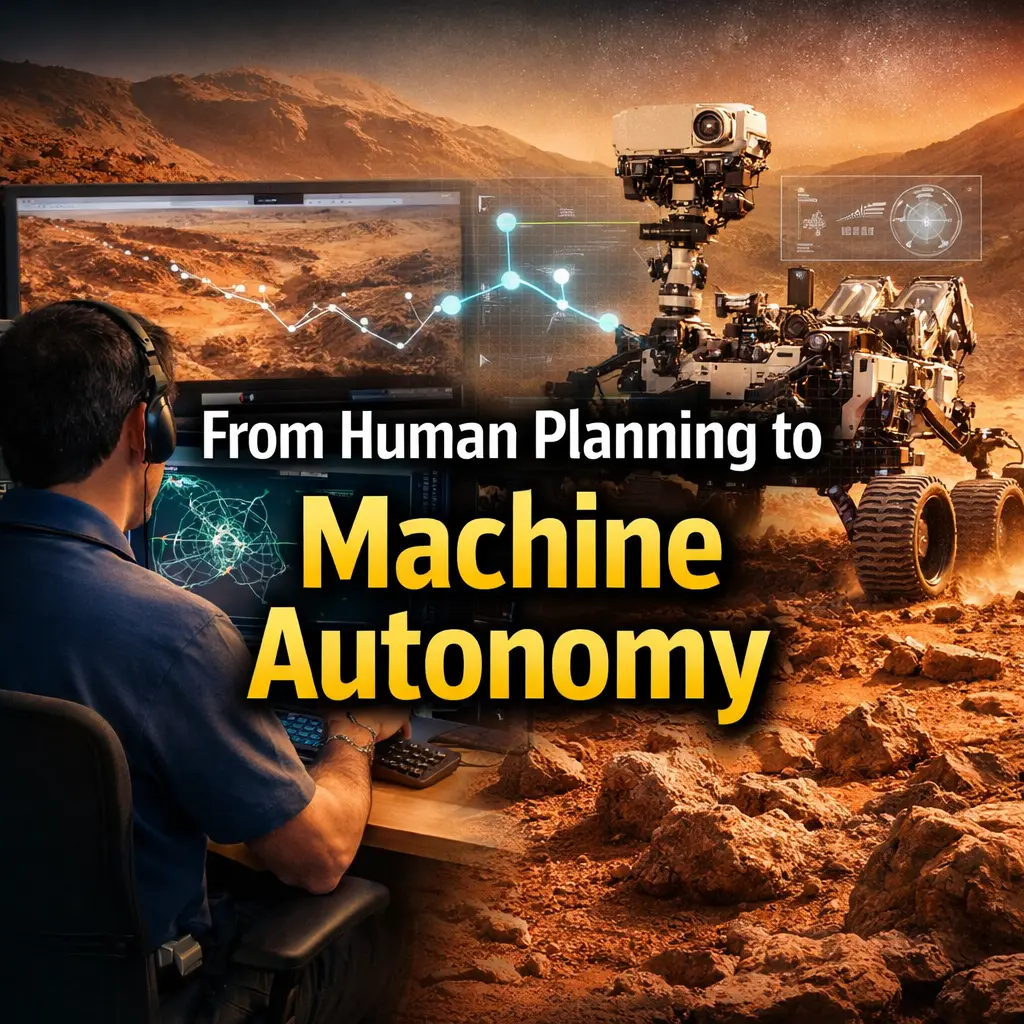
From human waypoints to AI-planned waypoints
What NASA tested in the AI-planned drive on Mars
NASA describes the December demonstration as a generative AI system creating waypoints for Perseverance—work that rover planners usually do manually.
On December 8, Perseverance drove 689 feet (210 meters) using the AI-planned route. On December 10, it completed a second AI-planned drive of 807 feet (246 meters).
Those numbers matter because they show this was not a single short proof. It was repeated, measured performance on real terrain.
Why this is more than “autopilot”
Perseverance already uses autonomy software for navigation. Research published in Science Robotics describes how rover autonomy can plan much of its driving in real operations.
What is new here is the planning workflow. Instead of humans crafting the route by hand from orbital imagery and terrain models, NASA tested generative AI to produce the waypoint plan that the rover would follow.
Think of it as shifting from “humans draw the route” to “humans supervise an intelligent planner.” That shift can scale across more missions and more surface platforms.
How NASA made AI reliable on another planet
NASA’s public write-up emphasizes responsibility and verification, and the supporting materials show why. This is the part that turns a bold demo into a credible operational step.
1) The AI used the same kinds of inputs humans use
NASA says the demonstration used generative AI to create waypoints and relied on the imagery and data rover planners already use in their process.
NASA’s visualization products also show the organization of the route and the terrain context around it, reinforcing that this was not guesswork.
2) The team validated the plan in a high-fidelity simulation
NASA explains that the rover team verified the AI’s commands with a “digital twin”—a virtual model of Perseverance—before sending the instructions to Mars.
That matters because planning is not only about avoiding rocks. Commands must match rover constraints: steering limits, wheel behavior, power rules, timing, and how flight software expects inputs.
3) The December 10 drive was reconstructed in detail
JPL published a detailed visualization of the December 10 drive. They note the rover captured navigation camera images during a 2-hour, 30-minute drive along the crater rim and that the images and rover data were placed into a 3D environment for reconstruction.
This kind of reconstruction helps engineers review what happened at a fine-grained level. It also helps validate that the plan and the outcome match expectations.
4) NASA treated it as “supervised autonomy,” not hands-off automation
NASA’s framing makes the operating philosophy clear: the team applied new technology carefully in real operations. The AI generated the route plan, and the mission team still ensured the output stayed within safe and approved boundaries.
That balance is the point. People keep mission responsibility. AI reduces workload and speeds planning.
Extra details that strengthen confidence
Visualizing the AI-planned drive on Mars
NASA’s Photojournal describes an animation of Perseverance’s 246-meter drive that lets mission “drivers” understand the rover’s decision-making process and why it chose one path over others.
In other words, NASA does not just claim success. They also provide tools that help review and interpret the rover’s choices.
Mapping Perseverance’s route with AI
NASA also shared a separate Photojournal entry focused on route mapping and the software pipeline used to manage engineering data and plan drives.
Even if most viewers never open these products, their existence matters: they show an engineering mindset built around traceability and review.
What this unlocks for Mars and future missions
This is where the AI-planned drive on Mars becomes bigger than two drives.
1) More science time, less planning time
If AI can reduce the time it takes to create safe routes, teams gain time for higher-level work: choosing targets, planning instrument sequences, and adapting science priorities based on results.
The win is not just distance per day. It is mission throughput—how many useful decisions you can make each week.
2) Longer traverses become more practical
NASA and partners have publicly discussed a future where smart tools support kilometer-scale drives and reduce operator workload.
Mars exploration often hinges on reaching the next compelling geology. If autonomy accelerates that journey, missions can sample more diverse environments within the same lifespan.
3) Autonomy scales to multi-vehicle surface missions
Future exploration will not rely on one rover alone. Surface missions may combine rovers, aerial scouts, and stationary instrument packages. Coordinating that ecosystem from Earth becomes harder as complexity rises.
Supervised autonomy helps here. It lets humans set intent while machines handle execution details, especially when communication windows are limited.
4) It supports future crewed exploration without using “crewed” as a buzzword
Space agencies continue to plan long-term exploration paths that involve humans operating far from Earth. On those missions, automated systems will need to scout terrain, handle routine logistics, and react quickly to surface conditions.
AI route planning is one piece of that foundation. It does not replace people. It supports them by reducing repetitive workload and by operating effectively when time delays and bandwidth constraints limit direct guidance.
Common misconceptions to avoid
“The rover drove itself without any oversight.”
No. NASA describes a careful demonstration led by JPL, where the team used generative AI to generate waypoints and verified plans before execution.
“This was just a chatbot driving a rover.”
Headlines can oversimplify. The official NASA and JPL materials focus on generative AI route planning, waypoint generation, and engineering validation. That framing is the reliable reference point.
“AI means faster at any cost.”
NASA’s approach suggests the opposite. They emphasize applying new technology carefully in real operations, which implies controlled testing and layered validation.
Conclusion: Why the AI-planned drive on Mars is a true milestone
The AI-planned drive on Mars is a milestone because it targets the real bottleneck in surface exploration: safe, repeatable planning under distance and time constraints. Perseverance completed AI-planned drives on December 8 and 10, 2025, and NASA backed the announcement with technical context, reconstructions, and mission-grade validation steps.
This is the practical version of “smarter exploration.” Humans still guide mission goals and protect the rover. AI helps produce safe routes faster, freeing teams to spend more time on discovery. If NASA can scale this approach across future platforms, the result will be simple: more science, more coverage, and a more capable path toward sustained exploration beyond Earth.
Main sources :
NASA — “NASA’s Perseverance Rover Completes First AI-Planned Drive on Mars”
https://www.nasa.gov/missions/mars-2020-perseverance/perseverance-rover/nasas-perseverance-rover-completes-first-ai-planned-drive-on-mars/
Jet Propulsion Laboratory — “NASA’s Perseverance Rover Completes First AI-Planned Drive on Mars”
https://www.jpl.nasa.gov/news/nasas-perseverance-rover-completes-first-ai-planned-drive-on-mars/
NASA Photojournal — “Visualizing Perseverance’s AI-Planned Drive on Mars”
https://science.nasa.gov/photojournal/visualizing-perseverances-ai-planned-drive-on-mars/
NASA Photojournal — “Mapping Perseverance’s Route With AI”
https://science.nasa.gov/photojournal/mapping-perseverances-route-with-ai/
Science Robotics (peer-reviewed background on rover autonomy)
https://www.science.org/doi/10.1126/scirobotics.adi3099