
BY:SpaceEyeNews
An interstellar visitor just gave scientists an unexpected “bonus scene.” The Comet 3I/ATLAS flare did not happen at the moment most people would expect. NASA’s SPHEREx space telescope watched the comet in December 2025, after its closest approach to the Sun. Instead of fading as it headed outward, it brightened dramatically and released a fresh surge of gas and dust.
That timing matters. It suggests the comet’s most revealing chemistry showed up late. SPHEREx also detected key molecules in infrared, including water-related emissions, carbon dioxide, and organic compounds in the coma. It is a rare chance to study material that formed around another star.
This article breaks down what SPHEREx saw, why the outburst likely came late, and what the Comet 3I/ATLAS flare may tell us about planet-building ingredients beyond our solar system.
Why the Comet 3I/ATLAS flare surprised researchers
Most comets become most active near perihelion. That is when solar heating drives surface ice to sublimate into gas. After perihelion, activity often drops as the comet heads into cooler regions.
3I/ATLAS did not follow that clean arc. SPHEREx observations in December 2025 show the comet was “full-on” active well after its close solar pass, leading to a clear brightening and a richer coma. NASA highlighted that even water ice quickly turned to gas in interplanetary space during this phase.
Space.com’s reporting adds a simple headline summary: the comet flared “while exiting the solar system,” producing a glowing coma with water vapor, carbon dioxide, and organic compounds, along with a distinctive dust tail shape.
The bigger point is not just brightness. It is diagnostic brightness. A flare increases the amount of material in the coma. That gives infrared instruments a stronger signal and more spectral detail. In plain terms, the comet briefly made itself easier to “read.”
SPHEREx in one line: why infrared made the difference
SPHEREx observes in infrared, which is ideal for identifying molecular signatures. Visible images can be striking, but they often mix dust reflection with gas glow. Infrared can help disentangle what the comet contains versus what it looks like.
NASA’s own image release about the event states that SPHEREx measured infrared light emitted by dust, water, organic molecules, and carbon dioxide in the comet’s coma during the December 2025 campaign.
That is exactly why the Comet 3I/ATLAS flare is more than a flashy headline. It is a chemistry story.
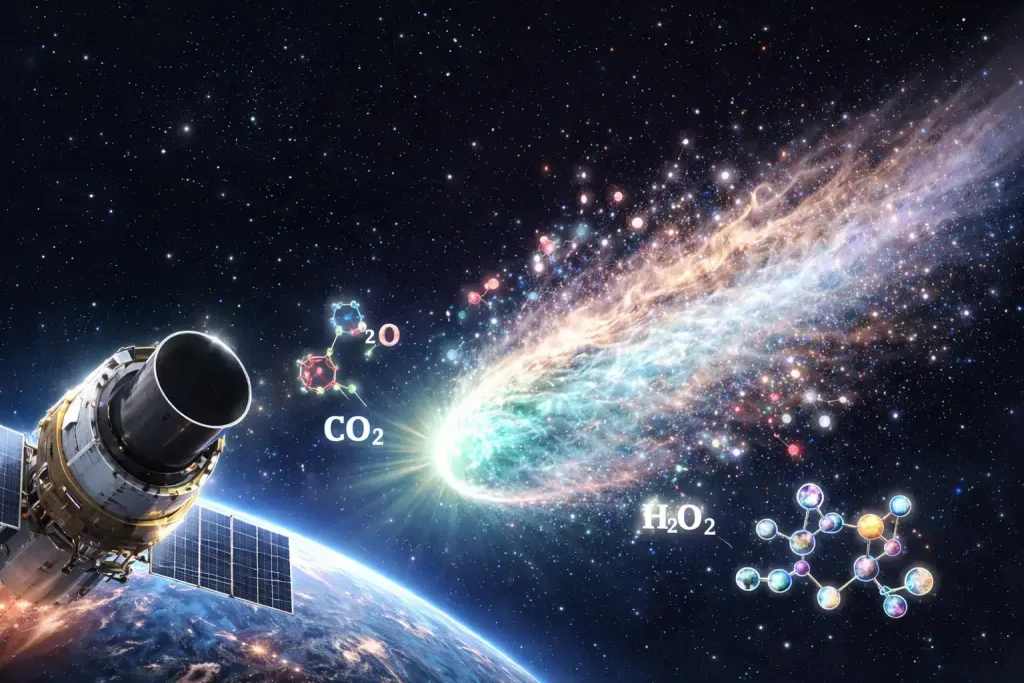
What SPHEREx detected: a chemical inventory in the coma
NASA’s summaries emphasize three headline components in the coma during the flare: water-related material, carbon dioxide, and organic molecules.
A separate technical preprint (authored by members of the SPHEREx team) expands the list of observed spectral features. It describes emissions tied to CN, H₂O, organic C–H bands, CO₂, and CO, plus dust signatures from scattered light and thermal emission. It also reports that the comet appeared far more active post-perihelion than in earlier SPHEREx observations.
What those molecules mean (without the textbook)
- Water (H₂O): a core comet ingredient. It also drives coma expansion when it sublimates.
- Carbon dioxide (CO₂) and carbon monoxide (CO): volatile carbon-bearing species. They can trace formation temperature zones in the comet’s birth disk.
- Organics (C–H features) and CN: indicators of carbon-rich chemistry. They can hint at complex chemical pathways in the parent system.
None of this proves anything sensational. It does show something valuable: the comet carried a recognizable set of planet-building ingredients, and SPHEREx caught them in strong signal during the flare.
The late outburst: the best explanation is “delayed heating”
So why did the flare happen after perihelion?
NASA’s SPHEREx blog points to a straightforward mechanism: sunlight likely took time to penetrate beneath the surface. That delayed heating then triggered a release of buried ices and carbon-rich material that had stayed locked below a processed outer layer.
The SPHEREx team’s preprint supports the idea of a major post-perihelion change. It reports a much more active object in December 2025 compared with earlier SPHEREx views, alongside shifts in the spectral signature consistent with a more strongly sublimating comet.
A helpful mental picture
Think of 3I/ATLAS as layered:
- A surface crust that has been altered over time.
- Deeper ice pockets that stay colder longer.
- A slow heat wave that travels inward.
When heat finally reaches volatile-rich zones, pressure builds. Gas finds a path out. Dust rides along. The comet brightens. That is the Comet 3I/ATLAS flare in a simple chain.
“Interstellar” is the real headline, not just the flare
3I/ATLAS matters because it is part of a tiny club. It is only the third confirmed interstellar object observed passing through our solar system, following 1I/ʻOumuamua (2017) and 2I/Borisov (2019).
Those earlier visitors taught scientists different lessons. ʻOumuamua raised debates about shape, spin, and non-gravitational acceleration. Borisov looked more like a classic comet. 3I/ATLAS now adds something else: a well-observed, late-stage chemical outburst captured in infrared, with a clear molecular inventory.
In other words, the Comet 3I/ATLAS flare is interesting. The fact that SPHEREx observed the flare’s chemistry from an interstellar body is the bigger win.
What the dust tail hints at during the Comet 3I/ATLAS flare
Reports describe a noticeable dust structure during the outburst. Space.com notes a “pear-shaped” dust tail, tied to rocky material being ejected as activity increased.
The SPHEREx preprint echoes that description. It mentions a weak pear-shaped, solar-pointing dust tail consistent with large grains, alongside strong coma emissions and dust signatures.
Dust is not a side show. Dust is a record. Grain size, composition, and brightness can tell researchers how the comet breaks down, how jets behave, and how fresh material reaches the coma.
What scientists can learn by comparing 3I/ATLAS to local comets
The most useful question is not “Is it weird?” The useful question is “How does it compare?”
If interstellar comets show similar chemical families to our own comets, that supports a broader idea: many star systems produce icy bodies with comparable raw materials.
Space.com frames it this way: similarities and differences can help scientists assess whether the ingredients for planets and potentially life are common across the Milky Way.
The details will take time. Researchers will compare ratios and spectral strengths. They will also compare activity patterns. A delayed outburst can reveal thermal properties and layering, not only chemistry.
Where the results were published and what to watch next
NASA and Space.com both note that findings were published in February 2026 in Research Notes of the AAS.
Separately, the SPHEREx team’s detailed technical write-up is available as an arXiv preprint describing the December 2025 re-observation and the post-perihelion activity increase.
As 3I/ATLAS continues outward, the best new progress will come from:
- follow-up analysis of the SPHEREx spectra,
- cross-comparisons with other instruments, and
- careful modeling of the delayed heating and venting behavior.
Even if the comet fades from view, the dataset will stay active for years.
Conclusion: what the Comet 3I/ATLAS flare really means
The Comet 3I/ATLAS flare delivered two stories at once. First, it was a timing surprise. SPHEREx saw the comet brighten in December 2025, after perihelion, when many comets would calm down. Second, it was a chemistry gift. Infrared observations pointed to a coma rich in dust and key molecules, including water-related emissions, carbon dioxide, and organic compounds.
The leading explanation is sensible, not mysterious. Sunlight likely took time to penetrate deeper layers, then triggered a delayed release of buried ices.
Most importantly, this event gives scientists a sharper comparison point between our comets and material formed around other stars. The Comet 3I/ATLAS flare may be short-lived in the sky, but its chemical fingerprint will shape how we think about planet-building ingredients across the galaxy.
Main sources :
NASA SPHEREx blog (Feb 4, 2026): https://science.nasa.gov/blogs/spherex/2026/02/04/nasas-spherex-mission-tracks-brightening-of-interstellar-comet/
NASA Photojournal image release (PIA26720): https://science.nasa.gov/photojournal/nasas-spherex-examines-comet-3i-atlass-coma/
Space.com report (Feb 2026): https://www.space.com/astronomy/comets/nasa-space-telescope-sees-comet-3i-atlas-dramatically-flare-as-interstellar-visitor-exits-solar-system
SPHEREx technical preprint (arXiv): https://arxiv.org/abs/2601.06759