By:SpaceEyeNews.
A new MeerKAT hydroxyl megamaser detection is giving astronomers a rare look into a much earlier era of the universe. The signal came from a distant galaxy system called HATLAS J142935.3–002836, located at redshift 1.027, which places it more than 8 billion light-years away in look-back time. What makes this discovery stand out is not just the distance. It is the fact that the signal remained bright enough to detect so clearly at all.
That is why this story matters. The new MeerKAT hydroxyl megamaser is now described as the most distant OH megamaser detected so far. The team also reports that its apparent luminosity is the highest yet seen for this type of source. In simple terms, astronomers found a natural radio amplifier in the distant universe that looks far brighter than expected. That opens a new path for studying galaxy evolution, gas-rich mergers, and intense star formation across cosmic time.
What the MeerKAT hydroxyl megamaser actually is
The phrase MeerKAT hydroxyl megamaser may sound technical, but the basic idea is clear. This object is not a visible-light laser. It is a powerful source of amplified radio emission linked to the hydroxyl molecule, or OH. Astronomers detected the familiar OH spectral lines near 1665 MHz and 1667 MHz, which are the classic markers of hydroxyl megamasers in distant galaxies.
Under the right conditions, hydroxyl molecules can amplify radiation at very specific radio frequencies. That process works on the same principle as a laser, but at longer wavelengths. That is why astronomers use the term maser. When this effect becomes extremely powerful in another galaxy, it is called a megamaser. In this case, the researchers go even further and suggest that the source may be bright enough to qualify as a gigamaser, a proposed higher tier based on its apparent luminosity.
That distinction matters. The headline value of the story is the dramatic signal. The real scientific value is that the MeerKAT hydroxyl megamaser shows these amplified radio sources can be found much farther away than older surveys had managed. Previous OH megamaser work had mostly stayed below redshift 0.25. This new detection pushes that frontier much deeper into cosmic history.
Why this distant system is so unusual
The source galaxy is not calm or ordinary. Earlier studies had already shown that HATLAS J142935.3–002836 is a strongly lensed major merger at the same redshift. ESO described it as a complex and distant merging system, with properties that resemble the famous Antennae Galaxies, though seen at a much earlier epoch. That older work matters now because galaxy mergers are exactly the kind of environments that can drive strong hydroxyl maser activity.
When galaxies merge, gas clouds compress. Dust builds up. Turbulence rises. Star formation often increases sharply. Those are ideal conditions for pumping OH molecules into the states needed to amplify radio emission. So the extreme brightness of this MeerKAT hydroxyl megamaser did not come out of nowhere. It likely came from a dense, active, gas-rich environment created by the merger itself.
The new paper also notes that the spectrum is complex. It includes both narrow and broad components, with widths ranging from under 8 kilometers per second to about 300 kilometers per second. That wide spread hints at a dynamic internal environment rather than a simple, quiet gas cloud. In other words, this is not just a distant point of light. It is a physically rich system that could reveal how extreme galaxies behaved billions of years ago.
How gravity made the signal easier to see
Distance alone should have made this source very hard to detect. Yet the signal arrived bright and clear. The reason is gravitational lensing. Between Earth and the merging background galaxy sits another galaxy, positioned almost perfectly along the same line of sight. Its gravity bends space-time and redirects more of the background light toward us.
This lensing effect does not create new light. It magnifies what is already there. That is why the system appears distorted in earlier images, including the partial ring-like structures reported in ESO observations. It is also why the new radio signal looks so bright from our perspective. The paper makes an important distinction here: the source is the most apparently luminous OH megamaser known so far, but that value is not corrected for magnification.
That point is essential for a general audience. The source is still extraordinary. But its observed brightness combines two effects. First, the background merger is physically extreme. Second, nature placed a gravitational lens in front of it, giving astronomers a helpful cosmic magnifying glass. The result is a rare chance to study a distant radio source in much greater detail than would usually be possible.
What MeerKAT saw in only a few hours
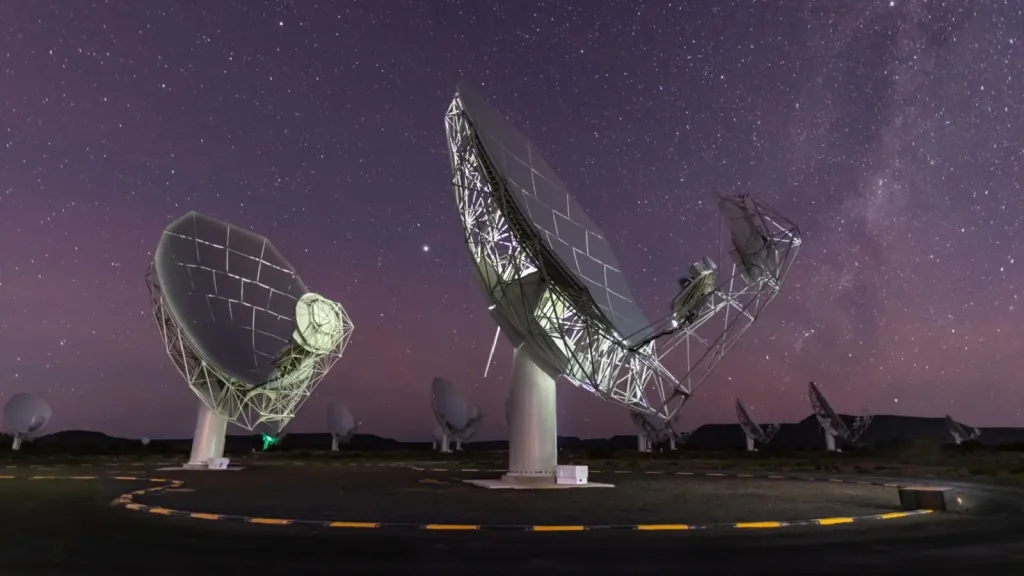
One of the strongest parts of this story is how efficiently MeerKAT made the detection. The team reports a signal-to-noise ratio above 150 using only 4.7 hours of observing time. That is a major reason this result matters beyond the headline. It shows that MeerKAT is not just capable of finding unusual radio sources. It can find them fast enough to support broader searches across the distant universe.
The array’s sensitivity makes a big difference here. MeerKAT, operated through the South African Radio Astronomy Observatory, has already built a reputation for high-impact radio discoveries. In this case, it confirmed a high-redshift OH source that older surveys would likely have missed. That gives astronomers a practical proof that deep searches for distant hydroxyl systems can work.
The same wide-band dataset also revealed a previously unknown neutral hydrogen, or H I, absorption line. That detail adds another layer to the result. It means the system is not only interesting because of the hydroxyl emission. It also contains other gas signatures that can help astronomers build a fuller picture of the galaxy merger and its surrounding material.
Why the MeerKAT hydroxyl megamaser matters for galaxy evolution
The most important takeaway is not the phrase “mega-laser.” It is what this object can teach us about the universe at earlier times. OH megamasers tend to trace gas-rich mergers, obscured starburst activity, and dense molecular regions. Those are some of the most important ingredients in galaxy growth. If astronomers can find more distant examples, they gain a new tool for tracing how energetic galaxy systems evolved across billions of years.
This discovery also arrives at a useful moment for radio astronomy. The paper highlights the promise of MeerKAT and the future Square Kilometre Array mid-frequency array for pushing this work further. That means this source may be the start of a larger sample, not an isolated curiosity. If more distant OH megamasers turn up, astronomers could compare them across epochs and test how merger activity, gas content, and star formation changed with time.
There is also a broader message here about how discoveries happen. The MeerKAT hydroxyl megamaser was not visible because one telescope alone outperformed everything else. It became visible because several cosmic and technical factors lined up at once. A violent merger created the right molecular conditions. A foreground galaxy provided lensing. MeerKAT delivered the sensitivity. Together, those ingredients turned a distant radio signal into a measurable scientific target.
A clearer way to read the headline
For readers outside astronomy, the phrase “mega-laser from 8 billion light-years away” sounds almost like science fiction. The reality is more grounded and, in many ways, more interesting. This is a natural radio amplifier, not an artificial beam. It comes from hydroxyl molecules inside a merging galaxy. It looks exceptionally bright because gravity from another galaxy magnified it on the way to Earth.
That makes the story stronger, not weaker. The MeerKAT hydroxyl megamaser is exciting because it combines chemistry, galaxy mergers, lensing, and modern radio astronomy in one result. It also shows that the distant universe still holds detectable signals that can surprise astronomers, even when theory suggests they should be difficult to spot.
Conclusion
The new MeerKAT hydroxyl megamaser detection is more than a record-setting signal. It is a new window into how extreme galaxies behaved when the universe was much younger. Astronomers found the source in a strongly lensed merger at z = 1.027, identified the classic OH lines, measured the highest apparent luminosity yet reported for this class, and did it in only a few hours of observing time.
For SpaceEyeNews readers, the real value of this story is clear. The MeerKAT hydroxyl megamaser shows that distant, gas-rich mergers can still be studied through amplified radio signals, especially when gravitational lensing gives nature’s own assist. If future surveys uncover more systems like this one, astronomers may gain a powerful new way to map the energetic history of galaxies across cosmic time.
Main Sources:
- MeerKAT discovery paper on arXiv: https://arxiv.org/abs/2602.13396
- South African Radio Astronomy Observatory release: https://www.sarao.ac.za/news/meerkat-discovers-record-breaking-cosmic-laser-halfway-across-the-universe/
- ESO background on HATLAS J142935.3–002836: https://www.eso.org/public/news/eso1426/