BY:SpaceEyeNews.
Introduction
Deep mantle deformation is revealing one of the clearest pictures yet of Earth’s hidden interior. Nearly 2,900 kilometers below the surface, just above the core, scientists have mapped widespread and organized movement. Using a massive global seismic dataset, researchers identified consistent deformation patterns across most of this region. The results point to a powerful connection between deep mantle deformation and ancient tectonic slabs that sank millions of years ago.
Deep Mantle Deformation Mapped Using Global Seismic Data
Studying deep mantle deformation has always pushed the limits of science. No instrument can directly reach these depths. Instead, researchers rely on seismic waves to uncover what lies far below.
A new global analysis examined more than 16 million seismograms gathered from 24 data centers. This dataset is one of the most extensive ever assembled for deep Earth research. By tracking how earthquake waves move through the planet, scientists constructed a detailed map of deformation in the lowermost mantle.
How Seismic Waves Expose Hidden Structure
Seismic waves respond to the internal structure of the materials they pass through. Shear waves, in particular, travel at different speeds depending on direction. This effect, known as Seismic Anisotropy, provides a powerful tool for detecting deformation.
When rocks deform, their internal structure becomes aligned. This alignment changes how waves propagate. As a result, scientists can detect patterns of deep mantle deformation without direct observation.
In this study, researchers focused on waves that pass through the mantle, enter the core, and return. These paths offer rare access to the deepest mantle layer.
A Global View of Deep Mantle Deformation
Earlier studies provided only regional snapshots. This work expands coverage to nearly 75% of the lowermost mantle. The scale alone marks a major advance.
Clear deformation signals appear across roughly two-thirds of the analyzed regions. This widespread detection confirms that deep mantle deformation is not isolated. It is a dominant feature of Earth’s deep interior.
At the same time, the dataset opens new opportunities. It provides a foundation for future research into Earth’s internal dynamics across multiple scales.
Deep Mantle Deformation Linked to Subducted Tectonic Slabs
The most striking outcome of this study lies in where deformation occurs. The patterns are not random. Instead, they cluster in regions associated with subducted tectonic slabs.
The Journey of Subducted Slabs
Subducted slabs are remnants of oceanic plates that once existed at the surface. Over millions of years, these plates sank into the mantle as part of Earth’s tectonic cycle.
Eventually, many of these slabs reached the boundary between the mantle and the core. This boundary marks one of the most extreme environments inside the planet.
How Slabs Shape Deep Mantle Deformation
As slabs descend to this depth, they interact with surrounding material. They bend, compress, and displace the mantle around them. These interactions create structured deformation patterns.
The study reveals a strong global correlation between slab locations and deep mantle deformation. This relationship has long been predicted by geodynamic models. However, it had not been confirmed at this scale using observational data.
A Deep Record of Earth’s Geological History
This discovery highlights a remarkable feature of Earth. The planet retains a dynamic memory of its past.
Ancient tectonic processes continue to influence the deepest regions of the mantle. Even after millions of years, subducted slabs remain active contributors to internal flow.
This connection links surface activity with deep planetary behavior. It shows that Earth operates as a fully integrated system, where past and present processes remain intertwined.
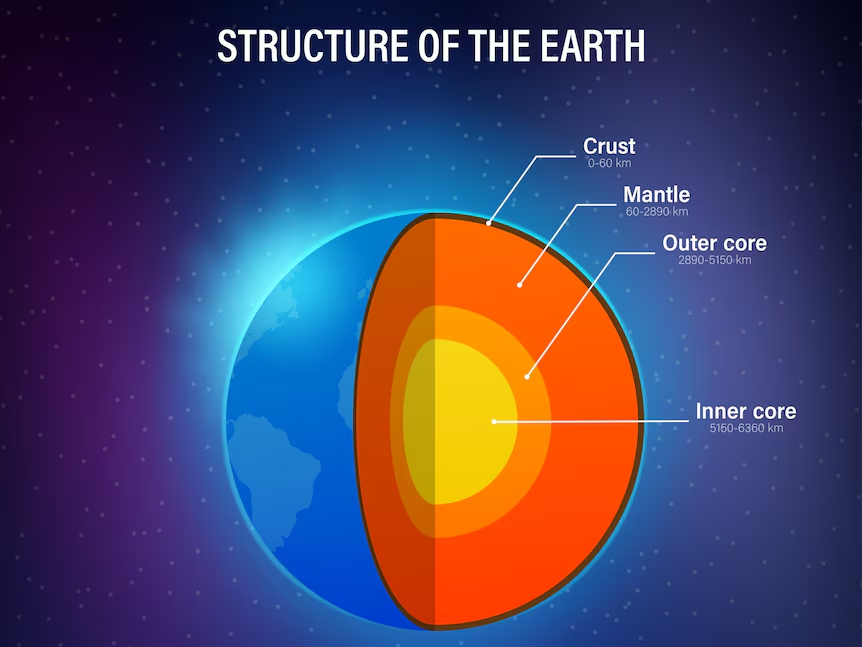
Deep Mantle Deformation Driven by Extreme Conditions
While slab locations explain where deformation occurs, the exact mechanisms remain under investigation. Conditions near the core-mantle boundary are unlike anything at the surface.
Temperatures reach thousands of degrees. Pressures rise to immense levels. These extremes reshape both materials and motion within the mantle.
Mechanical Forces at the Core’s Edge
One explanation focuses on mechanical deformation. As slabs arrive at the boundary, they undergo intense stress. They bend, compress, and interact with surrounding material.
These forces create aligned structures within the mantle. Over time, this alignment produces the anisotropic signals detected in seismic data.
Mineral Changes Under Extreme Pressure
Another explanation involves transformations at the microscopic level. Under extreme pressure and heat, minerals can reorganize into new structures.
These changes create internal patterns that influence wave behavior. As a result, deep mantle deformation may reflect both large-scale flow and small-scale mineral alignment.
Why Some Regions Appear Quiet
Not every region shows a strong deformation signal. However, absence of evidence does not mean absence of activity.
In some areas, the signal may be too weak to detect. In others, complex structures may obscure clear patterns. Current methods still have limitations.
As data improves, more subtle forms of deep mantle deformation may become visible.
Deep Mantle Deformation Reshapes Earth Science Models
This discovery carries significant implications for Earth science. Deep mantle deformation provides direct insight into how material moves near the core.
Refining Mantle Circulation Models
Mantle convection drives many of Earth’s long-term processes. It controls heat transfer, influences surface motion, and shapes planetary evolution.
By mapping deformation patterns, scientists can refine models of mantle flow. These models become more accurate when anchored in real observations.
Linking Surface and Deep Processes
The findings also strengthen the connection between surface tectonics and deep mantle behavior.
Subducted slabs originate at the surface. Over time, they travel deep into the planet. Their continued influence at the core-mantle boundary shows how surface processes extend into Earth’s interior.
This connection reinforces the idea of Earth as a unified system.
From Simulation to Observation
For years, understanding of the lowermost mantle relied heavily on simulations. This study changes that perspective.
Deep mantle deformation is now supported by global observational evidence. The shift from theory to measurement marks a major step forward.
Future Research on Deep Mantle Deformation
Despite this progress, the story is far from complete. Scientists are now working to build a more detailed picture of deep mantle flow.
Toward Global Flow Mapping
One key objective is to determine flow directions within the lowermost mantle. Current data reveals deformation patterns but not full circulation pathways.
Future work aims to fill this gap using expanded datasets and improved techniques.
Expanding Data Coverage
Increasing seismic coverage will enhance resolution. More data will help detect weaker signals and refine existing maps.
This expansion will also allow researchers to explore regions that remain less understood.
Unlocking Earth’s Deep Engine
Ultimately, deep mantle deformation research seeks to reveal how Earth’s internal engine operates.
By combining seismic observations with advanced modeling, scientists aim to reconstruct the full dynamics of the deep mantle.
Conclusion
Deep mantle deformation is reshaping our understanding of Earth’s interior. The discovery reveals organized movement near the core, driven in part by ancient tectonic slabs. These findings connect surface processes with deep planetary dynamics and provide the first global observational evidence of deformation at this depth.
Earth’s deepest layers are not isolated. They are active, connected, and shaped by a long geological history that continues to influence the planet today.
Main Sources
Seismological Society of America – The Seismic Record (April 2026)
https://www.seismosoc.org
SciTechDaily article (April 5, 2026)
https://scitechdaily.com/1800-miles-down-scientists-uncover-mysterious-movements-at-the-edge-of-earths-core/
University of California, Berkeley – Department of Earth and Planetary Science
https://eps.berkeley.edu