
BY:SpaceEyeNews.
Introduction: Primordial Black Holes Matter Origin and a Radical Idea
What if everything in the Universe exists because of tiny black holes that vanished almost instantly?
The concept of Primordial Black Holes Matter Origin offers a bold explanation for one of physics’ deepest mysteries. Scientists still cannot fully explain why matter dominates over antimatter. In theory, both should have formed in equal amounts during the Big Bang. That balance should have erased everything.
Yet, the Universe exists. Galaxies formed. Stars ignited. Life emerged.
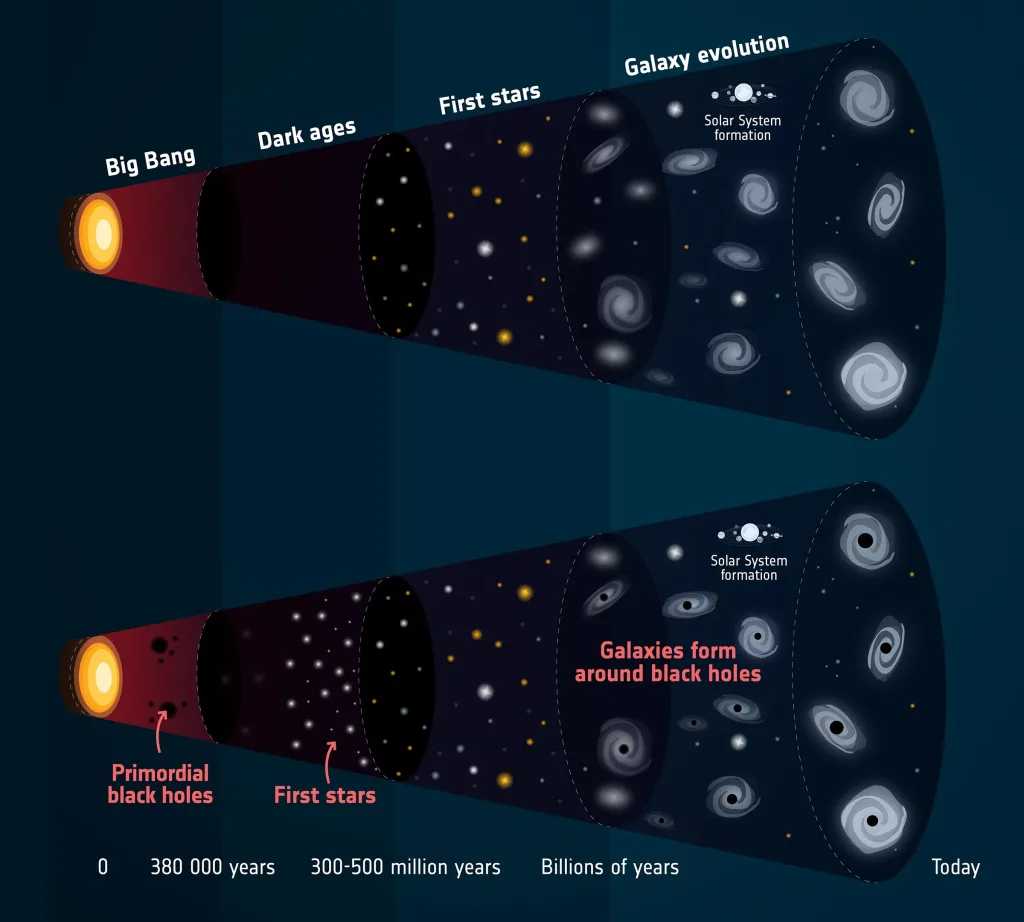
A new line of research points to microscopic black holes that formed in the earliest moments of cosmic history. These objects did not simply fade away. Instead, they released intense bursts of energy that reshaped their surroundings.
This idea connects black holes, particle physics, and cosmic evolution into a single narrative. More importantly, it reframes the question of why anything exists at all.
Primordial Black Holes Matter Origin: Not a Quiet Process
From Evaporation to Energy Release
The theory behind Primordial Black Holes Matter Origin begins with how these objects behave. Unlike massive black holes, primordial ones had extremely small masses. That difference changed everything.
Black holes emit radiation over time. As they lose mass, their temperature rises. Smaller black holes release energy faster. In the final stage, this process accelerates dramatically.
Earlier models described a gradual disappearance. New research suggests a different picture. The final phase involves a rapid and concentrated release of energy into the surrounding environment.
A Four-Phase Evolution
Researchers describe this lifecycle in four stages:
- A slow evaporation phase where the black hole steadily loses mass
- A transition phase as the object becomes extremely compact
- A rapid energy release stage marked by intense output
- A final dissipation phase where energy spreads into the surrounding plasma
Each stage contributes to shaping local conditions in the early Universe.
Why This Changes the Picture
This model shifts the narrative. Instead of passive decay, primordial black holes acted as active energy sources. Their influence extended beyond their immediate location.
That insight strengthens the Primordial Black Holes Matter Origin framework. These objects may have played a direct role in shaping the early Universe.
Primordial Black Holes Matter Origin and Cosmic Shock Waves
The Early Universe as a Dynamic Plasma
The early Universe looked nothing like what we see today. It was filled with an extremely hot and dense plasma made of fundamental particles.
When primordial black holes released energy, they injected it directly into this plasma. The result was not subtle. It triggered strong physical reactions in the surrounding environment.
Formation of Shock Waves
These energy bursts created sharp pressure differences. Those differences generated expanding shock waves that traveled through the plasma.
As these waves moved outward, they carried energy and interacted with surrounding matter. They created localized regions with higher temperatures and altered physical conditions.
Temporary High-Energy Zones
In some regions, temperatures briefly exceeded critical thresholds. This detail matters because certain physical symmetries depend on temperature.
When conditions change rapidly, those symmetries can break and reform.
A New Way to Influence Cosmic Conditions
The Primordial Black Holes Matter Origin concept highlights this mechanism. It introduces localized disruptions instead of uniform cosmic evolution.
These short-lived but powerful events may have reshaped how matter formed and survived.
Primordial Black Holes Matter Origin and the Matter–Antimatter Imbalance
The Core Problem
Physics predicts equal amounts of matter and antimatter. When they meet, they cancel each other out.
However, the observable Universe contains mostly matter. This imbalance remains one of the biggest unsolved problems in cosmology.
A New Path to Baryogenesis
The process that explains this imbalance is known as baryogenesis. It requires very specific conditions:
- A departure from thermal equilibrium
- Interactions that favor matter over antimatter
- Changes in fundamental symmetries
The Primordial Black Holes Matter Origin theory provides a new path to achieve these conditions.
How Shock Waves Shifted the Balance
Shock waves from evaporating black holes created localized environments that briefly moved out of equilibrium. These regions experienced rapid changes in temperature and pressure.
Under such conditions, symmetry-breaking processes could occur more easily. Even small differences between matter and antimatter could grow.
Over time, these imbalances became permanent. Matter remained. Antimatter disappeared.
A Unified Explanation
This framework connects multiple areas of physics:
- Black hole thermodynamics
- Plasma dynamics
- Particle interactions
By linking these fields, the theory offers a cohesive explanation for the origin of matter.
Primordial Black Holes Matter Origin: Implications for Modern Cosmology
A New Piece in the Puzzle
The Primordial Black Holes Matter Origin idea introduces a powerful concept. Small-scale events may have shaped the entire Universe.
It shifts focus from global conditions to localized processes.
Challenges and Open Questions
The theory remains under active investigation. Key questions remain:
- Do primordial black holes exist?
- Did they behave exactly as predicted?
- Can their effects be observed today?
Where Scientists Look Next
Researchers are exploring several paths:
- Studying patterns in cosmic background radiation
- Searching for indirect signatures of early shock waves
- Analyzing gravitational signals linked to early Universe events
Each method may reveal clues about this theory’s validity.
Comparing Competing Theories
Other explanations for baryogenesis exist. Some rely on particle interactions at extreme energies. Others focus on symmetry changes during cosmic transitions.
The Primordial Black Holes Matter Origin model stands out because it combines multiple mechanisms into one framework.
Conclusion: A New Origin Story for Everything
The Primordial Black Holes Matter Origin concept reshapes a familiar narrative. We often describe ourselves as made of stardust. That idea still holds.
But this theory goes deeper. It suggests that tiny black holes, through their final moments, helped create the conditions that allowed matter to exist.
If confirmed, this would redefine our understanding of cosmic history. It would mean that some of the smallest objects in the early Universe played one of the largest roles.
So the real question becomes:
If microscopic black holes helped create matter itself… what other hidden processes shaped the Universe we see today?
Sources:
- https://universemagazine.com/en/primordial-black-holes-may-have-given-rise-to-the-matter-of-the-universe/
- https://phys.org/news/2024-primordial-black-holes-early-universe.html
- https://www.nature.com/articles/s41586-021-03263-1