
BY:SpaceEyeNews.
🌌 A Rare Discovery Inside Markarian 501
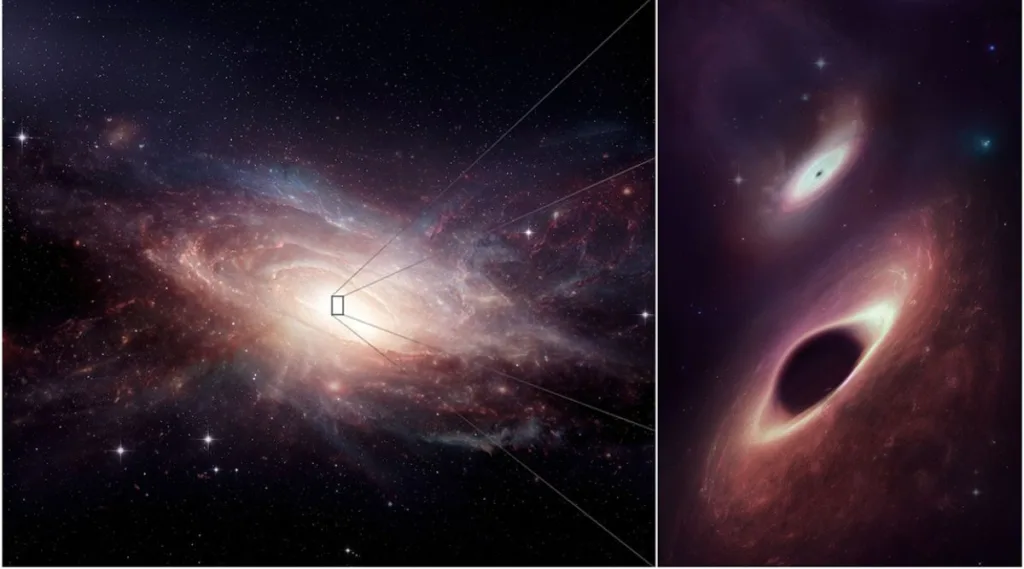
A remarkable breakthrough is reshaping how scientists observe extreme cosmic systems. At the center of Markarian 501, researchers have identified a supermassive black hole binary Markarian 501 system—confirmed through direct observation rather than theory.
This system contains two supermassive black holes orbiting each other at an unusually close distance. Even more striking, their orbital period is just 121 days. That is exceptionally short for objects with masses reaching hundreds of millions or even billions of times that of the Sun.
Because of this, the discovery opens a rare observational window. Scientists can now track how such systems evolve over time. More importantly, it offers new insight into how supermassive black holes grow across the universe.
🔭 Supermassive Black Hole Binary Markarian 501 Confirmed
A System Closer Than Ever Observed
The supermassive black hole binary Markarian 501 stands out for its compact structure. The two black holes orbit at a distance between 250 and 540 times the Earth–Sun separation. On a cosmic scale, that is extremely tight.
Until now, similar systems remained difficult to confirm. Most candidates relied on indirect signals or incomplete data. This system changes that.
Why This Detection Changes the Field
Astronomers have long expected black hole binaries to form during galaxy mergers. Yet detecting them has proven challenging. Even instruments like the Event Horizon Telescope cannot resolve such close pairs at great distances.
Now, the supermassive black hole binary Markarian 501 provides the clearest evidence yet. It bridges the gap between prediction and observation and gives scientists a real system to study.
🔬 How Scientists Revealed the Hidden Binary
Dual Jets Expose the System
Rather than observing the black holes directly, researchers analyzed their jets—powerful streams of particles traveling near the speed of light.
Across more than two decades of radio observations, a critical detail emerged: two distinct jets instead of one. Each jet followed a different orientation.
This finding was decisive. Each black hole produces its own jet. Detecting two jets strongly indicates a binary system.
Orientation and Motion Tell the Story
One jet points toward Earth, making it bright and easy to detect. The second jet is angled differently and remained hidden for years.
Over time, its motion became visible. The pattern repeated consistently, revealing an orbital cycle of approximately 121 days.
A Rare Einstein Ring Alignment
At one point, scientists observed a ring-shaped signal—an Einstein ring. This occurs when light bends around a massive object.
In this case, one black hole distorted light from the second jet. The effect aligned perfectly with Earth, confirming the system’s structure.
The role of gravitational lensing added strong supporting evidence and reinforced the binary interpretation.
⚡ A Rapid Orbit Points to a Future Merger
Orbital Decay Is Already in Motion
The supermassive black hole binary Markarian 501 is evolving. Its orbital period is gradually decreasing, which means the two black holes are moving closer together.
This process, known as orbital decay, reflects the system losing energy over time.
A Merger on a Short Cosmic Timescale
In astronomical terms, most mergers take millions of years. Here, estimates suggest something far quicker—possibly around 100 years.
For objects of this scale, that is remarkably fast.
Why This Phase Matters
The final stage of black hole mergers remains one of the least understood processes in astrophysics. Models often struggle to describe it accurately.
This system offers a rare opportunity. Scientists may be able to observe that final phase as it unfolds, turning theory into measurable data.
🌊 Gravitational Waves and a Missing Link
A Connection to a Recent Discovery
The supermassive black hole binary Markarian 501 may help explain a major signal detected in 2023—a background of gravitational waves across the universe.
These waves are ripples in spacetime generated by massive objects in motion.
A Leading Candidate Source
This system is now considered one of the strongest candidates behind that signal. As the black holes orbit, they should emit continuous low-frequency gravitational waves.
These signals can be detected through pulsar timing arrays.
What Comes Next
As the orbit tightens, the frequency of these waves should increase. This creates a measurable trend over time.
If confirmed, this system would become the first direct connection between gravitational wave background signals and a specific astrophysical source.
🧠 Rethinking Galaxy Evolution
Growth Through Mergers
The supermassive black hole binary Markarian 501 reinforces a key idea: supermassive black holes grow through mergers.
Gas alone cannot account for their massive size. Merging provides a faster and more efficient pathway.
A Natural Laboratory for Extreme Physics
This system offers a rare environment to test models of gravity, orbital dynamics, and energy loss under extreme conditions.
Scientists now have a real system to observe rather than relying solely on simulations.
Closing a Long-Standing Gap
For years, the final stage of black hole mergers remained hidden. Now, that gap is narrowing.
This discovery brings scientists closer to understanding how galaxies evolve and transform over cosmic time.
🎯 Conclusion: A Cosmic Event Unfolding
The supermassive black hole binary Markarian 501 is not just a distant phenomenon. It is an active system evolving right now.
Two massive black holes are locked in a tight orbit. Their motion is accelerating. Their separation is shrinking.
For the first time, scientists may be able to follow a supermassive black hole merger from start to finish.
That possibility marks a turning point. It transforms abstract theory into direct observation.
And it leaves us with a compelling question:
Are we witnessing the early stages of one of the universe’s most powerful transformations—almost in real time?
🔗 Sources :
- https://universemagazine.com/en/scientists-discover-first-close-pair-of-supermassive-black-holes/
- https://www.mpifr-bonn.mpg.de
- https://phys.org
- https://www.epta.eu.org