
BY:SpaceEyeews.
🛰️ Little Red Dots JWST — A Breakthrough Discovery
The Little Red Dots JWST mystery may finally be approaching an answer. A new discovery from the James Webb Space Telescope has revealed a rare galaxy system that could explain these strange cosmic objects. Scientists call it the “Stingray,” and it may represent a missing link in how galaxies evolve.
For years, little red dots puzzled astronomers. These compact objects appeared suddenly in deep-space observations. Their brightness and unusual spectral signatures did not match known models. Now, new evidence suggests they are not separate objects at all. Instead, they may be short-lived phases in the life cycle of galaxies powered by growing black holes.
This shift is significant. It changes how researchers interpret the early universe and the formation of massive cosmic structures.
🌌 The “Stingray” System and the Little Red Dots JWST Context
The “Stingray” system lies within the galaxy cluster MACS J1149. Astronomers observed it as it existed about 1.1 billion years after the Big Bang. This makes it a direct window into the early universe.
The system includes three interacting galaxies:
- A large and relatively stable Balmer break galaxy
- A compact transitional object known as a tLRD
- A smaller satellite galaxy
The name “Stingray” comes from its early visual appearance. Later analysis showed that part of the shape was caused by unrelated background alignment. Even so, the system itself remains real and scientifically valuable.
What sets this system apart is timing. It captures galaxies during interaction. These encounters can trigger rapid changes in star formation and black hole activity. In this case, researchers believe they are witnessing a rare transition stage tied directly to the Little Red Dots JWST phenomenon.
🔬 Little Red Dots JWST — Why These Objects Confused Scientists
A sudden appearance in deep space
When the Little Red Dots JWST population appeared in 2022, it challenged existing theories. These objects emerged in early-universe data with no clear explanation.
They share several striking traits:
- Extremely compact size
- Deep red color
- High brightness for their cosmic age
Competing explanations
Researchers proposed several ideas:
- Active galactic nuclei powered by feeding black holes
- Massive early stars nearing collapse
- Unusual or exotic early-universe objects
Each theory explained part of the picture. None explained everything.
The core challenge
The issue was consistency. These objects appeared too frequently to be rare anomalies. Yet their spectral signatures did not align with known categories. This left a gap in understanding that persisted until now.
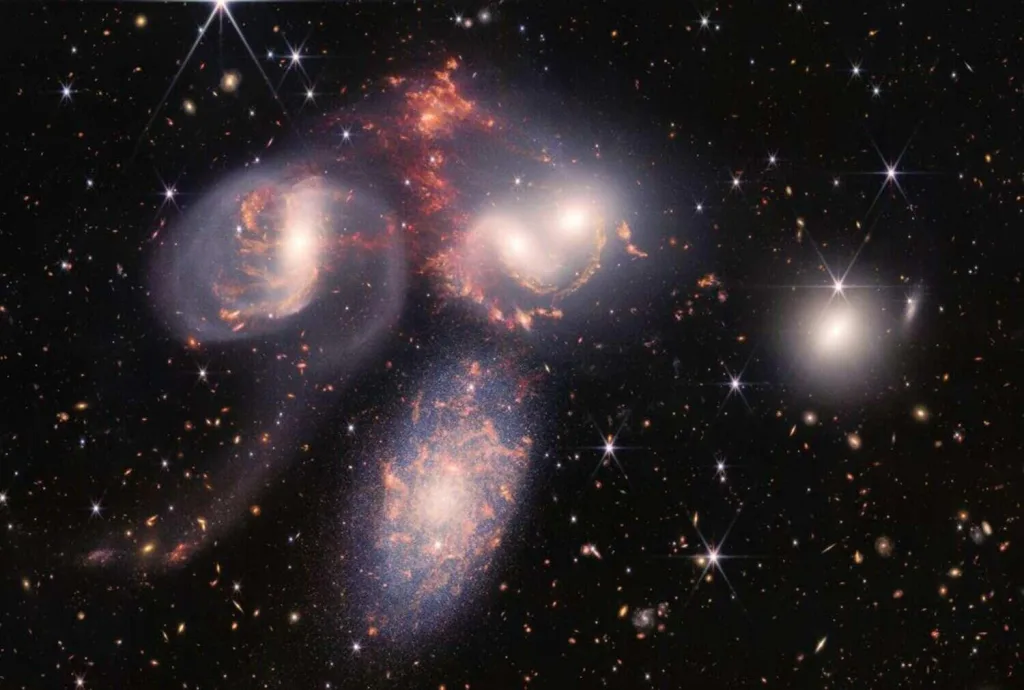
⚙️ The Transitional Object — A Turning Point for Little Red Dots JWST
A hybrid discovery
The key breakthrough came with the identification of a transitional little red dot, or tLRD, within the Stingray system.
This object displays a mix of properties:
- It behaves like an active galactic nucleus with a feeding black hole
- It emits strong ultraviolet light
- It resembles little red dots in size and brightness
At the same time, it lacks one of the defining spectral features seen in most little red dots. This makes it a hybrid rather than a perfect match.
Why this matters
This hybrid nature offers a crucial clue. It suggests that little red dots may not be fixed objects. Instead, they may represent a temporary stage in a broader evolutionary process.
A rare snapshot
Astronomers believe the tLRD captures a galaxy in transition. It sits between two states: an intense star-forming phase and a fully active black hole phase. If this stage is brief, then detecting it is extremely rare. That makes this observation especially valuable.
🔁 Galaxy Interactions and the Little Red Dots JWST Evolution Model
Reconstructing the sequence
By analyzing star formation across the system, researchers identified a likely timeline:
- Around 100 million years ago, a close interaction triggered a burst of star formation in the tLRD galaxy
- Around 10 million years ago, the smaller satellite galaxy joined the system
- Afterward, the central black hole in the tLRD became active
Understanding the process
This sequence reveals a clear pattern. Interactions between galaxies disturb gas and trigger star formation. Over time, that same gas feeds the central black hole.
These processes do not occur simultaneously. There is a delay between star formation and black hole activation.
The key insight
This delay may produce the Little Red Dots JWST phase. During this window, the galaxy appears compact, bright, and unusual. It has not yet evolved into a typical active galactic nucleus.
🧩 A New Explanation — Little Red Dots JWST as Evolutionary Phases
From mystery to framework
The new findings support a major shift in interpretation. Little red dots may not form a distinct class of objects. Instead, they may represent transitional stages in galaxy evolution.
Why this model works
This explanation resolves several long-standing issues:
- It accounts for their brightness
- It explains their compact structure
- It fits their presence in the early universe
Connecting key processes
The Little Red Dots JWST phenomenon may now link three major processes:
- Galaxy interaction
- Star formation bursts
- Black hole growth
This unified view offers a clearer picture of how galaxies evolve over time.
⚠️ What the Little Red Dots JWST Discovery Still Leaves Open
Remaining questions
Despite the progress, several uncertainties remain:
- The origin of the central black holes is still unclear
- Not all galaxies appear to enter this phase
- The duration of the transition remains unknown
Why timing matters
If this phase lasts only a few million years, it would be extremely difficult to observe. If it lasts longer, astronomers should find many more examples.
A cautious step forward
Researchers emphasize that this is not a final answer. It is a strong step toward understanding a complex phenomenon. Additional data will determine how broadly this model applies.
🔭 What Comes Next for Little Red Dots JWST Research
Future studies will focus on two key directions.
Searching for more transitional objects
Astronomers will examine deep-field data to identify similar hybrid systems. A larger sample would confirm whether this transition phase is common.
Refining theoretical models
Researchers will improve simulations to predict how often these transitions occur and how long they last. These models will help interpret future observations more accurately.
The James Webb Space Telescope remains central to this effort. Its sensitivity continues to reveal faint structures from the earliest stages of the universe.
🌍 Why the Little Red Dots JWST Discovery Changes Our View of the Universe
This discovery reshapes our understanding of early galaxies. It suggests that the early universe was more dynamic than previously thought.
Galaxies did not evolve in isolation. Interactions played a critical role in shaping their development. These encounters likely drove rapid changes in both star formation and black hole growth.
It also highlights the importance of short-lived phases. Even brief transitions can reveal key steps in cosmic evolution. Without observing them, entire processes remain hidden.
🧾 Conclusion — A Missing Link in the Little Red Dots JWST Mystery
The Little Red Dots JWST mystery is now closer to resolution. The Stingray system provides the strongest evidence yet that these objects represent a transitional phase in galaxy evolution.
This discovery does not close the case. Instead, it opens a new path forward. Scientists now have a working framework to test and refine.
The deeper question remains: how many hidden stages of cosmic evolution are still waiting to be discovered?