BY:SpaceEyeNews.
Introduction
The Two-component dark matter model is reshaping how scientists interpret one of the most puzzling signals in modern astrophysics. For years, researchers have observed a strange gamma-ray glow at the center of the Milky Way. Yet similar signals remain absent in dwarf galaxies. This contradiction has challenged long-standing theories. Now, a new approach suggests the issue may not lie in the data itself. Instead, it may come from how we define dark matter. Rather than a single particle, dark matter may exist as two interacting components.
The Milky Way Signal and the Two-Component Dark Matter Model
Gamma-ray excess at the galactic center
Observations revealed an unexpected gamma-ray glow near the Milky Way’s center. Scientists detected this signal across a broad, spherical region surrounding the galactic core. The intensity appears stronger than expected from known astrophysical sources.
Why scientists linked it to dark matter
Researchers proposed that this signal could come from dark matter interactions. In several models, dark matter particles collide and produce high-energy gamma rays. These photons act as indirect evidence of dark matter activity. Because of this, the Milky Way became a key testing ground for such theories.
Alternative explanations remain valid
Even so, caution remains essential. Pulsars and other compact sources can also generate gamma rays. These objects may explain part of the signal. As a result, the origin of the glow remains open to interpretation.
The Dwarf Galaxy Problem in the Two-Component Dark Matter Model
Why dwarf galaxies are critical
Dwarf galaxies contain large amounts of dark matter. They also produce less background radiation. This combination creates a cleaner environment for detection.
The missing signal contradiction
Standard models predict that if dark matter produces gamma rays in one galaxy, similar signals should appear elsewhere. However, observations show no comparable gamma-ray excess in dwarf galaxies. This absence creates a serious challenge for single-particle models.
Why this became a turning point
Scientists expected consistent behavior across cosmic environments. When that expectation failed, it raised fundamental questions. Either the Milky Way signal has another origin, or dark matter behaves in a more complex way than assumed.
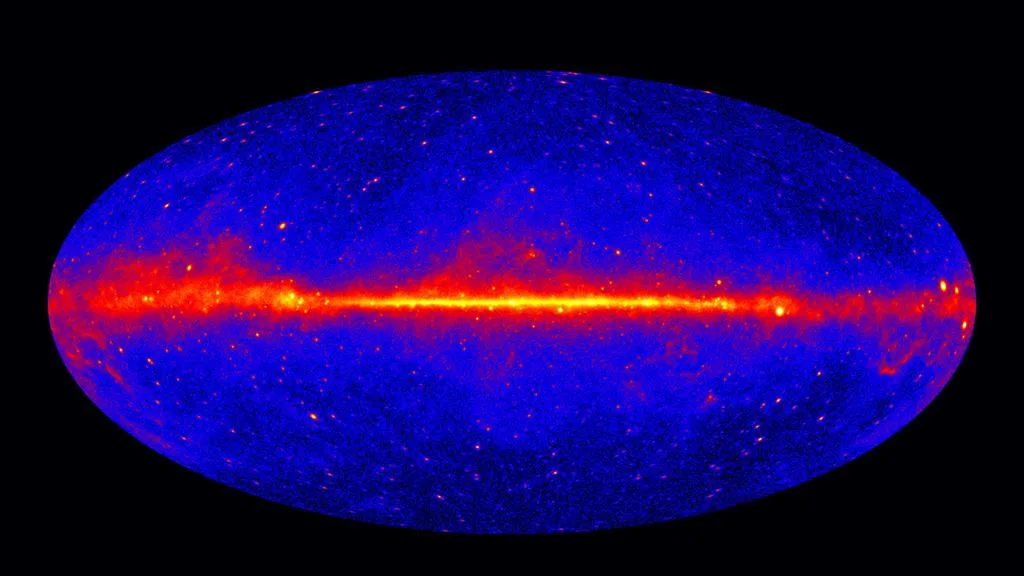
NASA’s Fermi Space Telescope Sharpens its High-energy Vision – NASA
Inside the Two-Component Dark Matter Model
A new structure for dark matter
The Two-component dark matter model proposes that dark matter consists of two distinct particle types. Each type plays a different role depending on local conditions.
Interaction drives the signal
In this framework, gamma rays appear only when the two particle types interact. These interactions produce detectable radiation. If one type dominates, interactions become rare, and the signal fades.
A flexible interpretation of data
This model introduces a new way to interpret observations. It explains why some galaxies show signals while others remain quiet. The key factor becomes the balance between the two particle types.
Environmental dependence explained
In the Milky Way, both particle types may exist in similar proportions. This balance increases the likelihood of interaction. In dwarf galaxies, one type may dominate. As a result, fewer interactions occur, and detectable signals remain weak or absent.
Why the Two-Component Dark Matter Model Changes the Interpretation
Resolving a long-standing contradiction
The Two-component dark matter model offers a direct explanation for the mismatch between galaxies. The Milky Way shows a signal because conditions allow interactions. Dwarf galaxies remain quiet because those conditions differ.
Moving beyond uniform assumptions
Traditional models assume that dark matter behaves the same everywhere. This new approach replaces that idea with environmental variability. It suggests that location matters as much as composition.
A broader view of the dark universe
Researchers now explore the idea of a complex dark sector. This concept includes multiple particles and interactions. It reflects a shift toward more detailed and dynamic models.
Stronger alignment with observations
Unlike earlier theories, this model aligns with both detection and non-detection. It does not force one explanation over another. Instead, it integrates all observations into a single framework.
Future Tests for the Two-Component Dark Matter Model
Ongoing observations
Current instruments continue to collect gamma-ray data across different galaxies. These observations will refine our understanding of dark matter behavior.
What scientists are looking for
Future studies may detect weak signals in dwarf galaxies. Even faint emissions could support the model. Researchers will also examine how signals vary between environments.
Challenges in interpretation
Astrophysical sources complicate the analysis. Many objects can produce gamma rays. Scientists must separate these signals carefully to isolate any dark matter contribution.
The role of next-generation tools
New telescopes with higher sensitivity will improve detection capabilities. These tools may reveal signals that current instruments cannot detect. Their data will play a key role in testing this model.
Broader Implications of the Two-Component Dark Matter Model
A more complex universe
The Two-component dark matter model suggests that dark matter may not be simple. Instead, it may involve multiple interacting components. This idea expands the scope of cosmology.
Impact on particle physics
The model encourages new theoretical work. Scientists may explore additional particles within the dark sector. These efforts could reshape our understanding of fundamental physics.
Rethinking detection strategies
Researchers may adjust how they search for dark matter. Instead of expecting uniform signals, they may focus on environmental differences. This shift could improve detection success.
A new interpretation of absence
The model reinforces a key scientific idea. Not detecting a signal does not mean it does not exist. Instead, it may reflect deeper complexity within the universe.
Conclusion
The Two-component dark matter model offers a compelling explanation for one of astrophysics’ most persistent mysteries. By introducing two interacting particle types, it resolves the gap between the Milky Way’s gamma-ray signal and the silence of dwarf galaxies. This approach shifts the focus from missing evidence to misunderstood behavior. As observations improve, scientists may move closer to uncovering the true nature of dark matter.
Sources
https://www.sciencedaily.com/releases/2026/04/260409101101.htm
https://jcap.iop.org