BY:SpaceEyeNews.
🚀 Introduction
For years, scientists assumed black hole mergers followed one universal pattern. New evidence now challenges that view. Using data from the LIGO-Virgo-KAGRA Collaboration, researchers identified merging black holes subpopulations that point to three distinct origins. This shift reshapes how astronomers interpret gravitational-wave signals and understand black hole formation. Built on more than 150 detections, the findings reveal multiple cosmic pathways behind these extreme events.
🔍 Merging Black Holes Subpopulations Reveal Unexpected Patterns
Astronomers expected a smooth distribution of black hole masses. Instead, the data showed structure. This pattern became the first clear signal of merging black holes subpopulations.
Mass Peaks That Break Expectations
The latest gravitational-wave catalog revealed two strong peaks:
- Around 10 solar masses
- Around 35 solar masses
A smooth curve did not appear. Instead, clusters formed. These clusters suggest that different physical processes produce different types of black holes.
Spin Behavior Strengthens the Case
Mass alone does not explain the full picture. Spin patterns provide deeper insight:
- Noticeable transitions appear around 20 and 40 solar masses
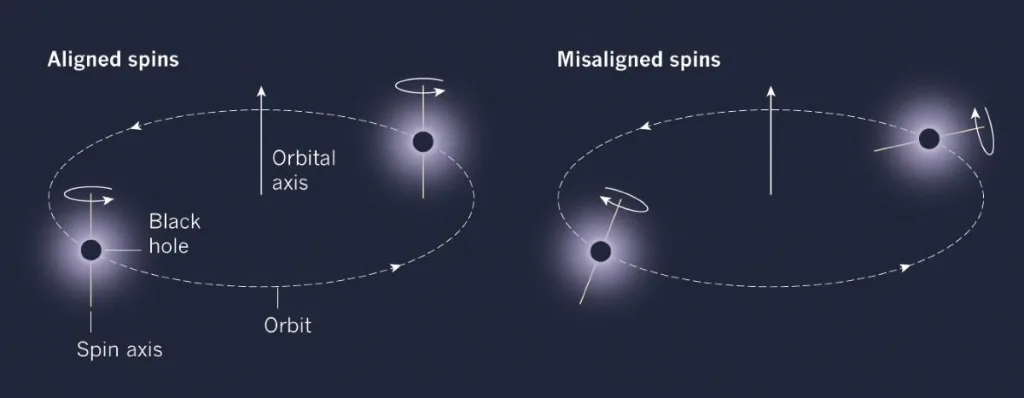
- Some systems show aligned spins
- Others display clear wobbling and misalignment
These differences point to separate formation histories. A single origin cannot account for all observed features.
A Clear Shift in Understanding
Earlier models favored one dominant formation channel. That assumption worked with limited data. With a larger dataset, the structure now stands out. The presence of these features confirms that merging black holes subpopulations exist.
🔬 Three Merging Black Holes Subpopulations Explained
To understand these patterns, researchers simulated the population. The best match revealed three distinct groups. Each carries unique physical traits and likely forms through a different pathway.
🟦 Subpopulation 1: Isolated Binary Evolution
This group dominates the population. It accounts for about 79% of observed mergers.
Key Characteristics
- Mass peak near 10 solar masses
- Low spin values
- Spins aligned with orbital motion
- Minimal wobbling
Formation Pathway
These systems likely formed from pairs of stars born together. Over time, both stars evolved and collapsed into black holes. The system remained largely undisturbed.
Why It Matters
This pathway reflects stability and predictability. It confirms that traditional stellar evolution still drives most black hole mergers.
🟨 Subpopulation 2: Dynamical Formation in Dense Environments
The second group represents about 14.5% of mergers. It introduces a more complex formation process.
Key Characteristics
- Mass peak near 35 solar masses
- Nearly equal-mass black holes
- Mixed spin alignment
- Noticeable wobbling
Formation Pathway
These systems likely formed in crowded environments such as globular clusters. In these regions, frequent gravitational interactions shape outcomes.
Three-Body Interactions and Instability
A third object can influence a binary system. This interaction alters orbits and spin directions. The result is a system with greater instability and variation.
Why It Matters
This group highlights the role of environment. Dense stellar regions produce systems that differ sharply from isolated binaries.
🟩 Subpopulation 3: Hierarchical Mergers
The third group is rare but critical. It accounts for about 2.5% of the population.
Key Characteristics
- Higher mass range
- Unequal mass ratios
- Complex spin behavior
- Strong wobbling signals
Formation Pathway
These systems likely form through hierarchical mergers. In this process, one or more black holes already formed from earlier mergers.
Multi-Generation Growth
The unusual mass and spin patterns suggest repeated merging events. At least one black hole in these systems carries a merger history.
Why It Matters
This pathway shows how black holes can grow over time. It reveals a layered and evolving process rather than a single event.
🌌 Why Merging Black Holes Subpopulations Change Our View of the Universe
The discovery of merging black holes subpopulations introduces a more detailed picture of cosmic evolution.
Multiple Formation Channels Replace a Single Model
Instead of one pathway, several mechanisms operate in parallel:
- Isolated stellar evolution
- Dynamical interactions in dense clusters
- Hierarchical merging
Each pathway produces distinct observational signatures.
A New Lens for Gravitational-Wave Astronomy
Gravitational-wave signals depend on mass and spin. By identifying subpopulations, scientists can:
- Interpret signals with greater precision
- Improve detection models
- Predict future merger trends
Connecting Black Holes to Their Environments
Different environments leave measurable fingerprints:
- Quiet regions produce stable systems
- Dense regions generate complex and dynamic systems
This connection helps map where different mergers originate.
📊 Limits and Open Questions
While the evidence is strong, uncertainty remains.
Overlap Between Formation Channels
Each subpopulation likely reflects a dominant pathway. However, some systems may form through multiple processes.
Growing Data, Evolving Insights
The current dataset includes more than 150 events. Future observations will refine these conclusions.
Model Sensitivity
Simulations depend on assumptions. Adjustments to these assumptions can shift results. Continued refinement is essential.
🔭 What Comes Next for Merging Black Holes Subpopulations
Future observations will test and expand these findings.
Upcoming Data Improvements
New releases will:
- Increase the number of detected mergers
- Improve measurement accuracy
- Reveal finer details in population structure
Toward a Complete Formation Map
As data grows, researchers expect:
- Stronger confirmation of the three groups
- Potential discovery of additional subpopulations
- Clearer links between formation pathways and observations
A Transforming Field
Black hole research is entering a new phase. These objects no longer appear as a single class. Instead, they form a diverse and evolving population.
🧠 Conclusion
The discovery of merging black holes subpopulations reveals a universe that builds black holes through multiple pathways. Each pathway leaves a distinct imprint in mass and spin. This insight reshapes how scientists study gravitational waves and cosmic evolution. As more data arrives, the picture will sharpen. The deeper question now emerges: how many hidden populations are still waiting to be uncovered?
🔗 Sources:
- Phys.org — https://phys.org/news/2026-04-astronomers-evidence-subpopulations-merging-black.html
- arXiv (preprint study) — https://arxiv.org/abs/2603.17987
- LIGO Scientific Collaboration — https://www.ligo.org
- Virgo Collaboration — https://www.virgo-gw.eu
- KAGRA Observatory — https://gwcenter.icrr.u-tokyo.ac.jp