
BY:SpaceEyeNews.
INTRO — Planet vs Star Boundary Faces a Major Shift
For decades, astronomers treated the planet vs star boundary as a clear divide. Planets formed one way, while stars followed another path.
New observations from the James Webb Space Telescope are now reshaping that idea.
A massive object known as 29 Cygni b sits right at this boundary. Based on its size, it could have been classified as something closer to a failed star.
Instead, new data shows it formed like a planet. That result is forcing scientists to rethink how cosmic objects are defined.
How Astronomers Define the Planet–Star Divide
Formation, Not Size, Drives Classification
The difference between planets and stars depends on how they form.
Planets grow inside disks of gas and dust around young stars. Small particles collide and merge over time. This process, known as accretion, builds increasingly larger bodies.
Stars form in a different way. A large cloud of gas collapses under gravity. The core becomes dense, and fusion eventually begins.
Why Mass Became a Shortcut
Because formation is difficult to observe, astronomers used mass as a practical guide.
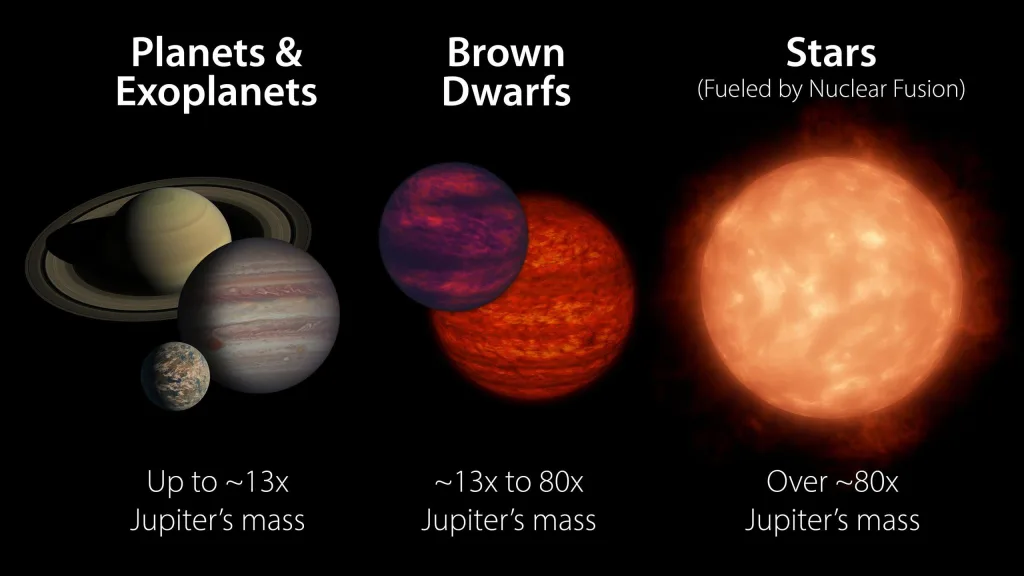
Objects above a certain limit were treated as star-like, while smaller ones were labeled planets. Around 13 times Jupiter’s mass became a common reference point.
However, this shortcut led to confusion. Some objects fall directly in between these categories.
A Boundary That Was Always Uncertain
Over time, it became clear that the dividing line was not fixed. It was a model based on assumptions rather than direct evidence.
Objects near this boundary provide critical tests for formation theories. One of the most important examples is 29 Cygni b.
Webb’s Observations Reveal a Planetary Origin
A Massive Object in a Critical Range
29 Cygni b has about 15 times the mass of Jupiter. This places it directly within the uncertain transition zone between planets and stars.
It orbits its host star at a distance similar to Uranus in our solar system. That makes it an ideal target for testing formation theories.
What the Data Shows
Using infrared imaging, Webb analyzed the object’s atmosphere in detail. Scientists focused on identifying chemical signatures that reveal how it formed.
Heavy Elements Provide the Key Evidence
The observations detected strong signals of carbon monoxide and carbon dioxide. These elements indicate a high concentration of heavy material.
Planets formed through accretion tend to show this enrichment. In contrast, objects formed through collapse usually do not.
The total amount of heavy elements in this object is estimated to equal around 150 Earth masses. That level of enrichment strongly supports a planetary origin.
Orbital Alignment Strengthens the Case
The orbit of 29 Cygni b aligns closely with the rotation of its host star. This pattern is typical for objects formed within a protoplanetary disk.
Objects formed through fragmentation often show more random orientations.
A Consistent Conclusion
All evidence points in the same direction.
29 Cygni b formed through accretion. It formed like a planet, not like a star.
Why This Discovery Changes Formation Theory
Accretion Can Build Extreme Worlds
The findings show that accretion can produce larger objects than previously expected.
Mass alone is no longer enough to define where planets end and stars begin.
Rethinking Brown Dwarfs
Some objects currently classified as brown dwarfs may need to be revisited.
If they formed through accretion, they could be better described as massive planets.
From a Line to a Spectrum
Instead of a sharp divide, scientists now see a continuum of formation outcomes.
Small rocky planets sit on one end. Stars formed through collapse sit on the other. Between them lies a wide range of transitional objects.
Impact on Exoplanet Research
This shift affects how astronomers interpret distant systems.
Large gas giants may form under conditions once thought unlikely. Formation history now plays a central role in classification.
For more insights into recent discoveries, explore our coverage of James Webb Space Telescope discoveries and evolving exoplanet science.
Rethinking Cosmic Categories
Limits of Traditional Definitions
Astronomy relies on clear categories such as planets, stars, and brown dwarfs.
However, new discoveries reveal a more complex reality. Nature does not follow strict labels.
Why Accurate Definitions Matter
Clear definitions support better models of how planetary systems evolve.
When those definitions break down, scientific understanding must adapt.
A Growing Population of Transitional Worlds
29 Cygni b may represent a broader group of massive planets that challenge traditional classification.
Future observations are likely to uncover more objects in this category.
Looking Ahead
Researchers are now studying similar objects across different systems.
Each new observation will refine how astronomers understand formation processes.
You can also read our deep dive on exoplanet formation theories to explore how these models are evolving.
CONCLUSION — A Flexible Boundary Replaces a Fixed Line
The planet vs star boundary once seemed clear. That clarity is fading.
29 Cygni b demonstrates that even very massive objects can form through planetary processes. Formation, not mass, is now the defining factor.
This discovery reshapes classification across astronomy. It also suggests that many known objects may need to be reinterpreted.
The boundary still exists, but it is no longer a strict line. It is a transition shaped by complex processes.
So a new question emerges.
If massive worlds can form like planets, how many objects we currently classify as stars belong to a completely different category?
Sources:
- https://phys.org/news/2026-04-webb-redefines-line-planets-stars.html
- NASA / JWST observation summaries