BY:SpaceEyeNews.
🌌 Introduction — A Map That Changes the Rules
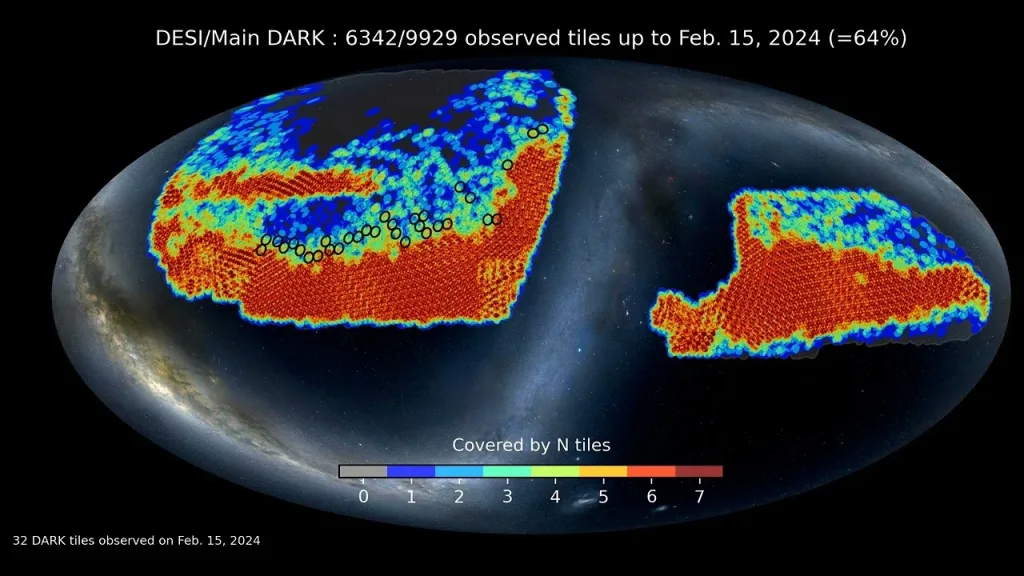
The DESI 3D universe map is now complete, and it is already reshaping how scientists understand the cosmos. Built over five years, this dataset captures tens of millions of galaxies across billions of years. It stands as the most detailed three-dimensional map ever created.
More importantly, the data hints at something unexpected. Dark energy, the force driving cosmic expansion, may not be constant. If confirmed, this finding could challenge the current model of the universe and open the door to new physics.
🔭 Inside the DESI Map of the Universe
A Precision Instrument at Work
At the center of this effort is the
Dark Energy Spectroscopic Instrument (DESI),
installed at the
Kitt Peak National Observatory.
This system uses 5,000 fiber-optic sensors to capture light from distant galaxies. Each observation helps measure how the universe expands over time.
Unlike earlier surveys, DESI focuses on depth and precision. It measures motion, distance, and evolution together. This approach allows scientists to reconstruct a dynamic view of the universe.
A Dataset Beyond Expectations
The DESI survey includes around 47 million galaxies and quasars, along with more than 20 million nearby stars. It traces roughly 11 billion years of cosmic history.
This scale goes far beyond initial goals. Scientists can now trace the cosmic web with remarkable clarity. Dense clusters, long filaments, and vast voids all appear in detail.
Why 3D Mapping Matters
Traditional sky surveys produce flat images. Those maps show position but miss depth.
DESI adds distance and time. This shift turns static images into a timeline of cosmic evolution. Scientists can follow how structures formed and changed over billions of years.
For readers interested in similar breakthroughs, explore our coverage of large-scale structure discoveries and new space observations on SpaceEyeNews.
🌌 Dark Energy Clues from the DESI Map
A Challenge to the Standard Model
The most important insight from the DESI 3D universe map involves
Dark Energy.
For decades, scientists assumed dark energy behaves as a constant force. This idea forms the basis of the
Lambda-CDM model.
However, DESI data suggests a different trend. Early signals indicate that dark energy may weaken over time. This result does not match current expectations.
Why This Matters
A changing dark energy strength alters how the universe expands. If the force weakens, expansion may slow in the future. If it strengthens, acceleration could increase.
Either scenario forces a reassessment of cosmic history. It also changes predictions about the universe’s long-term evolution.
Why DESI Can Detect This Shift
Previous experiments lacked the scale needed to detect subtle changes. Their datasets were smaller and less precise.
DESI solves both issues. Its wide coverage and accuracy allow researchers to track dark energy across billions of years. This capability reveals patterns that earlier tools could not confirm.
⚠️ A Possible Shift in Cosmology
What Could Change
If dark energy is not constant, several core ideas may need revision. These include the structure of the standard cosmological model and predictions about expansion.
Such changes would affect our understanding of fundamental physics.
New Physics on the Horizon
A dynamic form of dark energy could involve unknown fields or evolving energy states. Some theories already suggest that cosmic energy may shift over time.
DESI now provides data that can test these ideas. This creates a strong foundation for exploring new models.
Why Caution Still Matters
Despite the excitement, scientists remain careful. The current signal comes from early analysis. Confirmation requires deeper study and independent checks.
Future results will determine whether this trend holds.
🧪 What Comes Next for DESI
Entering the Discovery Phase
The completion of the DESI 3D universe map marks a transition. Data collection has finished, but analysis is just beginning.
Scientists will now explore the dataset in detail. This process will take time due to the scale involved.
Timeline and Collaboration
Full scientific results are expected through 2027. The work involves more than 900 scientists across multiple countries.
This global effort ensures careful validation and broad expertise.
Cross-Checking the Universe
To confirm findings, researchers will compare DESI results with other observations. These include cosmic background radiation, supernova data, and large-scale structure measurements.
Readers can also explore related insights in our articles about the James Webb Space Telescope and cosmic evolution studies.
🌠 Why This Map Matters
Beyond a Technical Achievement
At first glance, the DESI 3D universe map appears as a technical milestone. In reality, it represents a deeper shift in understanding.
Each data point reflects a galaxy’s position and history. Together, they form a record of how the universe evolved.
A New Lens on Reality
With this map, scientists can track cosmic changes with high precision. They can test how structures form and how expansion evolves.
This level of detail allows more accurate models of the universe. It also raises new questions about its nature.
A Turning Point in Cosmology
The discovery of dark energy in the late 1990s changed cosmology. This new dataset may represent a similar turning point.
If its findings hold, they could reshape the field for decades.
🧾 Conclusion — A Universe Still Full of Surprises
The DESI 3D universe map stands as the most detailed map of the cosmos ever created. It captures billions of years of history with remarkable precision.
Its greatest impact lies in the questions it raises. Early data suggests dark energy may not behave as expected. That possibility challenges long-held assumptions.
If confirmed, this shift could redefine our understanding of the universe. It may also reveal entirely new aspects of physics.
🔗 Main Sources:
- Space.com — https://www.space.com/astronomy/dark-universe/a-dark-energy-tool-just-created-the-most-comprehensive-3d-map-of-our-universe-ever-this-is-a-major-paradigm-shift
- DESI Collaboration — https://www.desi.lbl.gov
- U.S. Department of Energy — https://www.energy.gov