BY:SpaceEyeNews.
🌌 Interstellar Glaciers SPHEREx: Mapping the Galaxy’s Hidden Water Supply
Introduction — A Map of Frozen Origins
The Interstellar Glaciers SPHEREx discovery reveals a hidden structure on a staggering scale. Scientists have mapped ice stretching across more than 600 light-years inside the Milky Way. These are not scattered pockets. They are vast, connected reservoirs embedded within molecular clouds.
For the first time, a mission has produced a full-sky chemical map of interstellar ice. This changes how we understand the origin of water in the universe. These frozen regions hold the materials that later shape comets, planets, and potentially life itself.
This is not just a discovery about ice in space. It is a direct glimpse into the earliest source of Earth’s water.
Interstellar Glaciers SPHEREx: Inside the Discovery
The Interstellar Glaciers SPHEREx breakthrough comes from NASA’s SPHEREx mission, an infrared observatory designed to scan the entire sky in 102 wavelengths. Instead of focusing on individual targets, it captures the broader chemical structure of the galaxy.
From Detection to Full Mapping
Earlier observatories relied on bright stars as backlights. They could only detect ice along narrow lines of sight. SPHEREx moves beyond that limitation. It reveals how ice spreads across entire molecular clouds, including the dense regions where stars form.
This shift transforms isolated detections into a complete environmental map.
Key Regions Revealed
The mission examined major star-forming regions such as Cygnus X and the North American Nebula. These areas contain thick concentrations of gas and dust. Within them, SPHEREx detected large-scale distributions of frozen molecules.
Why This Matters
This is the first time scientists have observed interstellar ice as a connected system rather than isolated features. That change in perspective redefines the scale of the phenomenon.
What Are Interstellar Glaciers SPHEREx Revealing?
The term Interstellar Glaciers SPHEREx describes massive regions where ice forms on microscopic dust grains. These grains are smaller than particles in smoke, yet they host complex chemical activity.
Composition of Cosmic Ice
SPHEREx identified key molecules within these regions:
- Water
- Carbon dioxide
- Carbon monoxide
These compounds play a central role in planetary chemistry.
How the Ice Forms
Ice forms when molecules freeze onto dust grains. Dense clouds shield these grains from ultraviolet radiation, allowing the ice to accumulate and persist.
A Continuous Structure
Previous models treated interstellar ice as scattered deposits. SPHEREx shows that these frozen materials extend across vast distances. They form large, connected structures within molecular clouds, justifying the term “interstellar glaciers.”
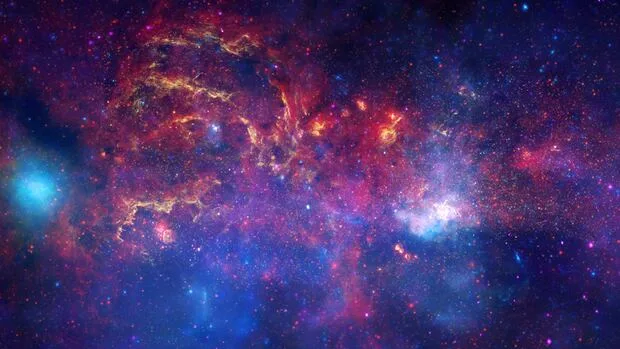
NASA SPHEREx telescope launched to study universe’s origins.
Interstellar Glaciers SPHEREx and the Origin of Water
The Interstellar Glaciers SPHEREx findings strongly support the idea that most water in the universe forms within these environments.
From Ice to Oceans
The process follows a clear sequence. Ice forms on dust grains inside molecular clouds. These grains combine into comets and other bodies. Those objects later deliver water to forming planets.
This chain suggests that Earth’s water likely originated in interstellar space.
A Stronger Scientific Link
The new maps show how water-rich regions align with areas of active star formation. This reinforces the connection between interstellar ice and planetary systems.
A Shift in Perspective
The question is no longer whether water forms in space. The focus now turns to how widely it spreads and how efficiently it reaches young planets.
Why Interstellar Glaciers SPHEREx Matter for Life
The Interstellar Glaciers SPHEREx discovery extends beyond water. It highlights the presence of complex chemistry within these frozen regions.
Chemistry Before Planets Form
These icy environments contain organic molecules that contribute to prebiotic chemistry. This means the building blocks of life may exist before planets even take shape.
Planets Start with an Advantage
Planets forming in these regions may inherit water and organic compounds from the start. This changes how scientists think about habitability.
A New Direction for Exploration
SPHEREx data helps identify regions rich in life-forming ingredients. This provides a new framework for targeting future observations.
What Makes Interstellar Glaciers SPHEREx Unique
SPHEREx stands out because of its ability to map chemistry across the entire sky.
A Wide-Field Approach
Unlike missions that focus on small areas, SPHEREx captures large-scale distributions of molecules. This provides a complete view of chemical structures.
Complementing Other Observatories
High-resolution telescopes offer detailed snapshots. SPHEREx provides the broader context. Together, they create a more complete picture of the universe.
Tracking Environmental Effects
The mission reveals how different ices respond to environmental factors. Water and carbon dioxide behave differently under radiation and heat. These variations shape the chemistry of emerging planetary systems.
The Physics Behind Interstellar Glaciers SPHEREx
The Interstellar Glaciers SPHEREx maps also uncover the physical conditions that control ice formation.
Key Influences
- Dust density
- Ultraviolet radiation
- Thermal energy
Where Ice Survives
Ice remains stable in dense regions where dust blocks radiation. In less protected areas, it breaks down more easily.
Hidden Structures Revealed
Dark filamentary lanes inside molecular clouds block visible light. Infrared observations penetrate these regions, revealing dense concentrations of ice.
A Non-Uniform Distribution
Ice forms unevenly across space. Local conditions determine where it accumulates. This explains differences between star-forming regions.
A 3D View of Interstellar Glaciers SPHEREx
SPHEREx is building more than a map of ice. It is creating a three-dimensional view of the universe.
Expanding the Survey
The mission has already completed its first full-sky map. Additional surveys will refine the data further.
Massive Scale
Hundreds of millions of galaxies are included in this mapping effort. At the same time, the structure of molecular clouds is captured in detail.
Connecting the Dots
This data links chemical composition with galactic structure and evolution. It allows scientists to study how stars and planets emerge within a larger system.
The Bigger Picture of Interstellar Glaciers SPHEREx
The Interstellar Glaciers SPHEREx discovery reshapes our understanding of the galaxy.
A Chemically Active Universe
Space is not empty. It is filled with active chemical processes that prepare the ingredients for planetary systems.
Water May Be Common
If these ice reservoirs are widespread, then water could be a common feature across the Milky Way.
Implications for Life
This does not confirm life elsewhere. However, it increases the likelihood that the conditions needed for life appear in many places.
Conclusion — From Frozen Dust to Living Worlds
The Interstellar Glaciers SPHEREx discovery provides a new way to view the universe. It reveals vast reservoirs of ice that connect directly to the formation of planets and the delivery of water.
These findings suggest that many worlds begin with the essential ingredients already in place. Water and complex molecules may not be rare. They may be part of a larger cosmic system that naturally supports planetary development.
The question is no longer where water comes from.
It is how many worlds receive it—and what happens next.
Sources
NASA SPHEREx mission overview:
https://www.nasa.gov/missions/spherex/interstellar-glaciers-nasas-spherex-maps-vast-galactic-ice-regions/
The Astrophysical Journal study (referenced by NASA)