
BY:SpaceEyeNews.
TOI-201 Planetary System Changes in Real Time
Introduction
The TOI-201 planetary system is doing something astronomers almost never see. Its planets are actively changing their orbits right now. Not over millions of years, but within a human lifetime. That makes this system one of the most dynamic ever observed.
Researchers are tracking how these worlds shift and tilt around their star. The discovery challenges long-standing ideas about planetary stability. It also opens a rare window into how planetary systems evolve in real time.
Unlike most exoplanet discoveries, which offer only a static snapshot, the TOI-201 planetary system behaves like a live experiment. Each observation reveals subtle changes. Those changes are already reshaping how scientists understand planetary formation and long-term evolution.
Inside the TOI-201 Planetary System
Three Distinct Worlds
At the center of the TOI-201 planetary system are three very different objects, each influencing the system in a unique way.
The first is TOI-201 d, a super-Earth. It measures about 1.4 times the size of Earth and carries roughly six times its mass. This rocky planet orbits extremely close to its star, completing a full revolution in just 5.85 days. Conditions there are extremely hot, making liquid water unlikely.
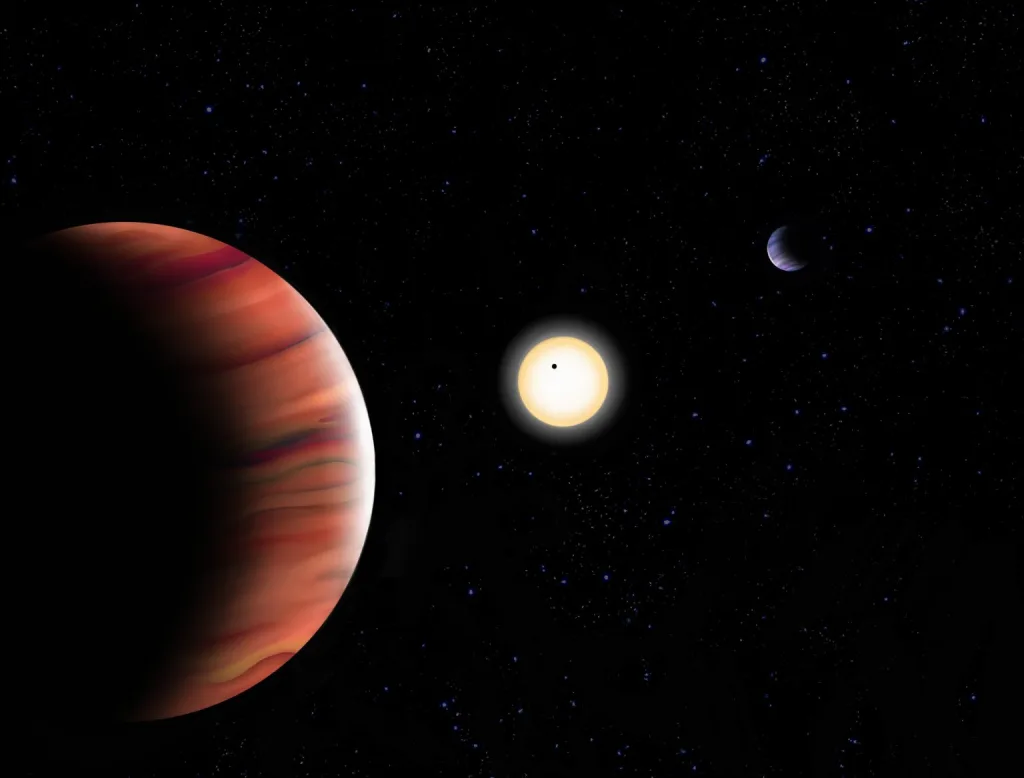
Next is TOI-201 b, a warm Jupiter. This gas giant has about half the mass of Jupiter and orbits its star every 53 days. Warm Jupiters sit between close-in gas giants and distant ones like Jupiter in our solar system. Their formation remains difficult to explain, which makes this planet especially important.
The third object is TOI-201 c, a brown dwarf. It is the most massive body in the system aside from the star. With a mass about 13 times that of Jupiter, it exists between a planet and a star. Its orbit is wide and highly elliptical, taking nearly eight years to complete.
A System Driven by Contrast
This unusual combination creates a complex gravitational environment. A compact inner system interacts with a distant, massive companion. That structure is not typical.
Because of this setup, the TOI-201 planetary system behaves in ways that differ from more stable systems. Each object influences the others, leading to continuous changes. These interactions are the key to understanding why the system evolves so quickly.
Why the TOI-201 Planetary System Is Changing So Fast
Misaligned Orbits
Most planetary systems form within a flat disk of gas and dust. As a result, their orbits remain aligned. The TOI-201 planetary system breaks this rule.
Its planets orbit at different angles. Their paths are tilted relative to one another. This misalignment creates a dynamic environment where gravitational forces constantly reshape the system.
Gravitational Interactions
Each object exerts a pull on the others. These forces gradually change orbital shape and orientation. Over time, this leads to measurable effects.
One key process is orbital precession. The direction of an orbit slowly rotates. In the TOI-201 planetary system, this effect occurs fast enough to observe directly.
Real-Time Evolution
What sets this system apart is the speed of change. Astronomers can already detect shifts in alignment and transit behavior.
Models suggest that within about 200 years, some planets will stop passing in front of their star from our viewpoint. Later, all transits may disappear. Over longer timescales, the planets could begin transiting again.
This cycle highlights how dynamic the TOI-201 planetary system truly is.
How Astronomers Detected the TOI-201 Planetary System
Multi-Method Approach
Confirming the TOI-201 planetary system required several detection techniques working together. Each method revealed a different part of the system.
Spectroscopy measured subtle changes in the star’s motion. These shifts revealed the gravitational influence of orbiting objects and helped estimate their masses.
Transit photometry tracked small dips in brightness. When a planet crosses its star, it blocks a portion of light. These events reveal the planet’s size and orbit.
Transit timing variations added another layer of detail. Slight differences in timing showed that multiple objects were interacting gravitationally.
Astrometry provided further confirmation. Tiny shifts in the star’s position revealed the presence of a massive companion, identified as the brown dwarf.
Global Observations
Space-based observations played a key role in detecting transits. Ground-based telescopes provided additional coverage from multiple locations around the world.
This global network allowed continuous monitoring of the system. Combined data produced a precise and reliable model of the TOI-201 planetary system.
The Biggest Mystery Behind the TOI-201 Planetary System
Why Are the Orbits Tilted?
The tilted orbits remain the central mystery. Planets usually form in alignment within a protoplanetary disk. Yet in this system, the orbits differ significantly.
This suggests that the system experienced major disruptions after formation.
Possible Explanations
One explanation involves gravitational scattering. Early interactions between massive bodies may have altered the planets’ paths.
Another possibility centers on the brown dwarf. Its strong gravitational influence could have gradually reshaped the system.
Planetary migration may also play a role. As planets move through the system, they can disturb each other’s orbits and create long-term instability.
What Scientists Still Don’t Know
Many questions remain unanswered. Researchers continue to study how stable the system will be over long periods. They also want to determine whether similar systems exist but remain undetected.
The TOI-201 planetary system may be rare. It may also represent a class of systems that scientists are only beginning to recognize.
What Happens Next in the TOI-201 Planetary System
Upcoming Observations
Future observations will be critical. One key event is expected on March 26, 2031. This transit will provide an opportunity to collect new data and refine current models.
Such events may also allow broader participation from the global astronomy community.
Future Research Goals
Scientists aim to track changes in orbit, mass, and inclination over time. These measurements will improve models of planetary dynamics and system evolution.
Long-term monitoring will test current predictions and reveal whether the system behaves as expected.
Why This Matters for Exoplanet Science
The TOI-201 planetary system offers insights beyond a single discovery. It provides a real example of how gravitational interactions shape planetary systems.
Understanding this process helps scientists interpret other complex systems across the galaxy.
What the TOI-201 Planetary System Reveals About the Universe
Planetary systems are not always stable. Some evolve in ways that challenge established models. The TOI-201 planetary system highlights this reality.
It shows that orbital alignment is not guaranteed. It also demonstrates that change can occur on relatively short timescales.
As more systems are studied, astronomers may find that dynamic evolution is more common than once believed.
This discovery encourages a shift in perspective. Planetary systems are not fixed structures. They are evolving environments shaped by ongoing interactions.
Conclusion
The TOI-201 planetary system stands out as one of the most dynamic systems ever observed. Its planets shift, tilt, and evolve in ways that can be tracked within a human lifetime.
This discovery offers a rare opportunity to study planetary evolution as it happens. It also raises new questions about how systems form and change.
As observations continue, the system may reveal deeper insights into the forces shaping planetary systems across the galaxy.
So here is the real question: are systems like TOI-201 rare exceptions, or are we only beginning to uncover a much broader pattern hidden across the universe?
Main Sources:
- https://universemagazine.com/en/astronomers-discover-constantly-changing-multi-planetary-system/
- https://www.science.org/doi/10.1126/sciadv (Science Advances publication)
- https://www.nasa.gov/tess/
- https://www.esa.int/Science_Exploration/Space_Science/Gaia