BY:SpaceEyeNews.
Introduction
The Voyager 1 power shutdown has officially begun. Engineers at NASA Jet Propulsion Laboratory made a precise decision to turn off one of the spacecraft’s science instruments. This move is not a setback. It is a carefully planned step to extend the life of Voyager 1, the most distant human-built object ever created.
Nearly five decades after launch, Voyager 1 still transmits data from interstellar space. Yet its power supply continues to decline. To keep the mission alive, NASA has started a gradual shutdown process. Each step sacrifices a small part of the spacecraft to protect the whole. This moment signals a major transition in one of humanity’s longest-running space missions.
Voyager 1 Power Shutdown: A Planned Decision to Preserve the Mission
The Voyager 1 power shutdown follows a strategy set years ago. The spacecraft runs on a radioisotope power system that loses output over time. As energy drops, engineers must decide which systems remain active.
On April 17, 2026, the Low-Energy Charged Particles instrument, known as LECP, was switched off. This instrument had operated almost continuously since 1977. Turning it off reduces power demand and supports the spacecraft’s core systems.
How NASA Prioritizes Each Shutdown
Engineers do not make these choices in isolation. Scientists and mission planners agreed on a shutdown sequence long before it was needed. The goal remains clear. Preserve the most valuable data for as long as possible.
A similar step took place on Voyager 2 in 2025. That consistency confirms the process is controlled and deliberate.
Why This Step Matters Now
At this stage, every unit of power counts. Small adjustments can extend the mission timeline. Each shutdown becomes a trade between immediate science and long-term survival.
The Voyager 1 power shutdown reflects disciplined mission management. Instead of ending operations, NASA is adapting the spacecraft to match its aging energy supply.
Voyager 1 Power Shutdown Impact: What Science Is Lost
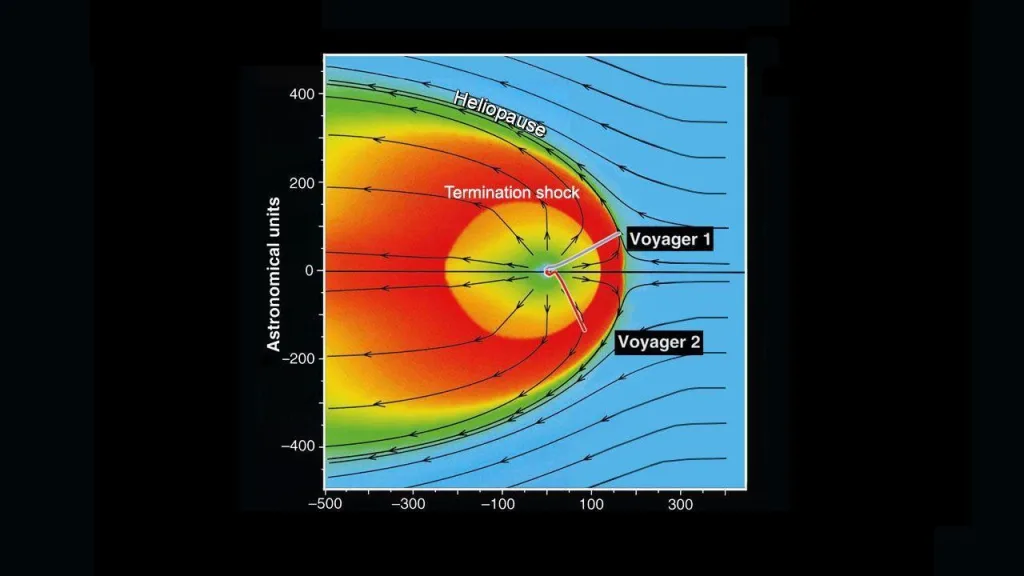
The Voyager 1 power shutdown comes with a clear trade-off. The LECP instrument played a central role in studying the region beyond our solar system. It measured low-energy charged particles, including ions, electrons, and cosmic rays.
Understanding the Interstellar Medium
These observations helped map the Interstellar medium. This region lies beyond the Sun’s influence and contains sparse gas and energetic particles. Voyager 1 remains one of the few probes to operate there.
The instrument detected changes in particle density and tracked pressure variations. These insights revealed that interstellar space is active, not empty.
Why This Data Was Unique
No current mission can fully replace this capability. Most spacecraft operate within the heliosphere or closer to Earth. Voyager 1 and its twin remain the only probes sending direct measurements from interstellar space.
With LECP turned off, part of that data stream is gone. However, other instruments continue to function. They still provide key measurements related to magnetic fields and plasma conditions.
Balancing Loss and Longevity
The Voyager 1 power shutdown represents a calculated balance. Scientists accept the loss of one instrument to preserve the mission as a whole. This approach ensures that data continues to reach Earth instead of ending abruptly.
Voyager 1 Power Shutdown Strategy: Extending a Historic Mission
The Voyager 1 power shutdown forms part of a broader survival plan. At launch, the spacecraft carried ten instruments. Over time, most have been turned off to conserve energy.
Today, only a limited number remain active. Each operates under strict power constraints. Engineers monitor performance closely and adjust as needed.
From Full Science to Essential Operations
In its early years, Voyager 1 conducted extensive observations. It explored planets, moons, and magnetic environments. Now, its role has shifted. The mission focuses on maintaining essential measurements and communication.
This evolution highlights a shift from expansion to preservation. The spacecraft no longer adds capabilities. It protects what remains.
How Long Can Voyager 1 Continue?
Current estimates suggest the spacecraft may continue into the early 2030s. That timeline depends on careful energy management. Each shutdown adds valuable time.
Voyager 1 has already surpassed its expected lifespan by decades. Its endurance reflects both robust engineering and careful planning.
Communication Across Interstellar Space
Despite its extreme distance, Voyager 1 still communicates with Earth. Signals travel billions of kilometers and require hours to arrive. NASA’s Deep Space Network receives these faint transmissions and converts them into usable data.
The Voyager 1 power shutdown helps maintain this connection. Without these adjustments, communication could be lost.
Voyager 1 Power Shutdown and Its Significance Today
The Voyager 1 power shutdown represents a pivotal moment in space exploration. Humanity is gradually losing its most distant probe, yet the process remains controlled.
A Mission That Redefined Exploration
Voyager 1 has traveled farther than any spacecraft in history. It crossed the heliosphere and entered interstellar space. Along the way, it transformed our understanding of the solar system.
Even now, it continues to deliver rare data from an unexplored region.
Why No Current Mission Can Replace It
Modern missions focus on targeted objectives. Some explore planets. Others observe distant cosmic structures. None operate in interstellar space like Voyager 1.
Future missions may attempt similar journeys. However, reaching that distance takes decades. For now, Voyager remains unmatched.
A Gradual Farewell, Not an End
The Voyager 1 power shutdown does not mark an immediate conclusion. Instead, it begins a slow transition. Each step reduces capability while extending survival.
This approach allows scientists to gather data for as long as possible. It also marks a quiet shift in how long-duration missions are managed.
Conclusion
The Voyager 1 power shutdown signals the start of the spacecraft’s final phase. NASA has chosen to turn off one instrument to preserve the mission as a whole. This strategy keeps Voyager 1 operating in interstellar space despite its declining power.
After nearly 50 years, it continues to send data from beyond the solar system. That achievement remains unmatched. Each decision extends the mission’s life, even as its capabilities slowly narrow.
The question now is not whether Voyager 1 will stop, but when. And more importantly, how much more it can reveal before its long journey finally comes to an end.
Sources:
NASA JPL News:
https://www.jpl.nasa.gov/news/nasa-shuts-off-instrument-on-voyager-1-to-keep-spacecraft-operating/
NASA Voyager Mission Overview:
https://science.nasa.gov/mission/voyager/