
BY:SpaceEyeNEWS.
Introduction
For the first time in history, the farthest distance between humans in space was measured not from Earth, but between people themselves. On April 6, 2026, astronauts aboard Artemis 2 and crew members on the Tiangong space station reached a record separation of about 419,643 kilometers. This moment was not planned. It emerged naturally as human activity extended across multiple regions of space. More importantly, it signals a turning point. Humanity is no longer confined to a single location beyond Earth.
Artemis 2 and Tiangong Create the Farthest Distance Between Humans in Space
A Record Born from Two Missions
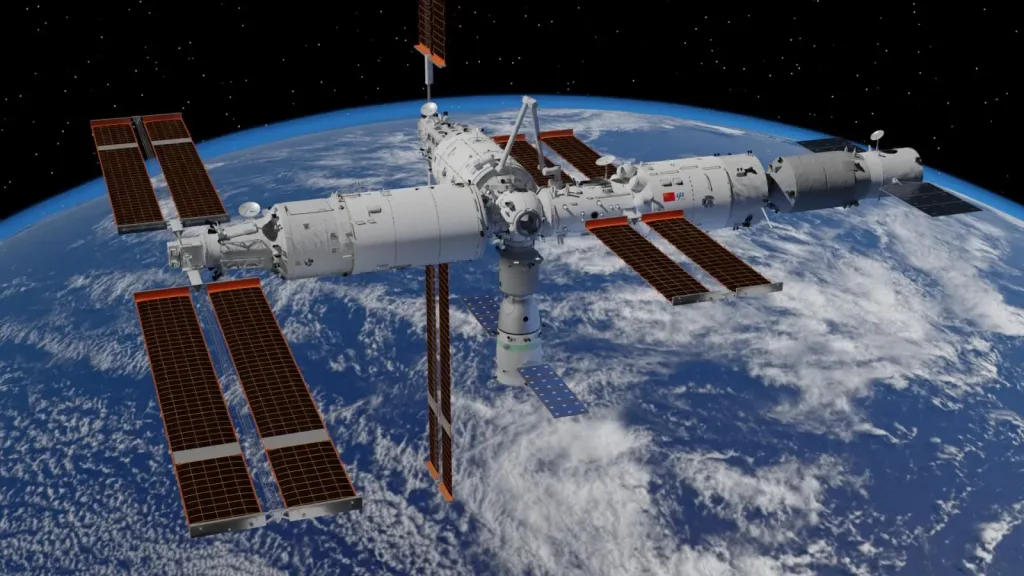
The farthest distance between humans in space occurred as the Orion spacecraft, named “Integrity,” traveled behind the Moon during Artemis 2. At the same time, three astronauts aboard Tiangong orbited Earth in low Earth orbit. These two crews reached a separation never seen before.
Astrophysicist Jonathan McDowell calculated the distance at approximately 260,754 miles, or 419,643 kilometers. That figure slightly exceeded the distance between the Orion crew and the International Space Station.
The milestone was not intentional. It formed as two independent missions unfolded at the same time. One pushed toward deep space, while the other maintained a steady presence in orbit. Together, they created a historic alignment.
Why Tiangong, Not ISS
Early assumptions pointed to the ISS as the likely reference point. However, Tiangong’s orbital position placed it marginally farther from Orion. The difference was small, but enough to define the record.
This outcome highlights how precise orbital positioning can shape history. Even slight variations can produce significant milestones. Further verification may refine the numbers, but the record itself stands firm.
From Apollo 13 to Artemis 2: Evolution of the Farthest Distance Between Humans in Space
A Historic Comparison
The previous benchmark traces back to Apollo 13. During that mission, astronauts reached a record distance from Earth as they looped around the Moon. At the time, no space stations existed. All humans in space were part of the same mission.
As a result, separation between humans remained limited. There was no second location where people lived simultaneously beyond Earth.
What Changed Over Time
Today’s environment looks very different. Continuous human presence now exists in orbit. Both the ISS and Tiangong host rotating crews throughout the year. This sustained presence enables new types of milestones.
The farthest distance between humans in space now depends on multiple active locations. Deep-space missions extend outward, while orbital stations remain closer to Earth. This combination creates a wider human footprint.
A New Type of Record
Unlike earlier milestones, this record measures distribution rather than distance from Earth. It reflects how far apart humans are, not how far they travel from their home planet.
This distinction marks a shift in how progress is defined in space exploration.
Why the Farthest Distance Between Humans in Space Signals a New Era
From Exploration to Distribution
According to Jonathan McDowell, the meaning of this milestone extends beyond numbers. The focus is shifting from distance from Earth to distance between humans.
This perspective introduces a deeper transformation. Humanity is beginning to spread across space. Although current distances remain modest, the concept carries long-term significance.
Multiple Locations, One Civilization
Artemis 2 and Tiangong operated independently. Yet together, they created a shared milestone. This moment shows that human activity in space is no longer centralized.
Different programs now contribute to a broader presence. One expands toward the Moon, while another sustains operations in orbit. Combined, they form the early structure of a distributed human presence.
A Subtle but Defining Shift
At first glance, the record appears technical. In reality, it marks the first time humans occupied clearly separate regions of space simultaneously.
This development signals the beginning of a new phase in human expansion.
From Moon Missions to Mars: The Future of Human Distance in Space
Expanding Beyond the Current Record
The current record stands at about 419,000 kilometers. Future missions will extend this boundary significantly. Upcoming Artemis missions aim to establish a sustained presence around and on the Moon.
Beyond that, Mars exploration plans continue to advance. Once humans operate on Mars while others remain near Earth or the Moon, separation distances will increase dramatically.
Scaling to Interplanetary Distances
Distances between Earth and Mars can exceed tens of millions of kilometers. This scale far surpasses the current record. The farthest distance between humans in space will expand by orders of magnitude when interplanetary missions begin.
Some projections even suggest future separations spanning vast portions of the solar system. While that vision remains distant, the foundation is already forming.
A New Measurement of Civilization
As distances grow, they will redefine how human presence is measured. Exploration will no longer be the only benchmark. Distribution across space will become equally important.
This shift transforms spaceflight into something larger than individual missions. It becomes a measure of civilization itself.
Why This Record Could Redefine Human Civilization in Space
A Quiet Milestone with Lasting Impact
This record did not arrive with dramatic headlines. There was no single defining event. Yet its importance is clear.
The farthest distance between humans in space reflects decades of progress. It combines advanced technology with continuous human presence beyond Earth.
A Turning Point in Space History
This moment represents a transition. Humanity is moving from exploration toward expansion. Even modest steps in this direction carry long-term meaning.
Future historians may view this event as a key milestone. It marks the point when humans first occupied multiple regions of space at once.
The Beginning of Something Larger
While the distance may seem small compared to cosmic scales, the idea behind it is profound. It points toward a future where humans live and work across different worlds.
That future is still unfolding. However, its early signs are now visible.
Conclusion
The farthest distance between humans in space is more than a record. It reflects a shift in how humanity exists beyond Earth. Artemis 2 and Tiangong did not just extend human reach. They demonstrated that humans can operate in separate regions of space at the same time. This moment may appear subtle, but its meaning is significant. It marks the early stage of a distributed human presence in space. The real question now is no longer how far we can travel, but how far apart we can exist.
Main Sources:
- https://www.space.com/space-exploration/artemis/artemis-2-and-tiangong-space-station-astronauts-set-record-for-farthest-distance-between-humans
- https://www.nasa.gov/artemis
- https://www.nasa.gov/mission_pages/station/main/index.html
- https://www.cmsa.gov.cn (China Manned Space Agency – Tiangong updates)