BY:SpaceEyeNews.
Introduction: New Glenn Upper Stage Malfunction Raises New Questions
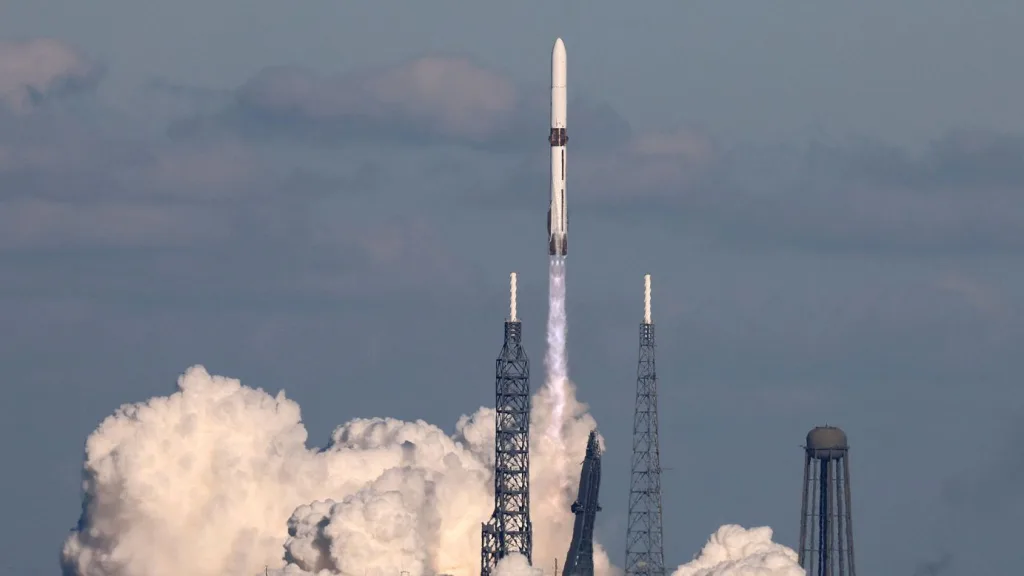
The New Glenn upper stage malfunction defined the rocket’s third mission. On April 19, 2026, the heavy-lift vehicle from Blue Origin lifted off without issue. The ascent looked clean. The payload deployed. Yet the mission still fell short.
The anomaly occurred at the most critical phase of flight. Instead of reaching its intended orbit, the satellite entered an off-nominal trajectory. That single deviation changed the outcome.
In modern launch systems, partial success does not count. Precision defines success. In this case, the New Glenn upper stage malfunction turned a promising mission into a mixed result.
New Glenn Upper Stage Malfunction: Mission Overview and Launch Details
Launch Timeline and Conditions
The rocket launched from Cape Canaveral Space Force Station at 7:25 a.m. Eastern Time. Conditions were stable. The vehicle climbed smoothly through the early phase of flight.
Onboard was the BlueBird 7 satellite from AST SpaceMobile. The target was a circular low-Earth orbit at roughly 460 kilometers.
First Stage Performance Success
The first stage delivered exactly what was expected. It completed its burn and separated cleanly. After separation, the booster executed a controlled descent and landed on the recovery vessel Jacklyn in the Atlantic.
This marked a major milestone. It was the first successful reflown and recovered New Glenn booster. The result confirms strong progress toward reusability and validates the lower stage design.
Where the Mission Deviated
The outcome shifted during the upper stage phase. The New Glenn upper stage malfunction occurred during a critical engine burn.
The payload deployed, but the rocket failed to reach the required velocity. As a result, the satellite entered an off-nominal orbit rather than its planned trajectory.
In orbital mechanics, even small differences matter. Precision is everything.
Understanding the New Glenn Upper Stage Malfunction
The Role of the Upper Stage
The upper stage performs the most precise work in any launch. It determines final altitude and velocity. This stage uses BE-3U engines to complete controlled burns and finalize orbital insertion.
Any disruption here directly affects mission success. That is exactly what happened during the New Glenn upper stage malfunction.
What Went Wrong
The anomaly occurred during the operation of the BE-3U engines. Evidence points to an issue during a key burn, likely the second burn used to refine the orbit.
Because of this disruption, the vehicle did not achieve the required speed. The payload entered a non-standard orbit as a result.
Known Facts and Open Questions
The presence of an anomaly is confirmed. The root cause is still under investigation. Engineers are analyzing performance data from the upper stage.
Possible factors include engine performance variation, propellant flow irregularities, or timing issues. None have been confirmed at this stage.
Why This Stage Matters Most
Upper stage reliability defines mission success. Lower stages provide thrust. The upper stage provides accuracy.
A small error in velocity can shift an orbit significantly. That is why the New Glenn upper stage malfunction carries weight. It highlights a critical area that must perform flawlessly.
Impact of the New Glenn Upper Stage Malfunction on Blue Origin
Certification and Strategic Goals
Blue Origin is working toward National Security Space Launch certification. This process requires consistent mission success.
The New Glenn upper stage malfunction introduces uncertainty into that timeline. Reliability must be proven across multiple flights.
Launch Cadence and Operational Pressure
The company also aims to increase its launch frequency. That goal depends on stable performance.
This anomaly slows momentum. Engineers must first understand and resolve the issue before accelerating operations.
Competitive Landscape
The launch market continues to tighten. Companies like SpaceX operate at high cadence with proven systems. Others, including United Launch Alliance, are advancing next-generation vehicles.
In this environment, consistency matters more than isolated milestones.
Customer Confidence
Commercial missions depend on precise orbital delivery. Even small deviations can impact satellite operations.
Although the payload deployed, the off-nominal orbit may require adjustments. These corrections can consume onboard resources and reduce operational lifespan.
The New Glenn upper stage malfunction therefore extends beyond the launch itself.
A Hidden Milestone Behind the New Glenn Upper Stage Malfunction
Booster Reuse Achievement
One success stands out. The first stage booster landed successfully after completing its mission.
This marks a significant step toward reusable launch systems. It demonstrates that Blue Origin can recover and potentially reuse key hardware.
Why Reusability Matters
Reusable systems reduce costs and improve launch efficiency. They allow faster turnaround between missions and support higher launch cadence.
The successful recovery aligns with broader industry trends. It positions New Glenn for long-term competitiveness.
A Mission of Contrasts
The New Glenn upper stage malfunction overshadowed this achievement. However, both outcomes define the mission.
The rocket proved it can return safely. It has not yet proven full mission consistency.
What Comes Next After the New Glenn Upper Stage Malfunction
Investigation and Technical Review
Blue Origin has launched a detailed investigation into the anomaly. Engineers are reviewing telemetry and engine performance data.
The focus remains on the BE-3U engines and the sequence of upper stage burns.
Potential Adjustments
Depending on findings, the company may introduce hardware changes or software updates. Operational procedures may also be refined.
Each adjustment aims to eliminate the risk of similar anomalies.
Future Launch Outlook
The timing of future launches will depend on the outcome of the investigation. Reliability will take priority over schedule.
The next mission will carry added significance. It will test whether corrective measures are effective.
A Defining Phase
The New Glenn upper stage malfunction marks a critical moment. It highlights both progress and remaining challenges.
The path forward depends on how quickly and effectively the issue is resolved.
Conclusion: A Turning Point for New Glenn
The New Glenn upper stage malfunction captures the reality of launch system development. Progress often comes with setbacks.
This mission delivered a major step forward in booster recovery. It also revealed a critical weakness in upper stage performance.
Blue Origin now faces a clear task. It must resolve the anomaly and demonstrate consistent reliability.
The next launches will define the future of New Glenn. They will determine whether it can compete at scale in an increasingly demanding launch market.
Sources:
- https://spacenews.com/third-new-glenn-launch-suffers-upper-stage-malfunction/
- https://www.blueorigin.com/news
- https://ast-science.com/