BY:SpaceEyeNews.
Introduction — Uranus Outer Rings Origins Just Changed
For years, scientists assumed the Uranus outer rings origins followed a single formation path. That view no longer holds. New observations now show that the μ and ν rings formed through entirely different processes.
Using advanced data from major observatories, researchers identified clear differences in composition. This breakthrough does more than explain two faint rings. It reshapes how planetary ring systems are understood.
The Uranus outer rings origins now point to multiple formation pathways. That shift challenges long-standing models and opens new questions about how material behaves around planets.
Uranus Outer Rings Origins — The Puzzle Scientists Could Not Solve
The outer rings of Uranus have always stood apart. The μ and ν rings are faint and sit within the planet’s moon system. Their low brightness made them difficult to analyze in detail.
Early observations revealed something unusual. Both rings showed strong absorption near a wavelength of three micrometers. This signal suggested a shared composition. For years, that assumption shaped how scientists interpreted the Uranus outer rings origins.
A Shared Signal That Misled Scientists
At first glance, the spectral data appeared straightforward. Similar absorption patterns usually indicate similar materials. That logic pointed to a common origin.
However, deeper analysis exposed key differences. When researchers examined the full spectrum, the rings behaved differently. That inconsistency raised doubts about the original assumption.
Why the Outer Rings Matter
Unlike the dense inner rings, the outer rings interact closely with nearby moons. This position makes them sensitive to impacts and external material. It also makes them ideal for studying how debris forms and spreads.
Understanding the Uranus outer rings origins offers insight into how planetary systems evolve. These rings act as a natural test environment for tracking material over time.
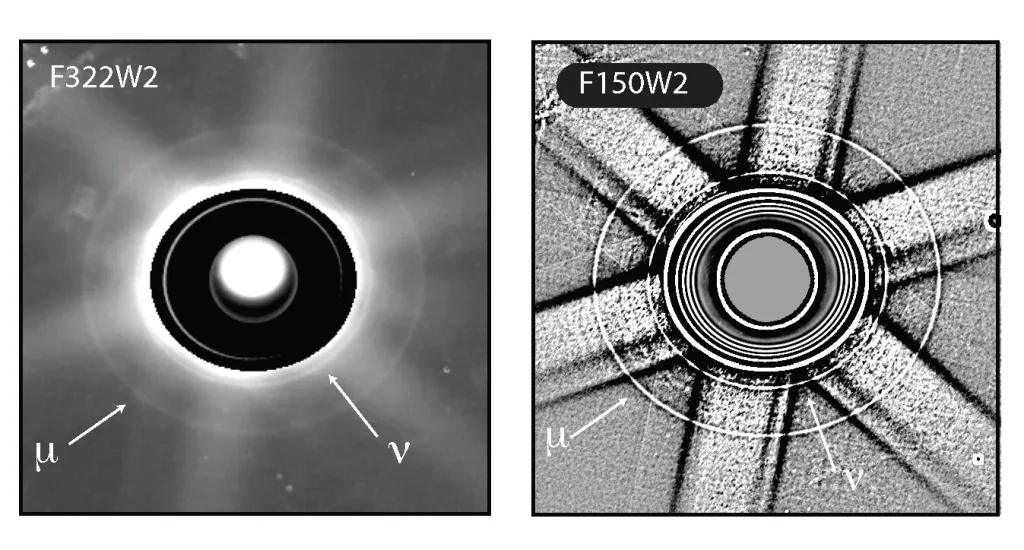
Uranus’s two outer rings show starkly different origins
μ Ring — Ice-Dominated and Linked to Mab
The μ ring stands out due to its blue appearance. That color signals the presence of very fine ice particles.
Composition and Structure
Detailed analysis shows that the μ ring consists mostly of nearly pure ice. The particles are extremely small. This explains both the ring’s faint brightness and its color.
This finding plays a key role in redefining the Uranus outer rings origins. It confirms that one of the outer rings forms through an ice-driven process.
Connection to Mab
Scientists traced the likely source of this material to Mab. This small moon measures only about 12 kilometers across. Despite its size, it appears to supply the material that forms the μ ring.
Micrometeorite impacts likely strike Mab’s surface. These impacts eject tiny ice particles into space. Over time, this material spreads out and forms the ring.
A Surprising Comparison
This process resembles the mechanism seen on Enceladus, which feeds Saturn’s E ring with icy particles. However, there is a critical difference. Enceladus actively releases material through geysers. Mab shows no signs of such activity.
Why μ Ring Remains a Mystery
This contrast creates a major question. How can such a small and inactive moon produce enough material to sustain a ring?
The μ ring remains one of the most puzzling features tied to the Uranus outer rings origins. It behaves like a system driven by active processes, yet its source appears inactive.
ν Ring — Dust, Organics, and an Unknown Source
The ν ring tells a completely different story. Its structure and composition contrast sharply with the μ ring.
Composition Differences
Instead of ice, the ν ring consists mainly of silicates and organic compounds. These materials form larger dust grains. The ring appears more neutral in color and resembles typical dusty rings.
This difference confirms that the Uranus outer rings origins involve at least two distinct formation mechanisms.
A More Conventional Structure
The ν ring behaves more like standard planetary rings. Its particles are larger and less reflective. This gives it a more stable appearance.
Yet its origin remains unclear. Scientists have not identified a specific moon or source body responsible for supplying its material.
Possible Formation Scenarios
Researchers have proposed several explanations. One idea suggests the ring formed from debris after a collision. Another possibility involves external material captured by Uranus’s gravity.
Each scenario points to a different pathway within the Uranus outer rings origins. None has been confirmed.
Why the ν Ring Matters
Even without a confirmed source, the ν ring plays a critical role in this discovery. It shows that not all rings form from local icy material. Some may arise from entirely different processes involving rock and organic compounds.
How New Observations Changed Uranus Outer Rings Origins
The turning point came from combining multiple datasets. Each instrument revealed a different layer of information.
Role of Advanced Observatories
Infrared observations exposed subtle differences in composition. Visible-light data confirmed the rings’ appearance and structure. Ground-based measurements added further detail.
Together, these datasets formed a complete and consistent picture.
Breaking the Single-Origin Assumption
The results showed that similar spectral features do not guarantee a shared origin. This insight forced a shift in interpretation.
The Uranus outer rings origins now reflect a more complex system. Rings can share certain signals while forming through entirely different processes.
Rethinking Ring Formation Across the Solar System
This discovery extends beyond Uranus. It suggests that planetary rings may be more diverse than previously thought.
Multiple Formation Pathways
Scientists once grouped ring formation into a few main categories. These included moon activity, collisions, and leftover material from planetary formation.
Now, the Uranus outer rings origins show that multiple pathways can operate within the same system. Each ring may follow its own history.
Implications for Other Planets
This raises new questions about rings elsewhere. Could similar hidden differences exist in other systems? Are some rings misunderstood due to limited data?
Future observations may reveal more mixed-origin systems.
A Shift in Planetary Science
Planetary science is moving toward more detailed models. Researchers now analyze each ring as an independent structure rather than part of a uniform system.
This shift highlights the importance of high-precision observations in understanding cosmic environments.
Unanswered Questions About Uranus Outer Rings Origins
Despite this progress, key questions remain.
Why Mab Produces So Much Material
Mab should not generate large amounts of debris. Yet the μ ring persists.
What Created the ν Ring
No confirmed source explains the ν ring’s material.
Why Spectral Signals Overlap
Both rings show similar absorption features despite different compositions.
What Future Observations Might Reveal
Upcoming observations may refine current models and provide clearer answers.
Conclusion — Uranus Outer Rings Origins Redefine Planetary Systems
The latest findings show that the Uranus outer rings origins are not uniform. The μ ring forms from icy material linked to a small moon. The ν ring consists of dust and organic compounds from an unknown source.
This discovery changes how scientists view planetary rings. It introduces the idea that multiple formation processes can exist within a single system.
More importantly, it highlights how much remains unknown. Uranus continues to challenge expectations and reveal deeper complexity.
As research continues, the Uranus outer rings origins may unlock new insights into how planetary systems form and evolve across the universe.
Main Sources:
https://universemagazine.com/en/uranuss-outer-rings-have-different-origins/
https://www.nasa.gov
https://www.esa.int
https://www.keckobservatory.org