BY:SpaceEyeNews
Introduction — Mars Ancient Ocean Evidence Reaches a Turning Point
For decades, one question has shaped our understanding of Mars: did it ever host a true ocean? New Mars ancient ocean evidence now brings that question closer to an answer. Scientists have identified a vast geological feature that resembles a “bathtub ring,” a structure strongly linked to long-standing oceans on Earth.
This discovery marks a shift in how researchers interpret Mars’ surface. Instead of relying on inconsistent shoreline clues, they focused on more stable geological signatures. The result is a clearer, more coherent picture of a planet that may once have supported a massive, persistent ocean.
Beyond geology, the implications reach deeper. If Mars held a stable ocean for extended periods, it may also have offered conditions suitable for life.
Mars Ancient Ocean Evidence — A Smarter Way to Read the Surface
Earlier studies searched for ancient shorelines across Mars. Those features, however, appeared at different elevations. That inconsistency weakened the ocean hypothesis. On Earth, stable oceans produce level shorelines, so the mismatch raised doubts.
Researchers responded by changing their approach. Instead of tracing shorelines, they looked for coastal shelves—broad, flat regions formed where land meets a long-lasting ocean.
Why Coastal Shelves Matter
Coastal shelves provide a more reliable signal because they:
- Remain stable over long periods
- Form through gradual sediment accumulation
- Reflect sustained interaction between land and water
To test this idea, scientists simulated Earth’s oceans by digitally removing water. Even after the oceans disappeared, coastal shelves remained clearly visible. That insight offered a new method for identifying ancient oceans on other planets.
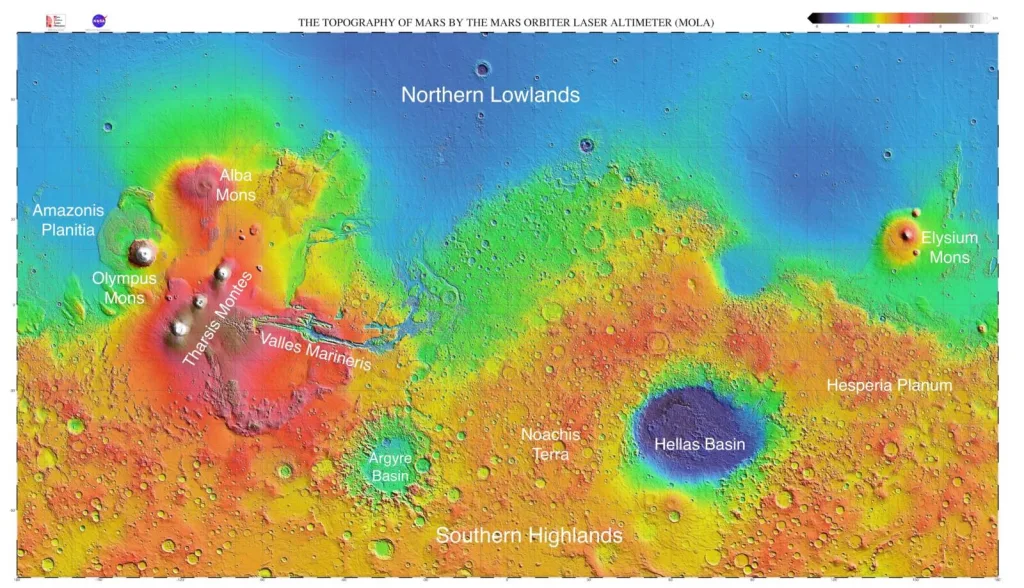
A Massive Coastal Shelf Emerges on Mars
Using orbital topography data, researchers identified a striking feature on Mars. A vast, flat zone stretches across the northern hemisphere, closely matching the scale and shape of a coastal shelf.
Key Characteristics
- Extends across nearly one-third of the planet
- Sits 1.8 to 3.8 kilometers below estimated sea level
- Forms a continuous, ring-like boundary
- Mirrors the geometry of continental shelves on Earth
Such a structure does not form quickly. It requires stable water levels and long-term sediment processes. That makes it one of the strongest pieces of Mars ancient ocean evidence to date.
Aligned Evidence — Rivers and Deltas Tell the Same Story
The case strengthens when additional features come into view. Several river deltas align with the same identified as a coastal shelf.
Why This Alignment Matters
On Earth, rivers flow into oceans and deposit sediment along coastal shelves, forming deltas. The same pattern appears on Mars:
- Deltas cluster along the proposed boundary
- Their elevation matches the flat zone
- Their shapes indicate long-term water flow
This alignment creates a consistent geological narrative. The coastal shelf suggests a large ocean, while the deltas confirm sustained water movement into that basin. Together, they transform isolated clues into a unified model.
A Long-Lived Ocean, Not a Temporary Phase
Time is a critical factor in this discovery. Coastal shelves do not form during brief events. They require stability over extended periods.
What the Evidence Indicates
- The ocean likely persisted for millions of years
- Water levels remained relatively stable
- Sediment accumulated gradually across the shelf
This scenario contrasts with earlier ideas of short-lived flooding. Those models cannot account for a large, structured coastal shelf.
Reconstructing Mars’ Ancient Environment
A long-lasting ocean implies a very different Mars:
- A thicker atmosphere
- Warmer surface conditions
- A functioning water cycle
These factors bring ancient Mars closer to early Earth than previously assumed.
Mars Ancient Ocean Evidence and the Search for Life
The presence of a stable ocean shifts the discussion toward habitability. Water alone does not guarantee life, but it provides the essential foundation for it.
Why Oceans Matter
On Earth, oceans created a stable environment where life could begin and evolve. Similar conditions may have existed on Mars.
Sediments as Natural Records
Coastal sediments can preserve:
- Organic molecules
- Chemical signatures
- Potential biological traces
This makes the newly identified region a high-value target for future exploration. If life ever emerged on Mars, traces of it may still exist within these layers.
Unanswered Questions Still Shape the Debate
Despite strong progress, important uncertainties remain.
Key Open Questions
- What exact processes formed the coastal shelf?
- What sustained the ocean for so long?
- Where did the water eventually go?
Even on Earth, coastal shelf formation is not fully understood. Mars adds new complexity to that puzzle.
Limits of Current Observations
Orbital data provides a global view, but it cannot confirm everything. Surface-level investigation will be essential to validate these interpretations.
What Comes Next — A New Priority for Mars Exploration
Future missions to Mars are expected to focus on regions linked to this discovery.
Key Research:
- Analyze sediment composition
- Study mineral layers
- Search for organic material
These efforts could confirm whether the coastal shelf truly formed in an ocean environment.
A High-Value Exploration Zone
If verified, this region becomes a prime target. It combines strong geological evidence with high potential for scientific breakthroughs.
Conclusion — A Clearer Picture of Ancient Mars
The latest findings deliver powerful Mars ancient ocean evidence. By shifting attention from shorelines to coastal shelves, scientists have uncovered a more stable and convincing signal of a past ocean.
The discovery of a vast, structured shelf in the northern hemisphere suggests that Mars once hosted a long-lasting ocean. Supporting evidence from river deltas reinforces this conclusion.
While questions remain, the direction is clear. Mars may have been far more Earth-like than once believed. That possibility continues to drive exploration, shaping the next phase of discovery on the Red Planet.
Main Sources
- https://www.space.com/astronomy/mars/scientists-found-a-bathtub-ring-on-mars-could-it-be-evidence-of-an-ancient-red-planet-ocean
- https://www.nature.com/
- https://mars.nasa.gov/
- https://www.jpl.nasa.gov/