BY:SpaceEyeNews.
Introduction: Mars Organic Molecules Discovery Changes the Game
The Mars organic molecules discovery marks a defining moment in planetary science. NASA’s Curiosity rover has detected complex organic compounds on the Red Planet—chemicals closely linked to the building blocks of life on Earth.
This is not a routine finding. For the first time, scientists used a new chemical method on another planet, revealing preserved organic material locked inside ancient Martian rocks.
Yet the central mystery remains. Did these molecules come from life, or did Mars produce them through natural chemistry? The answer is still out of reach—but the implications are growing stronger.
Mars Organic Molecules Discovery: What Curiosity Found
Ancient Clues in Gale Crater
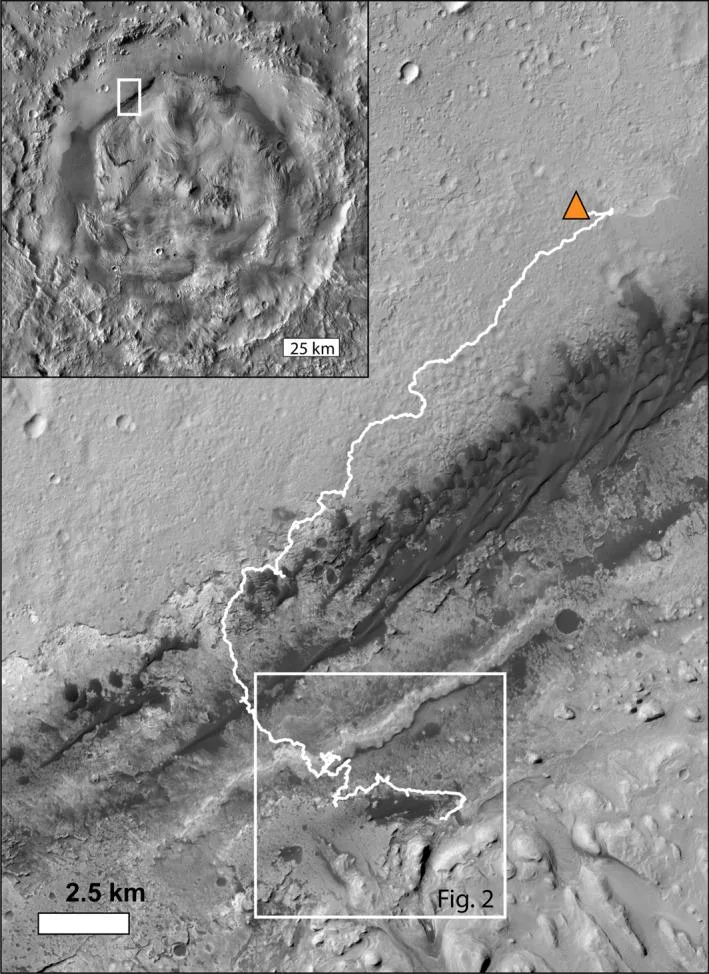
The Mars organic molecules discovery comes from Gale Crater, specifically the Glen Torridon region. This area contains clay-rich rocks formed billions of years ago.
Clay acts like a natural archive. It protects chemical signatures from degradation over long periods. That makes it one of the best places on Mars to search for traces of past habitability.
A Diverse Set of Organic Molecules
Inside these rocks, Curiosity identified more than 20 organic molecules. These compounds include carbon-based structures with nitrogen and sulfur—elements essential for life as we know it.
Such diversity matters. It points to a complex chemical environment rather than a single isolated reaction. In simple terms, Mars shows evidence of sustained organic chemistry over time.
A Breakthrough in Detection Technology
The discovery relied on Curiosity’s onboard laboratory, SAM (Sample Analysis at Mars). Scientists enhanced its capabilities using a chemical method based on tetramethylammonium hydroxide.
This process breaks down larger, hidden molecules into detectable fragments. As a result, previously invisible organic material becomes measurable.
The significance is clear. This marks the first successful use of such a technique on another world, opening a new path for planetary exploration.
Why the Mars Organic Molecules Discovery Stands Out
From Simple Carbon to Complex Chemistry
Earlier missions confirmed the presence of carbon on Mars. The Mars organic molecules discovery moves beyond that baseline. It reveals complex, macromolecular carbon structures—closer to the chemistry associated with life.
While this does not confirm biology, it raises the level of scientific relevance. Mars now shows signs of advanced chemical processes once thought unlikely.
Preservation Against the Odds
Mars is not a friendly environment for organic material. Radiation and oxidation gradually destroy chemical compounds.
Despite this, these molecules survived for billions of years. That resilience suggests Mars can preserve ancient chemical records far more effectively than expected.
Reinforced by Independent Findings
The results align with observations from the Perseverance rover, which has detected similar organic signatures using different instruments.
This overlap strengthens confidence in the findings. Organic material appears across multiple regions of Mars, not just one isolated site.
Mars Organic Molecules Discovery: The Origin Question
Two Competing Explanations
At the heart of the Mars organic molecules discovery lies a critical question: where did these molecules come from?
Scientists are considering two main possibilities. The first involves ancient microbial life. The second points to non-biological processes such as geological reactions or delivery by meteorites.
Both explanations remain plausible.
Why the Answer Remains Elusive
Current instruments can identify molecular composition but cannot confirm origin. They detect chemistry, not biology.
This limitation explains why the discovery stops short of proving life. It provides strong evidence of potential—but not confirmation.
Chemistry That Mirrors Early Earth
The detected compounds resemble those linked to early life formation on Earth. This similarity makes the discovery especially compelling.
Mars may have followed a comparable chemical pathway. Whether it crossed the threshold into life remains unknown.
Implications of the Mars Organic Molecules Discovery
A Shift in Scientific Focus
Mars exploration has reached a turning point. The presence of organic molecules is no longer in question.
Now, the focus shifts to origin. The Mars organic molecules discovery marks the transition from detection to interpretation.
Potential for Preserved Biosignatures
Macromolecular carbon structures can trap biosignatures—chemical patterns left by life.
If life once existed on Mars, traces could still be preserved within these materials. This possibility now guides future mission design.
A Wider Astrobiology Perspective
Beyond Mars, organic molecules appear in meteorites and deep space environments.
This discovery reinforces a broader conclusion. The building blocks of life may be common across the universe. Mars becomes a key test case for that idea.
What Comes Next After the Mars Organic Molecules Discovery
Advancing Detection Techniques
Future missions will deploy more advanced instruments. These tools aim to analyze molecular structures with greater precision.
Scientists will focus on identifying patterns that could indicate biological origins.
Upcoming Mars Missions
The European Space Agency’s Rosalind Franklin rover will carry specialized instruments designed to search for signs of life.
At the same time, NASA continues to refine its Mars exploration strategy. Each mission builds directly on the Mars organic molecules discovery.
The Long-Term Objective
The goal remains unchanged. Scientists want clear evidence of whether life ever existed on Mars.
This discovery does not answer that question—but it brings it within reach.
Conclusion: Mars Organic Molecules Discovery Raises the Stakes
The Mars organic molecules discovery confirms that complex organic chemistry exists on Mars. These molecules formed in ancient environments that could have supported life and survived for billions of years.
Yet the origin of these compounds remains unresolved. That uncertainty is not a weakness—it is the next frontier.
Mars no longer appears as a chemically barren world. Instead, it stands as a planet rich in preserved organic material, waiting to be decoded.
The question has evolved. We are no longer asking whether Mars had the ingredients for life. We are now asking whether life ever used them.
Main Sources:
- https://www.space.com/astronomy/mars/nasas-curiosity-rover-finds-building-blocks-of-life-on-mars-scientists-arent-sure-how-they-got-there
- NASA Mars Exploration Program (official releases)
- Nature Communications (Curiosity SAM experiment study)