BY:SpaceEyeNews.
Introduction — A New Chapter Begins
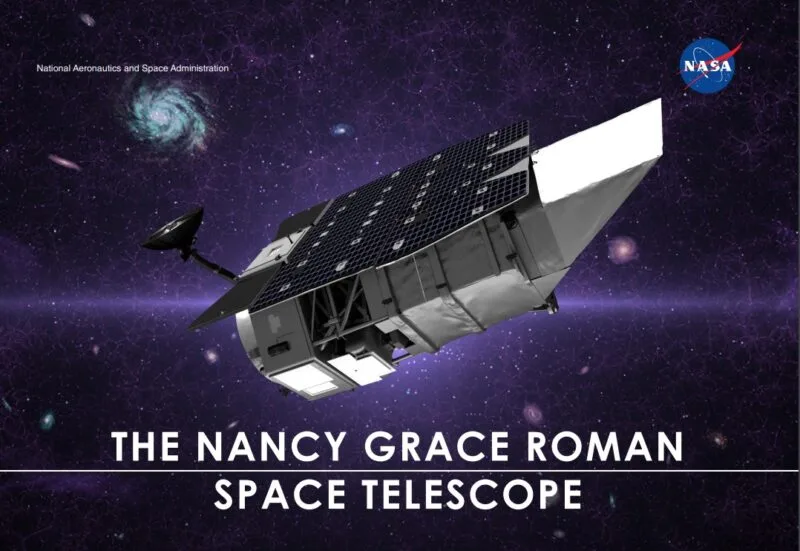
The Roman Space Telescope has officially entered the spotlight. NASA confirmed that its next flagship observatory is fully assembled and moving toward launch. This moment marks a turning point in modern astronomy.
Unlike earlier missions, this telescope is designed for scale. It will observe vast regions of space in a single scan. That capability allows scientists to explore how the universe formed and continues to evolve.
Following the legacy of Hubble Space Telescope and working alongside James Webb Space Telescope, this mission introduces a broader observational strategy. It connects precision with wide coverage.
For more insights on next-generation observatories, you can explore our coverage of upcoming space missions on SpaceEyeNews.
A Wide-Field Design That Changes Everything
Beyond Traditional Observation
At its core, the telescope uses a 2.4-meter mirror, similar to Hubble. However, its mission approach is entirely different.
Instead of focusing on small targets, it captures large sections of the sky. Its field of view is nearly 100 times larger. This allows scientists to gather more data in less time.
Such a design transforms how research is conducted. Rather than studying isolated objects, astronomers can analyze patterns across vast cosmic regions.
Why Scale Matters in Astronomy
Wide-field imaging reveals how galaxies are distributed. It also shows how structures evolve across billions of years.
With this approach, researchers gain access to millions of galaxies in a single dataset. That scale improves accuracy and accelerates discovery.
It also increases the chances of detecting rare cosmic events. These events often remain hidden in narrow observations.
Mapping the Invisible Universe
Uncovering Dark Energy
One of the primary goals of this mission is to investigate dark energy. This force drives the accelerated expansion of the universe.
By tracking galaxy movement and clustering, scientists can measure how expansion changes over time. These observations will refine existing models.
New data may even challenge current theories about cosmic acceleration.
Revealing Dark Matter Structures
Dark matter cannot be observed directly. However, its gravitational effects shape galaxies and clusters.
By analyzing how light bends around massive objects, researchers can map hidden structures. This method builds a clearer picture of the universe’s framework.
The telescope will provide large-scale maps that show how matter is distributed across space.
A Shift Toward Data-Driven Discovery
Modern astronomy relies on large datasets. This mission is built to support that shift.
Instead of isolated findings, continuous surveys will provide consistent data streams. These datasets allow for long-term studies and statistical analysis.
To understand how space-based discoveries evolve over time, check our detailed breakdown of recent cosmic findings on SpaceEyeNews.
A New Way to Discover Exoplanets
Exploring Dense Star Regions
The mission includes a focused survey of the Milky Way’s central region. This area contains dense clusters of stars.
Studying this region increases the likelihood of detecting planetary systems. It also reveals environments different from our own.
Detecting Planets Through Light Distortion
The telescope will use Gravitational Lensing to detect planets. This technique measures how light bends when objects pass in front of distant stars.
Small changes in brightness indicate the presence of planets. This method can detect worlds that remain invisible to other techniques.
Expanding the Planetary Map
Traditional detection methods often miss distant or low-mass planets. This approach fills that gap.
It can identify planets far from their stars. It may also detect free-floating worlds.
This broader view will reshape our understanding of planetary systems.
From Assembly to Launch
Final Testing Phase
The telescope is undergoing final testing at Goddard Space Flight Center. Engineers are ensuring that all systems operate under space conditions.
Preparing for Launch
After testing, it will be transported to Kennedy Space Center. There, final preparations will take place.
Launch Timeline
The mission will launch aboard a Falcon Heavy rocket. The current launch window spans late 2026 to mid-2027.
Final readiness will determine the exact schedule.
A New Era of Discovery
From Precision to масштаб Exploration
Astronomy is evolving. This mission represents a shift from narrow observation to large-scale exploration.
Wide-field surveys allow scientists to study the universe as a system. This perspective reveals patterns that smaller observations cannot capture.
Working Alongside Other Observatories
This telescope will complement missions like James Webb Space Telescope. While Webb focuses on detailed observations, this mission identifies targets across wide regions.
This collaboration improves efficiency and expands scientific reach.
Unlocking Future Discoveries
With its advanced capabilities, the mission may reveal unexpected phenomena. It could refine our understanding of cosmic expansion and uncover new planetary systems.
Each dataset will contribute to a deeper understanding of the universe.
Conclusion — A Turning Point in Space Observation
The Roman Space Telescope marks a defining step in astronomy. Fully assembled and approaching launch, it is ready to reshape how scientists explore the cosmos.
Its wide-field design sets a new standard. By combining scale with precision, it enables deeper and broader discoveries.
As the launch window approaches, anticipation continues to grow. This mission will not just observe the universe—it will redefine how we understand it.
Main Sources:
- https://www.space.com/astronomy/nasa-reveals-its-roman-space-telescope-today-how-to-watch-live-and-whats-next-for-the-next-generation-observatory
- https://www.nasa.gov/roman-space-telescope
- https://roman.gsfc.nasa.gov/