BY:SpaceEyeNews.
Introduction: Milky Way Star Formation Boundary Explained Clearly
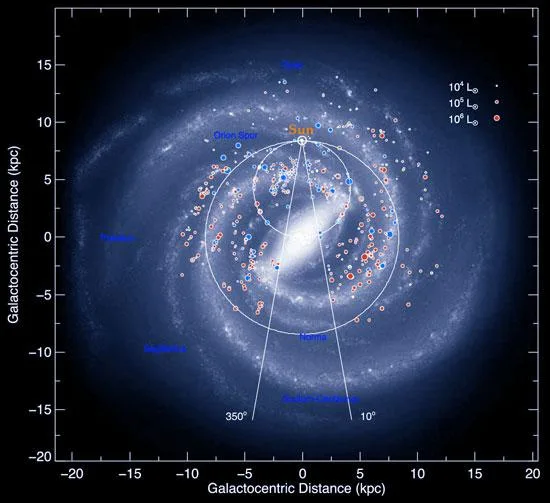
The Milky Way star formation boundary defines where new stars can still form in our galaxy—and where that process fades. Recent research shows that star formation in the Milky Way is limited to an inner region that extends to about 40,000 light-years from the center. Beyond that, activity drops sharply.
This finding reshapes how we understand galaxy structure. It shows that large parts of the Milky Way are no longer actively forming stars. Instead, those outer regions preserve older stellar populations that reflect earlier stages of the galaxy’s evolution.
Star Formation Limit in the Milky Way: Inner Activity vs Outer Quiet
The newly defined star formation limit in the Milky Way separates two distinct zones.
A Clear Structural Divide
The galaxy stretches far beyond 80,000 light-years. However, only its inner portion remains active. Inside this region, gas density supports continuous star formation. Outside it, conditions change.
- Inner disk: dense gas, ongoing star formation
- Outer disk: sparse gas, mostly older stars
This contrast reveals that the Milky Way is not uniformly active. Instead, it operates with a defined inner engine and a quieter outer structure.
Why This Boundary Matters
A measurable limit allows astronomers to study galaxy evolution with greater precision. It confirms that star formation efficiency declines with distance from the center.
For more on how galaxy structure evolves over time, explore our coverage of findings from the James Webb Space Telescope.
How Scientists Identified the Star Formation Edge
Mapping this boundary required combining large datasets with advanced simulations.
Observational Data Sources
Researchers analyzed over 100,000 stars using:
- Gaia
- LAMOST
- APOGEE
These projects provided detailed measurements of stellar positions, motion, and composition.
Reconstructing Stellar History
Instead of tracking star formation directly, scientists examined stellar populations. Bright giant stars served as reliable indicators of age.
By analyzing temperature and chemical composition, researchers built a timeline of star formation across the galaxy.
The Role of Modeling
Simulations helped confirm the observed pattern. The results pointed to stellar migration as a major factor shaping the galaxy’s structure.
The U-Shaped Pattern Across the Galactic Disk
The structure of the Milky Way star formation boundary becomes clear when looking at stellar ages.
A Reversal in Age Trends
As distance from the center increases, stars first become younger. This reflects inside-out growth. Near the boundary, however, the trend reverses.
- Central region: older stars
- Mid-disk: younger stars
- Outer disk: older stars again
This creates a U-shaped profile that marks the transition from active to inactive regions.
Position of the Sun
The Sun lies about 26,000 light-years from the center. It remains within the active zone, where star formation still occurs.
What Causes the Star Formation Boundary
The Milky Way star formation boundary is closely tied to gas distribution.
Declining Gas Density
Inside the boundary, cold gas is abundant. These conditions allow clouds to collapse and form stars. Beyond it, gas becomes less dense and less efficient at forming new stars.
Outer Regions Preserve Older Stars
The outer galaxy still contains stars, but most are older. They did not form recently in those regions.
Stellar Migration Shapes the Disk
Many of these stars likely moved outward over time. Gravitational interactions gradually shift stars across the disk. This process explains the presence of older stars far from the center.
Open Questions Remain
The exact mechanism that defines the boundary is still under investigation. Gas dynamics and large-scale structure both play a role.
Implications for Galaxy Evolution
Understanding the Milky Way star formation boundary helps refine broader models of galaxy formation.
Inside-Out Growth Confirmed
The discovery supports the idea that galaxies build from their centers outward. Star formation begins in dense regions and fades with distance.
Migration Is a Key Process
Stellar migration redistributes stars over time. It blends populations and shapes the overall structure of the galaxy.
A Benchmark for Other Galaxies
Because the Milky Way is well-studied, it provides a reference point. Its structure helps astronomers interpret observations of distant galaxies.
Future Research and Improved Mapping
Upcoming surveys will provide deeper insight into the Milky Way star formation boundary.
Next-Generation Projects
- 4MOST
- WEAVE
These instruments will map millions of stars with improved precision.
What Scientists Aim to Learn
Future work will focus on:
- Refining the exact location of the boundary
- Understanding gas distribution in more detail
- Identifying the processes that define this limit
Conclusion: A Defined Edge to Star Formation
The Milky Way star formation boundary reveals that our galaxy is only partly active. Star formation continues within the inner disk but fades toward the outer regions. Beyond that limit, the galaxy becomes a record of earlier cosmic history.
This discovery sharpens our view of how galaxies evolve. It shows that size alone does not define a galaxy. What matters is where new stars can still form—and where that process has already slowed to a stop.
Main Sources:
- https://universemagazine.com/en/our-galaxys-star-forming-region-extends-only-halfway-across-its-radius/
- https://www.esa.int/Science_Exploration/Space_Science/Gaia
- https://www.sdss.org/surveys/apogee/
- https://www.lamost.org/public/