BY:SpaceEyeNews.
🚀 Introduction — A Warning in the Making
The concept of a lunar blockade is no longer speculative. As NASA advances plans for a sustained human presence on the Moon, experts are drawing attention to a growing vulnerability. The region between Earth and the Moon is not limitless. It is structured, narrow in key areas, and increasingly important.
Recent disruptions in critical Earth routes, such as the Strait of Hormuz, highlight how sensitive global systems can be. A similar pattern could emerge in space. Analysts including Marc Feldman and Hugh Taylor warn that control over specific pathways could influence access to the Moon.
The implication is clear: space may be vast, but its access points are limited.
🌌 Cislunar Chokepoints — The Geography Behind Lunar Blockade Risk
Structured Space, Not Open Territory
Cislunar space, the region linking Earth and the Moon, operates under strict physical rules. Spacecraft rely on carefully calculated trajectories shaped by gravity. These routes are efficient, but limited in number.
This structure creates natural chokepoints. Any mission traveling to or from the Moon must pass through predictable corridors. The idea of a lunar blockade emerges from this constraint.
Strategic Role of Lagrange Points
Certain stand out. Lagrange points offer stable positions where gravitational forces balance. These locations serve as staging areas, observation نقاط, and logistical hubs.
Because of their stability, they hold strategic importance. Control over such points could influence traffic flow across the entire region.
Natural Highways, Limited Access
These pathways function like highways. They reduce energy costs and enable repeatable travel. Yet they also concentrate movement.
A small number of routes means a small number of vulnerabilities. This is where the risk of restricted access begins to take shape.
💰 Moon Economy and the Stakes of Lunar Access
From Exploration to Economic Value
The Moon’s current economic role remains limited. However, expectations for its future value are rising quickly. Analysts such as Peter Garretson emphasize that long-term growth may depend on resources beyond Earth.
This shift reframes the Moon from a destination into an economic platform.
Emerging Space-Based Industries
Several industries are under active development:
- Orbital energy systems
- Space-based data infrastructure
- Advanced manufacturing in microgravity
- Resource utilization from lunar materials
Each relies on reliable transport between the Moon and surrounding orbits.
Expanding Supply Chains Beyond Earth
As these systems mature, supply chains will extend into cislunar space. Materials, equipment, and data will move through these routes regularly.
At that point, stability becomes essential. Any disruption—technical or strategic—could slow operations and raise costs.
Dependency Creates Vulnerability
The risk lies in dependency. Once industries rely on lunar logistics, access becomes critical. Even minor delays could ripple across multiple sectors.
This is where the concept of a lunar blockade gains relevance. It is not about immediate disruption. It is about long-term leverage over essential systems.
🛰️ Cislunar Security and Monitoring Efforts
Growing Strategic Awareness
Governments have started to respond. The United States Space Force now treats cislunar space as a strategic domain. This reflects a broader shift in how space is perceived.
Focus is moving from exploration to sustained presence and oversight.
Tracking Movement Beyond Earth Orbit
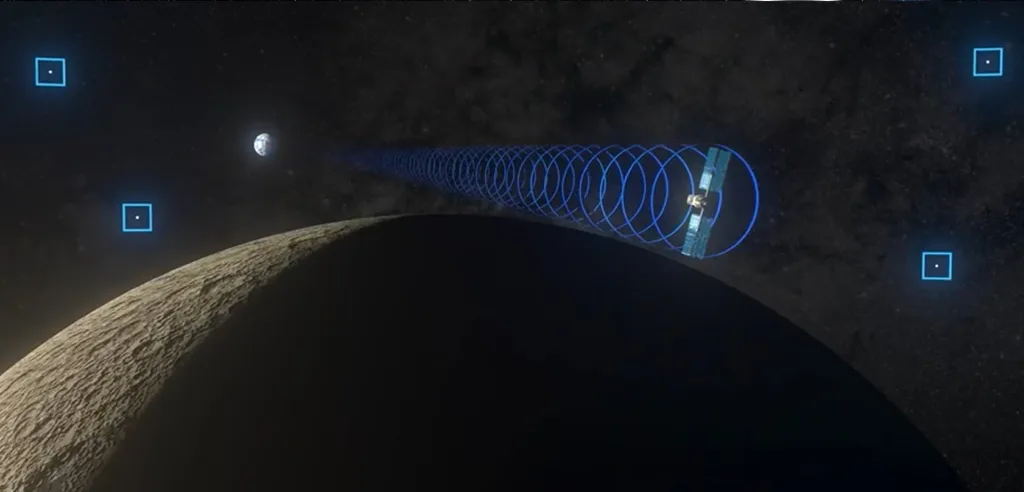
Monitoring near-Earth space is well established. Monitoring cislunar space presents new challenges. Distances are greater, and objects is less predictable.
To address this, the Air Force Research Laboratory is developing the Cislunar Highway Patrol System (CHPS). This initiative aims to improve visibility across the region.
Why Visibility Matters
Awareness underpins stability. Without accurate tracking, coordination becomes difficult. With it, actors can detect congestion, anticipate risks, and manage movement.
This capability forms the foundation for maintaining open access.
Strategic Locations Gain Importance
Not all areas carry equal value. Key locations include:
- Lunar polar regions
- Equatorial zones
- Lagrange points
- Areas with resource potential
These areas shape movement patterns. They are likely to remain central in any discussion of access and control.
⚠️ Understanding the Lunar Blockade Scenario
Subtle Control Rather Than Direct Disruption
A lunar blockade would not necessarily involve dramatic events. It could develop through positioning and influence.
Control over key could shape how and when others move.
Potential Mechanisms
Several approaches could affect access:
- Occupying strategic orbital positions
- Influencing navigation corridors
- Creating congestion in key routes
- Limiting safe or efficient transit options
Each method changes the operating environment without direct confrontation.
Gradual Impact on Operations
The effects may appear slowly. Delays increase. Costs rise. Planning becomes more complex.
Over time, this can discourage investment and reshape priorities.
Broader Economic Effects
As space systems connect to Earth-based industries, disruptions extend further. Logistics delays affect production cycles. Financial planning adjusts to uncertainty.
The influence spreads beyond the space sector.
🌍 Why Lunar Blockade Risk Redefines Space Strategy
Infrastructure Changes the Equation
Space activity is entering a new phase. Infrastructure is replacing exploration as the main focus.
Infrastructure brings permanence. It also introduces reliance on stable systems.
More Participants, More Complexity
Both governments and private companies are expanding their roles. This increases traffic and competition for limited routes.
Coordination becomes more challenging as participation grows.
Governance Still Evolving
Regulatory frameworks for cislunar operations remain limited. Existing agreements do not fully address future scenarios.
This creates uncertainty. It also leaves room for strategic positioning.
Access Becomes a Strategic Priority
Reaching the Moon is no longer the only objective. Maintaining reliable access is just as important.
The concept of a lunar blockade reflects this shift. It highlights how control over movement can influence outcomes.
🧠 Conclusion — A Manageable Risk, If Addressed Early
The idea of a lunar blockade reflects a broader pattern. Systems evolve, dependencies grow, and access points gain importance.
Space may appear open, yet its pathways are limited. As activity increases, these pathways become more valuable.
The current moment offers an opportunity. Early awareness allows for better planning, coordination, and governance.
The future of lunar access will depend on decisions made today. Keeping pathways open will require cooperation, transparency, and long-term thinking.
🔗 Main Sources:
- Universe Magazine: https://universemagazine.com/en/lunar-blockade-space-around-the-moon-could-become-a-new-strait-of-hormuz/
- Center for the Study of Space Crime, Piracy & Governance (Marc Feldman insights)
- American Foreign Policy Council (Peter Garretson analysis)
- U.S. Space Force public releases
- Air Force Research Laboratory (CHPS program details)