BY:SpaceEyeNews.
Orbital Data Centers Are Redefining AI Infrastructure
Orbital data centers are moving from bold concept to early execution. China’s $8.4 billion push signals a clear direction: computing is expanding beyond Earth. As artificial intelligence scales, the limits of traditional infrastructure are becoming harder to ignore. Energy demand is rising, cooling systems are under pressure, and expansion is slowing in key regions.
This shift is not about replacing what already exists. It is about extending computing into a new environment where some of today’s constraints no longer apply. By placing systems in orbit, engineers aim to unlock continuous energy, efficient cooling, and faster data handling.
The result is a new layer of digital infrastructure—one that could reshape how AI is powered and deployed in the coming decade.
Why Orbital Data Centers Are Emerging Now
AI Growth Is Straining Energy Systems
The rise of AI has changed the scale of computing demand. Data centers already consume hundreds of terawatt-hours of electricity each year. That figure is climbing quickly as AI models grow larger and more complex.
In many locations, electricity supply is becoming the main limiting factor. Even where hardware is available, energy capacity can restrict expansion. This marks a turning point where infrastructure, not innovation, defines the pace of progress.
Cooling Demands Are Increasing
Heat management is now a critical challenge. Advanced processors generate large amounts of heat, and keeping systems stable requires constant cooling. These systems consume additional energy and depend on local conditions such as climate and water availability.
As demand rises, cooling becomes harder to scale efficiently. This adds another layer of pressure to an already strained system.
Space Changes the Equation
Orbital environments offer a different approach. Solar energy is more consistent, especially in specific orbits where sunlight is nearly continuous. This provides a stable power source that is not affected by weather or day-night cycles.
Cooling also becomes simpler. In space, heat dissipates naturally, reducing the need for complex cooling systems. This combination makes orbital computing an attractive complement to ground-based infrastructure.
How Orbital Data Centers Function in Practice
Computing in Orbit
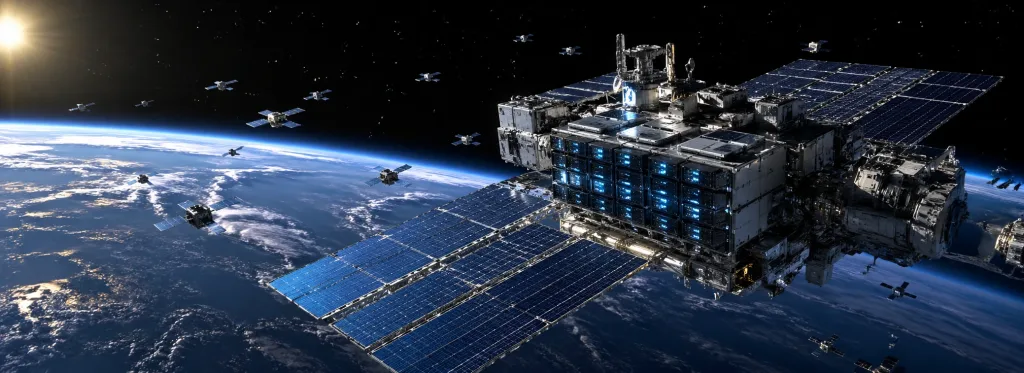
Orbital systems use satellites equipped with processing hardware. These units act as distributed data centers, capable of handling tasks directly in space. Instead of sending all raw data back to Earth, some processing can happen closer to where the data is generated.
This reduces transmission demands and improves response times for certain applications.
Optimized Orbital Design
Placing satellites in sun-synchronous orbits allows them to receive steady sunlight. These paths maximize energy availability and support continuous operation. At altitudes of around 700 to 800 kilometers, systems can maintain efficient coverage while remaining connected to ground networks.
Hybrid Network Integration
Orbital computing is designed to work alongside terrestrial systems. The goal is a hybrid model where workloads are distributed based on efficiency. Some tasks remain on Earth, while others benefit from being processed in orbit.
This layered approach increases flexibility and resilience across the entire network.
China’s Orbital Data Centers Strategy
Strong Financial Backing
China’s initiative is supported by approximately 57.7 billion yuan in credit lines. Major financial institutions are involved, providing the resources needed to move from concept to deployment. This level of backing reflects long-term confidence in space-based computing.
Phased Development Approach
The roadmap is structured in stages. Early efforts focus on launching test systems and resolving technical challenges. The next phase connects orbital systems with existing infrastructure. The final stage aims to scale operations into a large, fully functional network.
This step-by-step strategy allows steady progress while managing complexity.
Expanding Satellite Networks
China has outlined plans for large satellite constellations, indicating a broad vision for orbital infrastructure. These networks are designed to support not only computing, but also communication and data services.
The scale of this approach shows how seriously space is being considered as part of future digital systems.
Integrated National Planning
This initiative is part of a wider strategy that combines artificial intelligence, commercial space activity, and advanced computing. Multiple organizations are aligned under long-term development frameworks, ensuring coordination across sectors.
This integration strengthens the foundation for continued progress.
Global Interest in Orbital Computing
Industry Participation Is Growing
Interest in orbital computing is expanding across the technology sector. SpaceX has already deployed a large satellite network that could support future computing layers. Google continues to invest in cloud systems and satellite data processing. Amazon is developing its own network through Project Kuiper.
These efforts suggest that the concept is moving beyond early research into practical development.
Research and Public Sector Involvement
Organizations such as NASA are exploring how in-orbit processing can improve efficiency and reduce delays. These studies support the idea that distributed computing across space and Earth can enhance performance.
Together, these initiatives show that orbital data centers are becoming part of a broader global trend.
Environmental Considerations and Trade-Offs
Operational Efficiency Gains
Orbital systems can reduce reliance on fossil-fuel-based energy during operation. Solar power and passive cooling lower ongoing energy consumption, making them efficient once deployed.
Lifecycle Emissions Challenges
The full environmental impact is more complex. Launching satellites requires significant resources, and manufacturing space-grade hardware is energy-intensive. A large portion of emissions comes from these early stages rather than daily operation.
Replacement Cycles Add Pressure
Satellites typically operate for several years before needing replacement. This creates recurring launch cycles, which contribute to overall emissions and resource use.
Balancing these factors is essential for assessing long-term sustainability.
Technical Challenges Ahead
Data Transmission Constraints
Bandwidth between orbit and Earth remains limited. Efficient data transfer is critical for scaling these systems.
Hardware Reliability
Space conditions are harsh. Radiation, temperature variations, and vacuum environments require durable designs and advanced engineering solutions.
Cost and Scalability
Although launch costs are improving, they remain a key factor. Expanding orbital infrastructure at scale will depend on continued cost reductions and technical progress.
The Future of Orbital Data Centers
Orbital data centers are unlikely to replace terrestrial systems in the near term. Instead, they are expected to complement them. A hybrid model will allow computing to occur where it is most efficient.
This approach supports flexibility, improves resilience, and opens new possibilities for processing data.
As AI continues to evolve, this combined system may become the foundation of global digital infrastructure.
Conclusion: A New Layer of Computing
Orbital data centers mark a shift in how computing is designed and deployed. China’s investment highlights the scale of this transition, while growing global interest confirms its relevance.
The path forward includes both opportunities and challenges. Energy efficiency, environmental impact, and technical complexity will shape development in the coming years.
What is clear is that computing is no longer limited to Earth. A hybrid future—where systems operate across ground and orbit—is beginning to take form, setting the stage for the next phase of technological progress.
Main Sources:
https://carboncredits.com/chinas-8-4b-orbital-data-center-push-sets-up-space-based-ai-showdown-with-spacex/
https://www.iea.org/reports/data-centres-and-data-transmission-networks
https://www.nasa.gov/