BY:SpaceEyeNews.
Introduction: A Close Pass That Changes the Stakes
In April 2029, the Apophis will pass closer to Earth than many operational satellites. The encounter is safe, yet it carries unusual significance. For scientists and engineers, it offers a rare chance to observe a large near-Earth object under real conditions.
More importantly, this moment is reshaping how planetary defense is approached. The Apophis 2029 asteroid flyby is no longer just a scientific curiosity. It is becoming a coordinated effort that blends research, commercial innovation, and global attention.
Apophis 2029 Asteroid Flyby: A Rare Close Encounter
The upcoming flyby will bring Apophis to within roughly 32,000 kilometers of Earth. Encounters at this distance are extremely uncommon for asteroids of this size. The proximity allows scientists to gather high-quality data that is usually out of reach.
Why This Flyby Matters for Science
At such a close range, Earth’s gravity will measurably influence the asteroid. Researchers expect subtle changes in its rotation and orbital path. These effects can be tracked and analyzed in real time.
This type of observation strengthens long-term prediction models. Accurate models are essential for assessing future risks and planning mitigation strategies.
A Natural Test for Tracking Systems
The event also serves as a live test for global observation networks. Telescopes and radar systems will operate under real conditions. Their performance will reveal both strengths and limitations.
Even small improvements in tracking can significantly enhance preparedness. That is why this encounter is viewed as a practical milestone, not just a theoretical opportunity.
Apophis EX Mission: Commercial Innovation Meets Deep Space
The flyby has already triggered new mission concepts. One of the most notable proposals comes from ExLabs, which plans to send a spacecraft to study Apophis during its approach.
Mission Scope and Objectives
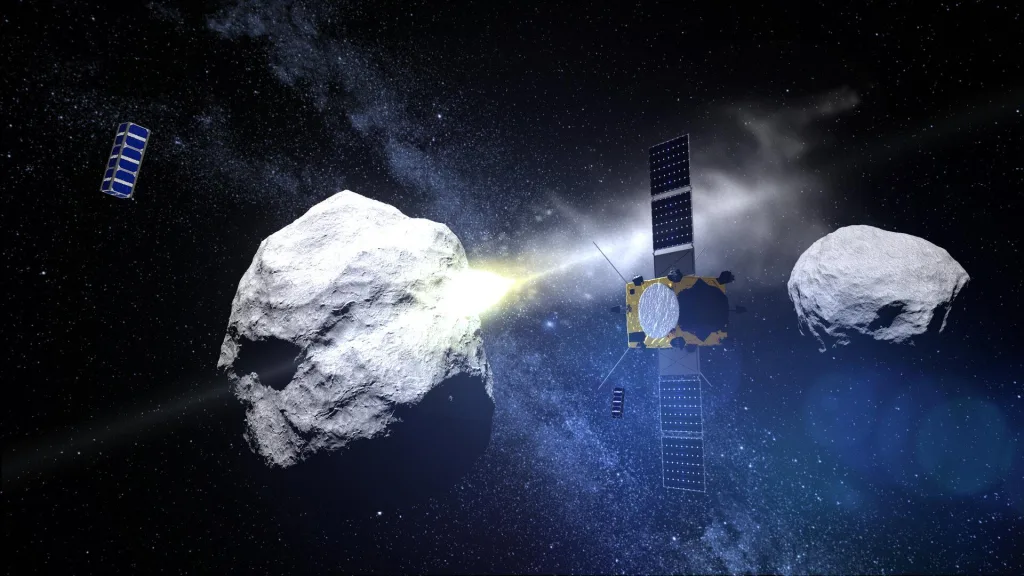
The Apophis EX mission aims to intercept the asteroid before its closest approach. It would collect data on its structure, rotation, and trajectory. The spacecraft would then continue tracking the object after it passes Earth.
This extended observation window could provide a complete picture of how close encounters affect asteroid behavior.
A Shift Toward Commercial Participation
Traditionally, deep-space missions have been led by government agencies such as NASA. However, planetary defense has received limited funding compared to other space priorities.
Private companies are beginning to fill this gap. Their involvement introduces faster development cycles and new funding models. This shift could make missions more frequent and more flexible.
Building a New Operational Model
The emerging model blends public oversight with commercial execution. Governments can define goals, while private firms develop and launch missions.
This approach encourages innovation and reduces costs. Over time, it could create a more responsive system for monitoring and studying near-Earth objects.
Planetary Defense in Focus During the Apophis Flyby
The Apophis 2029 asteroid flyby also brings renewed attention to planetary defense strategies. While the asteroid itself poses no danger, it highlights how complex real threats could be.
Experts such as Edward Lu stress that no single method can address every scenario. Each asteroid differs in size, composition, and trajectory.
Exploring Multiple Deflection Methods
Several approaches are under consideration. One option involves kinetic impact, where a spacecraft alters an asteroid’s path through direct contact. Another method uses a gravity-based approach, allowing a spacecraft to slowly shift the object’s trajectory over time.
More advanced concepts include ion beam techniques, which apply controlled force through charged particles. These ideas offer precision but require further development.
The Importance of Early Action
Timing remains the most critical factor. Small adjustments made years in advance can prevent large problems later. Without early detection, options become limited.
That is why missions like Apophis EX are so valuable. They provide real-world data that helps refine both detection and response strategies.
From Theory to Practice
Many of these methods have been studied extensively but tested only in limited scenarios. The current moment calls for practical validation. Frequent missions can build confidence and reduce uncertainty.
Global Attention Around the Apophis Encounter
Beyond science and engineering, the event is expected to capture global attention. The Apophis 2029 asteroid flyby could become one of the most widely observed space events in recent history.
A Shared Viewing Experience
Because the asteroid will be visible to the naked eye in certain regions, millions of people may witness the flyby directly. This level of visibility is rare for objects of this scale.
Expanding Public Engagement
Organizers are exploring ways to broadcast the event worldwide. Live coverage and large-format presentations could bring the experience to a global audience.
Such efforts can deepen public interest in space science. They can also highlight the importance of planetary defense in a clear and accessible way.
A Broader Shift in Planetary Defense Strategy
The significance of this event extends beyond a single flyby. It reflects a broader shift in how planetary defense is understood and prioritized.
Addressing Current Gaps
Detection systems continue to improve, yet some near-Earth objects remain difficult to track. Funding levels also limit the pace of development. These challenges require new approaches.
The Role of Innovation and Collaboration
Commercial participation introduces new capabilities. At the same time, international cooperation remains essential. Sharing data and resources improves overall readiness.
A Catalyst for Long-Term Change
Apophis is not a threat, but it highlights what is at stake. The lessons learned from this encounter can guide future planning. They can also help build a more coordinated and effective response system.
Conclusion: From Observation to Preparation
The Apophis 2029 asteroid flyby marks a transition in how humanity approaches near-Earth objects. It brings together scientific observation, commercial innovation, and public engagement in a single moment.
This convergence signals a move from passive observation to active preparation. While no immediate danger exists, the need for readiness is clear.
By the time Apophis passes Earth, the world will not simply be watching. It will be testing systems, refining strategies, and building the foundation for future planetary defense.
Main Sources:
- https://universemagazine.com/en/the-2029-asteroid-threat-how-the-world-is-preparing-for-apophiss-visit/
- https://www.esa.int
- https://www.nasa.gov
- https://www.spacefoundation.org