BY:SpaceEyeNews.
Introduction — A Turning Point in Circumbinary Planets Discovery
The latest circumbinary planets discovery marks a clear shift in how we understand planetary systems. Scientists have identified 27 new candidate worlds that orbit two stars instead of one. That alone changes the scale of what we thought was possible.
Until now, only about 18 such planets had been confirmed. This new set could more than double that number. The finding relies on precise space-based observations and a refined detection method.
For decades, two-star planets existed mainly in imagination. Now, they are becoming part of measured reality. This development does not just add more planets to a list. It challenges the way astronomers search, detect, and interpret planetary systems across the galaxy.
Circumbinary Planets Discovery and the Missing Planet Problem
Why Binary Systems Were Overlooked
Astronomers have confirmed thousands of exoplanets. Most orbit single stars. That pattern shaped early models of planetary systems. Yet more than half of stars exist in binary or multiple systems.
This mismatch created a gap. If binary stars are common, then planets around them should be common as well. The low count suggested a detection problem rather than a real absence.
Limits of Traditional Detection
The main method for finding planets depends on transits. A planet must pass in front of its star from Earth’s viewpoint. This alignment is rare. Many systems never line up in the right way.
Because of this limitation, large numbers of planets remain hidden. Circumbinary systems are even harder to detect due to their complex motion.
The recent circumbinary planets discovery addresses this bias directly. It points to a broader population that was simply difficult to observe.
How the New Circumbinary Planets Discovery Was Achieved
Tracking Timing Instead of Light Dips
Instead of relying only on brightness dips, scientists tracked the timing of stellar eclipses. In binary systems, stars pass in front of each other regularly. These events act like precise clocks.
When a hidden object influences the system, the timing shifts slightly. These shifts are small but measurable.
Apsidal Precession and Orbital Clues
Researchers used a technique based on orbital timing variations. Small changes in the stars’ motion can reveal the presence of another object. This method detects gravitational effects rather than direct light signals.
By studying these patterns, scientists can infer the existence of a third body even when it remains unseen.
From Data to Candidates
The team analyzed over a thousand binary systems. They isolated a smaller group that showed unusual timing behavior. After removing other explanations, 27 strong candidates remained.
Each candidate likely falls within a planetary mass range. However, confirmation requires further analysis. Scientists still need to determine whether these objects are planets, brown dwarfs, or faint stars.
A New Detection Path
This approach opens a new path for discovery. It allows astronomers to find planets that do not align with Earth’s line of sight. That alone expands the search field significantly.
The circumbinary planets discovery demonstrates that combining precision data with new methods can reveal systems once considered unreachable.
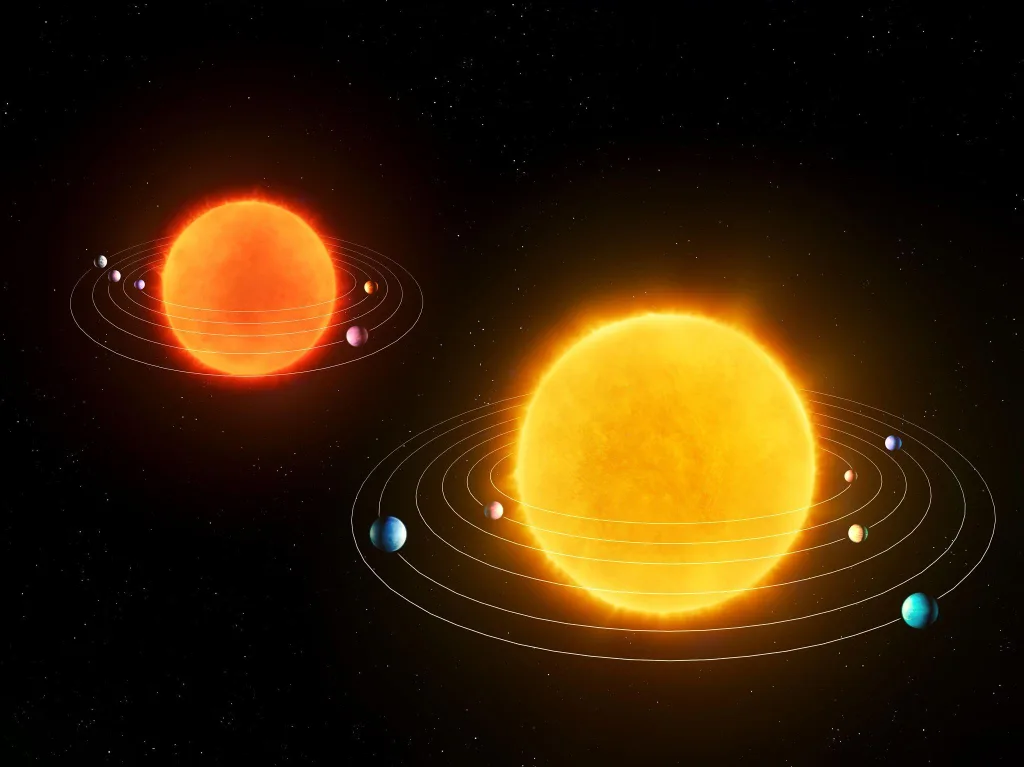
Double star system with planets in orbits.
Circumbinary Planets Discovery: Characteristics and Extremes
Massive Worlds and Gas Giants
Early estimates suggest that many of these candidates are large. Some resemble Neptune, while others may exceed Jupiter in mass. These are not small terrestrial planets.
Their size alone affects how they interact with their stars. Larger planets create stronger gravitational signatures, making them easier to detect through timing methods.
Complex Orbits in Dual-Star Systems
Two stars create a constantly shifting gravitational field. A planet must maintain a stable orbit within this environment. That stability depends on distance, mass, and orbital alignment.
Some planets orbit far from both stars, reducing instability. Others exist in tighter configurations, where gravitational forces interact more strongly.
Extreme and Variable Environments
Conditions on these worlds are likely intense. Two stars can produce fluctuating radiation levels. Light and heat may vary over time depending on orbital positions.
Such variation creates environments very different from Earth. Climate patterns, if present, would be highly dynamic.
Potential Stability Zones
Despite these extremes, stable regions can exist. In certain orbital ranges, energy input from both stars balances out. These zones may allow more moderate conditions.
Whether such regions can support long-term stability remains an open question. It depends on both orbital mechanics and stellar behavior.
Why This Circumbinary Planets Discovery Matters
Expanding the Exoplanet Landscape
This discovery increases the number of known candidates in a rare category. More importantly, it suggests that these systems may not be rare at all.
If binary stars commonly host planets, then the total number of planets in the galaxy may be higher than current estimates.
Rethinking Planet Formation Models
Most formation models focus on single-star systems. Binary systems introduce additional forces that affect how planets form and evolve.
The circumbinary planets discovery pushes scientists to refine these models. It shows that planets can form and remain stable even in complex environments.
Unlocking Hidden Systems
New detection techniques allow astronomers to move beyond traditional limits. By tracking timing variations, researchers can identify planets that do not produce visible transits.
This approach may reveal many more hidden systems in the coming years.
From Concept to Observation
Ideas once explored in fiction now appear in real data. Two-star planetary systems are no longer theoretical. They are measurable and increasingly observable.
This connection highlights how scientific progress often transforms abstract ideas into evidence-based understanding.
Conclusion — Circumbinary Planets Discovery Redefines What Is Possible
The latest circumbinary planets discovery reshapes our view of planetary systems. With 27 new candidates, the known population of such worlds could expand rapidly.
The method behind this discovery matters as much as the result. By focusing on orbital timing, scientists can detect planets that were previously invisible. This opens a broader window into the structure of the galaxy.
Confirmation will take time. Each candidate requires detailed measurement and classification. Some may turn out to be different types of objects.
Even so, the direction is clear. Planetary systems are more varied than once believed. Many may orbit more than one star.
This discovery does not just add new planets. It changes how we search for them—and how we understand the universe itself.
Main Sources:
- https://www.theguardian.com/science/2026/may/04/scientists-discover-27-potential-new-planets
- https://www.nasa.gov/mission_pages/tess/overview/index.html
- https://academic.oup.com/mnras (Monthly Notices of the Royal Astronomical Society)