BY:SpaceEyeNews.
Introduction — Phobos Destruction Enters a New Phase
The fate of Phobos is no longer a distant projection. It is a process already underway. For decades, scientists expected a clean breakup far in the future. Now, new modeling suggests something more complex. The timeline may be shorter. The process may be gradual. And the outcome could be far less predictable.
At the center of this shift is a simple idea. Phobos is not a solid body. It behaves more like a loose collection of material. That detail changes everything. It means Phobos destruction may begin earlier than expected and unfold in stages rather than a single event.
Orbital Decay Driving Phobos Destruction
A Shrinking Orbit Around Mars
Phobos circles Mars at an unusually close distance. It orbits faster than Mars rotates. This mismatch creates tidal forces that steadily drain orbital energy.
As a result, the moon moves inward with each cycle. The change is slow, but it is constant. There is no mechanism to stop it. This inward spiral sets the stage for long-term instability.
Why the Process Cannot Reverse
Most moons remain stable because they orbit far from their host planet. Phobos does not. Its position exposes it to continuous gravitational stress. Over time, that stress reshapes both its orbit and its structure.
This makes its eventual breakup unavoidable. The only uncertainty lies in how the process unfolds.
Mysterious grooves on Martian moon Phobos explained by impacts | ASU News
Rethinking Phobos Destruction Beyond the Roche Limit
The Traditional Model
For years, predictions focused on the Roche limit. According to this model, Phobos would remain intact until it crossed that boundary. At that point, tidal forces would exceed its structural strength.
The expected result was simple. The moon would fragment and form a ring around Mars.
A Structural Weakness Changes the Outcome
Recent studies challenge this view. Evidence suggests that Phobos has low internal cohesion. Instead of behaving like a solid object, it likely resembles a “rubble pile.”
This structure cannot withstand prolonged stress. Surface material begins to shift and detach earlier than predicted. Because of this, Phobos destruction may start well before the Roche limit is reached.
Stages of Phobos Destruction Unfolding
Initial Surface Loss
The first signs of breakdown appear at higher orbital distances than expected. At roughly 2.25 times the radius of Mars, surface grains begin to loosen. This stage marks the beginning of visible change.
Increasing Material Shedding
As the orbit shrinks, the rate of loss rises. Larger sections begin to separate between 2.15 and 2.13 Mars radii. The structure weakens further during this phase.
Rapid Destabilization
Closer to Mars, near 2.09 radii, the process accelerates. Significant streams of material detach. The internal balance of forces collapses. At this point, the moon becomes unstable.
Forces Acting on Both Sides
Material does not break away from one location alone. The side facing Mars experiences strong gravitational pull. At the same time, the far side is affected by outward forces linked to rotation. Together, these effects drive the fragmentation.
Self-Reinforcing Collapse in Phobos Destruction
Debris Remains in Orbit
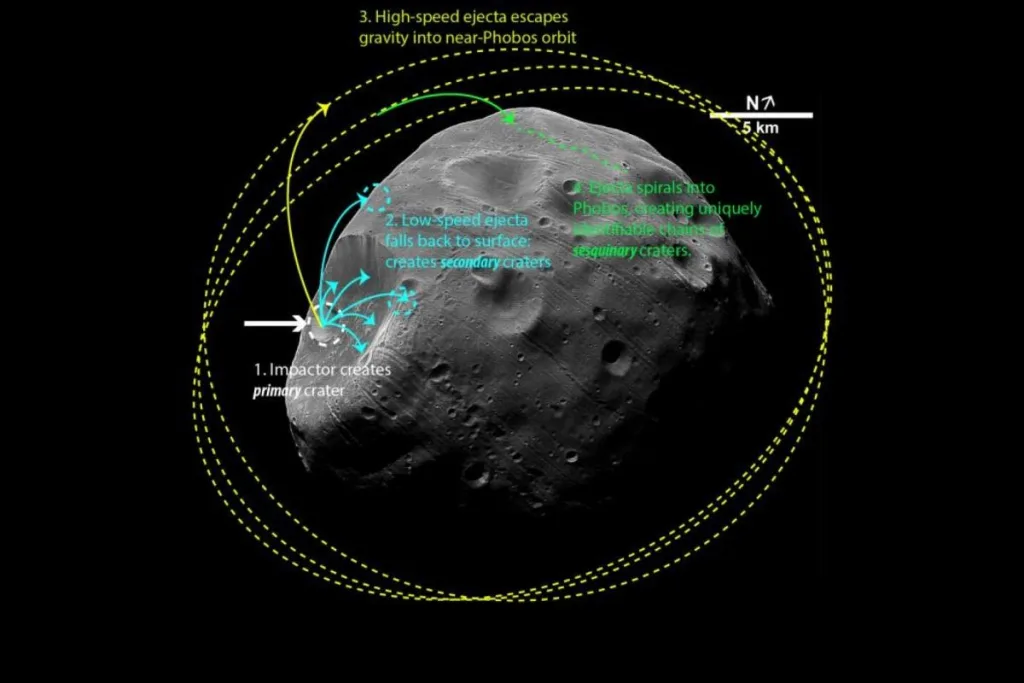
Material stripped from the surface does not disappear. It enters orbit around Mars and forms streams of debris. This adds a new layer of complexity to the process.
Returning Impacts Accelerate the Process
Over time, some of this debris intersects with Phobos again. These impacts release additional material and weaken the structure further.
A Feedback Loop of Fragmentation
Scientists describe this chain reaction as a “sesquinary catastrophe.” In simple terms, the moon begins to contribute to its own breakup. Each stage feeds the next.
This effect may speed up Phobos destruction. In certain scenarios, it could trigger an earlier and more complete collapse than older models suggested.
Aftermath of Phobos Destruction Around Mars
Formation of a Temporary Ring
In the near term, debris may organize into a thin ring system. Mars could briefly host a structure similar to those seen around other planets, though much smaller.
Long-Term Evolution of Debris
That ring will not remain stable. Several outcomes remain possible. Some material may drift inward and fall into Mars. Other fragments could spread outward over time. In some cases, new small moons might form from the remaining debris.
The final result depends on how these fragments interact over extended periods.
Why Phobos Destruction Matters Beyond Mars
A Shift in Understanding Small Moons
This research highlights the importance of internal structure. A weak, loosely bound body responds differently to tidal forces than a solid one.
Implications Across the Solar System
Many small moons share similar characteristics. The gradual disintegration seen in Phobos may not be unique. It could represent a broader pattern.
From Sudden Events to Gradual Processes
Older models emphasized sudden collapse. New findings suggest a more extended sequence. This shift changes how scientists model the evolution of planetary systems.
Testing the Future of Phobos Destruction
A Mission Built for Answers
The Martian Moons eXploration (MMX) mission will study Phobos up close. It will examine the surface, analyze composition, and return samples to Earth.
What Scientists Hope to Confirm
The mission aims to determine whether Phobos truly has a rubble-like structure. That detail will be critical in validating current models.
Refining Predictions
If the structure matches expectations, the staged destruction model gains strong support. If not, scientists will need to adjust their understanding again.
Conclusion — Phobos Destruction Is Already in Motion
The story of Phobos destruction has entered a new stage. The inward spiral toward Mars continues. What has changed is the expected path to its end.
Rather than a single dramatic breakup, the process may unfold gradually. Surface material may peel away in phases. Debris may return and accelerate the collapse. Each step adds complexity to what once seemed like a simple outcome.
This evolving picture does more than redefine the fate of one moon. It reshapes how scientists understand the life cycle of small bodies across the Solar System. Mars may one day gain a ring, but that transformation will begin with a slow and intricate unraveling already in progress.
Main Sources:
- https://www.skyatnightmagazine.com/news/mars-tear-phobos-apart-could-happen-sooner
- https://solarsystem.nasa.gov/moons/mars-moons/phobos/in-depth/
- https://www.esa.int/Science_Exploration/Space_Science/Mars_Express
- https://mmx.isas.jaxa.jp/en/