
BY:SpaceEyeNews.
Introduction: A New Insight Into Cosmic Ray Acceleration
The latest cosmic ray acceleration discovery is reshaping how scientists view high-energy space particles. New observations from the Dark Matter Particle Explorer reveal that cosmic rays do not gain energy without limit. Instead, they reach a precise threshold tied to their electric charge.
This result confirms a long-standing prediction and introduces a more structured view of particle acceleration. It also hints at a powerful source influencing the particles that reach Earth. Scientists can detect its effects, but its exact identity remains uncertain.
Cosmic Ray Energy Limits: What the Discovery Shows
A Sharp Cutoff Across Particle Types
Researchers examined years of high-precision data covering multiple particle types, including protons, helium, carbon, oxygen, and iron. Each group followed a similar trend as energy increased. Then, at a specific point, the number of particles dropped sharply.
This cutoff appeared suddenly and consistently. It was not gradual, and it did not vary randomly between particle types. Such a pattern signals a controlled process rather than a scattered one.
Charge, Not Mass, Sets the Boundary
Further analysis revealed the key factor behind this limit. The maximum energy depends on electric charge, not mass. Particles with higher charge reach higher energy levels, while those with lower charge stop earlier.
This relationship confirms a theoretical model first proposed in 1961. For decades, it remained unverified due to limited measurement precision. With modern data, scientists have now confirmed it directly.
Why This Pattern Matters
This cosmic ray acceleration discovery introduces a clear rule into a field that once seemed unpredictable. Instead of random behavior, cosmic rays now show structured limits governed by physical properties.
That shift improves how scientists model particle acceleration and propagation. It also strengthens confidence in existing theoretical frameworks.
A Nearby Cosmic Accelerator: Interpreting the Evidence
Clues Point to a Powerful Local Source
The discovery suggests that a natural particle accelerator is shaping these energy limits. This is not a human-built system. It is a large-scale astrophysical environment capable of accelerating particles to extreme energies.
Based on current data, the source appears to be about 1,000 light-years from Earth. In galactic terms, that distance is relatively close.
Position Within the Milky Way
The likely source is not located near the center of the Milky Way. Instead, it lies in a more distant region from the core. This detail challenges earlier assumptions that the most energetic processes occur primarily in central zones.
It shows that strong acceleration can also happen in less crowded regions of the galaxy.
Possible Astrophysical Candidates
Several types of objects could act as this accelerator:
- Supernova remnants with expanding shock fronts
- Pulsars with intense magnetic fields
- Neutron stars with concentrated energy output
Each of these environments can generate the conditions needed to accelerate particles to high energies.
Why the Source Remains Unidentified
Although the evidence is strong, the exact source has not been directly observed. Scientists infer its presence from particle behavior rather than direct imaging.
This indirect detection highlights both the strength and limits of current observations. It also points to the need for further study.
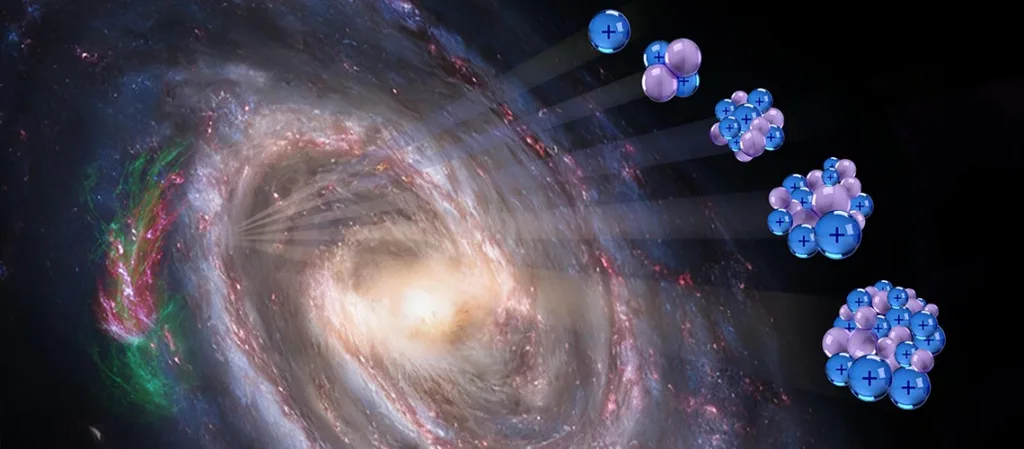
DAMPE Satellite Sheds Light On Origin Of Cosmic Rays.
Implications for Astrophysics and Cosmic Ray Research
From Uncertainty to Structure
The cosmic ray acceleration discovery marks a shift from uncertainty toward structured understanding. Cosmic rays no longer appear entirely random. Instead, they follow measurable rules tied to physical characteristics.
This allows researchers to build more accurate models of how particles gain energy and move through space.
Refining the Origin of Cosmic Rays
Identifying energy limits helps narrow down where cosmic rays come from. It suggests that nearby sources may contribute more than previously thought.
This insight improves predictions about particle pathways and interactions across the galaxy.
Using Cosmic Rays as Probes
Cosmic rays act as carriers of information from distant environments. By analyzing their properties, scientists can learn about regions that are otherwise difficult to observe.
The new findings provide a clearer framework for interpreting this information.
Relevance to Dark Matter Studies
A better understanding of cosmic rays also benefits the search for dark matter. By reducing uncertainty in background signals, scientists can identify subtle patterns more effectively.
This supports future research aimed at uncovering new physics beyond current models.
Looking Ahead: What Comes Next
Continued Data Collection
The DAMPE mission continues to gather data. Over time, this will refine measurements and improve accuracy. Scientists expect to identify more detailed patterns as datasets grow.
Search for the Source
Locating the exact accelerator remains a key goal. Combining different observation methods may help pinpoint its origin.
A confirmed source would provide direct insight into one of the most powerful processes in space.
Advancing Theoretical Models
The discovery will guide updates to existing models in astrophysics. Researchers will incorporate these findings into simulations of high-energy environments.
This will improve understanding of how energy is transferred and distributed across space.
Conclusion: A Turning Point in Cosmic Ray Research
The cosmic ray acceleration discovery represents a major step forward in understanding the universe. It confirms that particle acceleration follows clear physical rules and reveals the influence of a nearby cosmic source.
While the exact origin remains unknown, the evidence points to a structured and dynamic environment shaping high-energy particles. As research continues, scientists move closer to identifying this source and unlocking deeper insights into space.