
BY:SpaceEyeNews.
The ESA Aphelion game is changing how people experience space exploration. For the first time, the European Space Agency officially partnered with a video game studio to create a science-fiction adventure built around real space science. Instead of focusing only on cinematic action, the project aims to recreate the feeling of genuine exploration at the edge of the solar system.
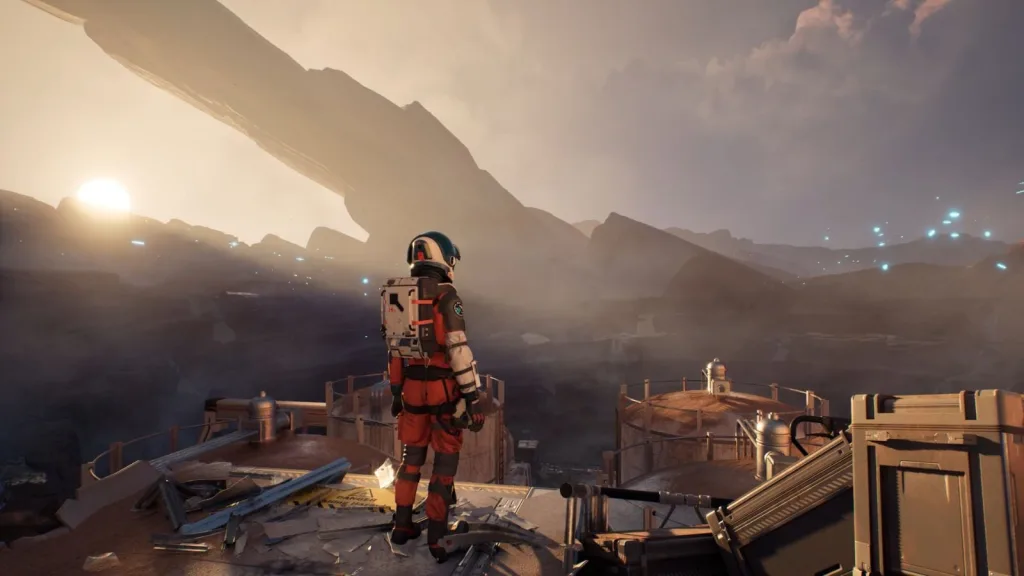
The game, called Aphelion, places players inside the fictional Hope-01 mission. Two ESA astronauts travel toward a mysterious planet named Persephone. While the planet itself does not exist, its design draws inspiration from real scientific discussions surrounding the possible Planet Nine hypothesis.
The collaboration marks a major shift for ESA. The agency is no longer relying only on documentaries, press releases, and classroom programs. Through the ESA Aphelion game, space science now enters interactive entertainment in a far more immersive way.
The project also reflects a larger trend in the space industry. Agencies increasingly seek new ways to connect with younger audiences. Gaming offers one of the strongest tools for that mission.
ESA Aphelion Game Creates a Realistic Space Mission
The ESA Aphelion game launched on April 28, 2026, for PC, PlayStation 5, and Xbox Series X/S. The game was developed by the French studio DON’T NOD Entertainment in direct collaboration with ESA specialists.
Players control astronauts Ariane Montclair and Thomas Cross during the Hope-01 expedition. Their mission takes them far beyond the familiar planets of the inner solar system. They travel toward Persephone, a distant and mysterious world located near the outer edge of the Sun’s gravitational influence.
ESA Scientists Helped Shape the Game
Unlike most science-fiction titles, the ESA Aphelion game involved real scientists and engineers during development. ESA experts advised the studio on multiple technical areas.
These included:
- realistic space physics
- spacecraft procedures
- astronaut terminology
- mission operations
- scientific instruments
- sound behavior in space environments
That level of involvement helped the game avoid many traditional science-fiction clichés. Instead of exaggerated fantasy technology, Aphelion attempts to reflect what future ESA missions could realistically resemble.
ESA astronauts also contributed ideas to improve the realism of crew interactions and mission behavior. The developers wanted the astronauts to feel authentic rather than fictional movie heroes.
The Hope-01 Mission Extends Beyond the Game
ESA expanded the fictional mission outside the game itself. The agency created a dedicated Hope-01 webpage and even designed an official-style mission patch.
That approach mirrors how ESA presents real missions to the public. The goal was simple: make the fictional expedition feel believable.
The strategy also creates stronger emotional engagement. Players do not simply watch a space mission unfold. They feel connected to it.
The Fictional Planet Draws From Real Planet Nine Science
The ESA Aphelion game does not claim that scientists discovered a real ninth planet. Persephone remains entirely fictional. However, the game draws clear inspiration from one of astronomy’s most debated ideas: Planet Nine.
What Is Planet Nine?
Planet Nine is a hypothetical world believed to exist far beyond Neptune. Astronomers proposed the idea after observing unusual orbital patterns among distant Kuiper Belt objects.
Several researchers believe a massive hidden planet could explain those strange movements. Yet no telescope has confirmed its existence.
The theory continues to attract major scientific interest because it could reshape our understanding of the solar system’s structure.
Persephone Reflects Modern Astronomy
The fictional world inside the ESA Aphelion game uses many concepts inspired by real planetary science. Developers wanted Persephone to feel scientifically plausible.
Its environment, orbit, and isolation all resemble how scientists imagine distant icy planets in the outer solar system.
That scientific grounding gives the game a very different atmosphere from older space adventures. Many classic sci-fi games focused mainly on fantasy technology or alien conflict. Aphelion instead emphasizes exploration, uncertainty, and survival in extreme environments.
Why Scientific Accuracy Matters
Scientific realism helps audiences connect more deeply with space exploration. Viewers and players increasingly expect believable science in modern entertainment.
Films like Interstellar showed how realistic astrophysics can strengthen storytelling rather than limit it. The ESA Aphelion game follows a similar philosophy.
By using authentic terminology and realistic mission design, the game makes deep-space exploration feel possible rather than imaginary.
That emotional realism may become one of the project’s biggest achievements.
ESA Aphelion Game Targets a New Generation
The ESA Aphelion game serves a larger purpose beyond entertainment. ESA views the project as a powerful outreach tool.
The agency plans to announce more than 400 job openings during 2026. Those positions will include engineers, researchers, software specialists, and mission experts.
Gaming now offers a direct path to inspire future applicants.
Gaming Reaches Audiences Traditional Media Misses
Space agencies face increasing competition for public attention. Younger audiences spend far more time inside interactive digital platforms than traditional television broadcasts.
ESA understands that shift clearly.
Instead of waiting for audiences to discover space science, the agency is bringing space science directly into modern entertainment.
The ESA Aphelion game creates a bridge between education and storytelling. Players absorb scientific ideas naturally while exploring the fictional mission.
That strategy may prove more effective than traditional outreach campaigns.
ESA’s Strategy to 2040 Appears Inside the Game
The project also aligns with ESA’s Strategy 2040 goals. Those plans focus heavily on:
- sustainability
- climate awareness
- future technologies
- long-term exploration
- scientific cooperation
The game reflects many of those themes through its story and environmental design.
ESA hopes the project encourages players to think about humanity’s future beyond Earth. At the same time, it promotes interest in science and engineering careers.
Interactive Storytelling Is Becoming Essential
Modern audiences want participation. Passive viewing no longer dominates entertainment.
The ESA Aphelion game demonstrates how interactive storytelling can make science more memorable. Players actively experience the challenges of exploration rather than simply reading about them.
That difference matters.
A strong emotional connection often inspires long-term curiosity. ESA appears to recognize that reality very well.
Could Space Agencies Use More Games in the Future?
The ESA Aphelion game could become the beginning of a much larger trend.
Space agencies already use advanced simulations for astronaut preparation and mission planning. Gaming technology continues to improve those systems every year.
The gap between simulation tools and entertainment software is shrinking quickly.
Games Already Influence Real Aerospace Technology
Modern game engines now help engineers visualize spacecraft systems and planetary environments. Some training simulations even borrow technology originally designed for gaming.
As virtual reality improves, future outreach projects could become even more immersive.
Players may eventually explore accurate digital versions of:
- the Moon
- Mars
- Europa
- Titan
- asteroid bases
- future orbital stations
ESA’s collaboration with DON’T NOD may represent an early step toward that future.
Public Engagement Could Shape Future Missions
Public excitement often influences political and financial support for major missions. Space agencies understand that public enthusiasm matters.
Interactive experiences create stronger emotional investment than simple news updates.
If projects like the ESA Aphelion game succeed, more agencies could adopt similar strategies. Future missions may include interactive educational platforms from the beginning.
That possibility could reshape how the public experiences space exploration over the next decade.
ESA Aphelion Game Opens a New Era for Space Storytelling
The ESA Aphelion game is not about revealing a real ninth planet. Instead, it represents something potentially more important: a new way to communicate science.
ESA and DON’T NOD Entertainment created a project that blends real astrophysics with interactive storytelling. The result feels more grounded than traditional science fiction while still capturing the mystery of deep space.
The project also shows how space agencies are adapting to modern audiences. Exploration no longer exists only inside laboratories or press conferences. It now appears inside immersive digital worlds that millions of people can experience directly.
If the ESA Aphelion game succeeds, it may influence how future generations first connect with space science. For some players, a fictional mission to Persephone could become the spark that inspires a real career in space exploration.
Main Sources:
ESA official announcement:
https://www.esa.int
Universe Magazine article:
https://universemagazine.com/en/ninth-planet-revealed-to-the-world/
DON’T NOD Entertainment official website:
https://dont-nod.com/