
BY:SpaceEyeNews.
For years, scientists watched a strange atmospheric structure move across Venus without understanding what caused it. The massive feature stretched nearly 6,000 kilometers across the planet’s equator. It appeared inside Venus’ thick cloud layers and behaved unlike anything seen on Earth.
Now, researchers finally believe they have solved the mystery.
A new study published in the Journal of Geophysical Research: Planets suggests the enormous disturbance comes from a gigantic atmospheric phenomenon called a Venus hydraulic jump. According to scientists, this may be the largest hydraulic jump ever discovered anywhere in the Solar System.
The breakthrough could change how researchers understand Venus’ atmosphere. It may also help explain one of the planet’s biggest mysteries: why Venus’ atmosphere rotates dramatically faster than the planet itself.
The Giant Venus Wave That Confused Scientists
A Strange Structure Hidden Inside Venus’ Clouds
Scientists first detected the enormous wave using images from Akatsuki, Japan’s Venus exploration spacecraft. The mission captured unusual dark cloud patterns moving through the lower cloud layers near the equator.
The feature extended almost 6,000 kilometers across the atmosphere. Yet despite years of study, researchers could not explain how it formed.
Unlike Earth, Venus has an extremely hostile atmosphere. Thick carbon dioxide clouds trap heat across the planet. Surface temperatures exceed 460 degrees Celsius. Meanwhile, sulfuric acid clouds dominate the upper atmosphere.
These extreme conditions create weather systems unlike anything seen on Earth.
Scientists already knew Venus had unusual atmospheric circulation. However, the giant wave did not match existing climate models.
Why Older Models Failed
Previous Venus simulations used global circulation models similar to those developed for Earth. Those models successfully explained some atmospheric motions. Still, they failed to reproduce the giant equatorial wave.
The lower and middle cloud layers remained poorly understood.
Researchers knew something unusual was happening deep inside Venus’ atmosphere. Yet they lacked the physics needed to explain the observations.
That changed when scientists began investigating the possibility of a Venus hydraulic jump.
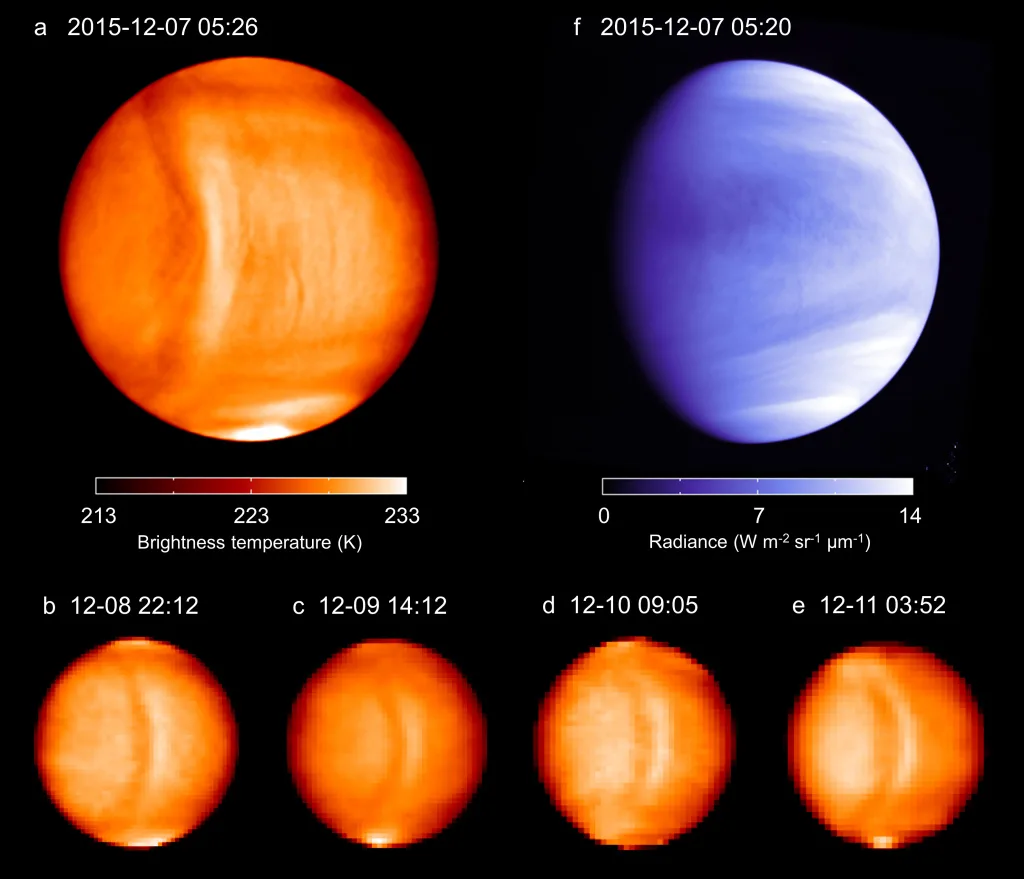
Giant Mystery Wave Spotted in Atmosphere of Venus.
What Is a Venus Hydraulic Jump?
A Massive Atmospheric Flow Disruption
A hydraulic jump happens when a fast-moving fluid suddenly slows down and changes behavior.
A simple example appears in a kitchen sink. Water falls quickly from a faucet. Then it suddenly spreads outward into a slower and wider flow pattern.
On Venus, researchers discovered a similar process happening inside the atmosphere itself.
As powerful atmospheric winds move eastward through the lower cloud layers, they eventually become unstable. Wind speeds rapidly decrease. This sudden slowdown creates a strong upward atmospheric motion.
The Venus hydraulic jump then pushes sulfuric acid vapor high into the atmosphere. Clouds form behind the disturbance, producing the massive wave observed from orbit.
Scientists believe this process creates the giant atmospheric structure visible across Venus’ equator.
The Largest Hydraulic Jump Ever Observed
The research team was led by Professor Takeshi Imamura from the University of Tokyo.
Using advanced fluid dynamics simulations, the team recreated the atmospheric conditions surrounding the wave. Researchers also used microphysical box models and high-powered computer calculations.
For the first time, the simulations reproduced the strange cloud disruption seen by Akatsuki.
Professor Imamura described the discovery as unexpected because it connects massive horizontal atmospheric motion with localized vertical processes. In fluid dynamics, those systems usually remain separate.
The Venus hydraulic jump therefore represents a rare planetary-scale atmospheric interaction.
Venus Superrotation May Finally Be Explained
The Atmosphere Moves Faster Than Venus Itself
Venus rotates very slowly. One full rotation takes longer than an entire Venusian year.
Yet the atmosphere behaves very differently.
High-altitude winds circle the planet in only a few Earth days. Scientists call this phenomenon superrotation. In some regions, atmospheric winds move roughly 60 times faster than the planet’s surface rotation.
For decades, researchers struggled to explain how Venus maintained this extreme atmospheric speed.
The newly discovered Venus hydraulic jump may finally provide an answer.
How the Hydraulic Jump Transfers Energy
According to the new study, the atmospheric wave may help transport momentum and energy through Venus’ atmosphere.
As the Venus hydraulic jump forms, vertical motions interact with large-scale atmospheric circulation. This interaction could help sustain the planet’s superrotation over long periods.
If confirmed, the discovery would solve one of planetary science’s longest-running atmospheric puzzles.
It would also improve global climate models for Venus.
Scientists believe the finding may help researchers better understand atmospheric circulation on rocky exoplanets as well.
Why This Discovery Matters Beyond Venus
The Venus hydraulic jump does more than explain one strange cloud feature.
It also demonstrates how extreme planetary atmospheres behave under conditions very different from Earth.
Many rocky exoplanets orbit close to their stars. Those worlds may experience dense atmospheres, powerful winds, and intense thermal conditions similar to Venus.
Understanding Venus therefore helps scientists build better planetary climate models for distant worlds.
The discovery may also improve future atmospheric simulations used in planetary exploration.
Future Venus Missions Could Reveal More Secrets
Venus Research Is Entering a New Era
For many years, Mars dominated planetary exploration. Venus received far less attention because of its harsh environment.
That situation is changing quickly.
Scientists now view Venus as one of the most important laboratories for studying extreme climate systems and atmospheric evolution.
Several upcoming missions aim to explore the planet in greater detail.
NASA’s DAVINCI mission plans to study Venus’ atmosphere directly. Meanwhile, VERITAS will map the planet’s surface and geology. Europe’s EnVision mission will also investigate atmospheric and geological processes.
These missions may provide new insights into the Venus hydraulic jump and its connection to superrotation.
Supercomputers Will Play a Critical Role
Modeling Venus’ atmosphere requires enormous computing power.
The planet’s cloud systems involve complicated interactions between temperature, chemistry, pressure, and atmospheric flow. Researchers say future simulations must include even more detailed physics.
That means scientists will depend heavily on advanced supercomputers during future studies.
As computing improves, researchers hope to simulate Venus’ atmosphere with far greater accuracy.
Those models could eventually reveal additional hidden atmospheric structures across the planet.
Venus Still Holds Many Mysteries
The discovery of the Venus hydraulic jump shows how much scientists still have to learn about Earth’s closest planetary neighbor.
For decades, the giant atmospheric wave remained unexplained. Now researchers believe they have identified a completely new large-scale atmospheric process operating inside Venus’ cloud layers.
The finding also highlights how dynamic Venus truly is.
Instead of being a static world hidden beneath thick clouds, Venus appears filled with powerful atmospheric interactions occurring on enormous scales.
And if one strange cloud wave led scientists to discover the largest hydraulic jump in the Solar System, many researchers now wonder what other hidden phenomena still remain inside Venus’ toxic atmosphere.
Main Sources:
Daily Galaxy
https://dailygalaxy.com/2026/05/6000-kilometer-wave-venus-explained/
Journal of Geophysical Research: Planets
https://agupubs.onlinelibrary.wiley.com/journal/21699100
University of Tokyo
https://www.u-tokyo.ac.jp/en/
JAXA Akatsuki Mission
https://global.jaxa.jp/projects/sat/planet_c/