
BY:SpaceEyeNews.
Astronomers have discovered a rare non-rotating galaxy in the early universe, and the finding is already raising major questions about how giant galaxies evolved after the Big Bang. Using observations from the James Webb Space Telescope, researchers identified galaxy XMM-VID1-2075, a massive system that appears to have almost no spin at all.
That alone makes the discovery unusual. Nearly every known galaxy rotates in some way. Spiral galaxies spin clearly, while elliptical galaxies often show more subtle motion. Rotation is considered one of the most natural outcomes of galaxy formation. Yet this newly observed system seems to break that expectation entirely.
Even more surprising, astronomers are seeing the galaxy as it existed only around two billion years after the Big Bang. Scientists expected galaxies from that era to remain highly dynamic and rich in rotational motion. Instead, this object appears strangely motionless.
Researchers now believe an extremely rare galactic merger may explain how this massive galaxy lost almost all of its spin so early in cosmic history.
Why Galaxies Normally Spin
A non-rotating galaxy sounds almost impossible because rotation is deeply connected to how galaxies form in the first place.
Shortly after the Big Bang, gas, dark matter, and cosmic material began collapsing under gravity. As these giant clouds contracted, they developed angular momentum. That motion eventually produced rotating galaxies filled with stars, gas, and dust.
The process works similarly to a spinning ice skater pulling in their arms. As material collapses inward, rotational speed increases naturally. Over billions of years, that motion shapes the structure of galaxies across the universe.
That is why spiral galaxies such as the Milky Way display clear rotational patterns. Their stars orbit the galactic center in organized motion. Even giant elliptical galaxies usually preserve some amount of spin.
Because of this, astronomers pay close attention whenever they discover a galaxy with weak rotation.
Old Galaxies Sometimes Lose Their Spin
Scientists have previously identified galaxies with very little rotation. However, those systems shared several important characteristics.
Most were:
- extremely old
- very massive
- located relatively close to Earth
- shaped by repeated galaxy mergers over billions of years
Over long timescales, gravitational interactions can disrupt rotational motion. Large mergers may scatter stars into chaotic orbits instead of smooth circular paths.
That explanation makes sense for ancient galaxies in the nearby universe.
But XMM-VID1-2075 is different.
This newly discovered non-rotating galaxy existed during a much earlier stage of cosmic evolution. At that time, galaxies were still actively forming and growing. Astronomers expected them to maintain strong rotational motion rather than lose it.
That contradiction immediately turned the discovery into a scientific mystery.
Inside the Non-Rotating Galaxy XMM-VID1-2075
The galaxy XMM-VID1-2075 sits so far from Earth that its light traveled for billions of years before reaching us. As a result, astronomers observe it as it appeared roughly two billion years after the Big Bang.
That period represents one of the most active eras in galaxy formation.
Massive galaxies were rapidly building stars. Cosmic mergers happened frequently. Huge reservoirs of gas fueled energetic galactic growth throughout the young universe.
Researchers expected galaxies from this epoch to display significant motion and rotation. Instead, JWST observations revealed something completely unexpected.
How JWST Detected the Missing Rotation
The James Webb Space Telescope allowed scientists to examine the internal stellar movement inside XMM-VID1-2075 with remarkable precision.
Normally, astronomers can detect rotation by observing how stars move across a galaxy. One side shifts slightly toward observers while the opposite side shifts away. That creates a clear rotational signature.
XMM-VID1-2075 showed almost none of that behavior.
Instead, the stars appeared to move in random or chaotic directions. Organized rotational motion barely existed at all.
The discovery shocked researchers because galaxies this massive usually preserve angular momentum very effectively.
One of the Largest Galaxies of Its Era
Another detail deepened the mystery.
Scientists determined that XMM-VID1-2075 is one of the most massive galaxies yet observed from this early period of the universe.
That matters because giant galaxies tend to retain rotational motion even during periods of rapid growth.
Large systems possess enormous gravitational stability. Losing rotational momentum on such a scale is difficult under normal conditions.
Yet this massive non-rotating galaxy somehow evolved into a nearly motionless structure while the universe itself remained relatively young.
Researchers quickly began searching for similar galaxies from the same era.
Astronomers Found More Slow-Spinning Galaxies
The team identified two additional giant galaxies with similarly weak rotational behavior.
All three systems shared important similarities:
- very large mass
- early-universe origins
- chaotic stellar motion
- extremely weak spin
That pattern suggested a larger explanation was hiding behind the observations.
Scientists soon focused on one rare but powerful possibility.
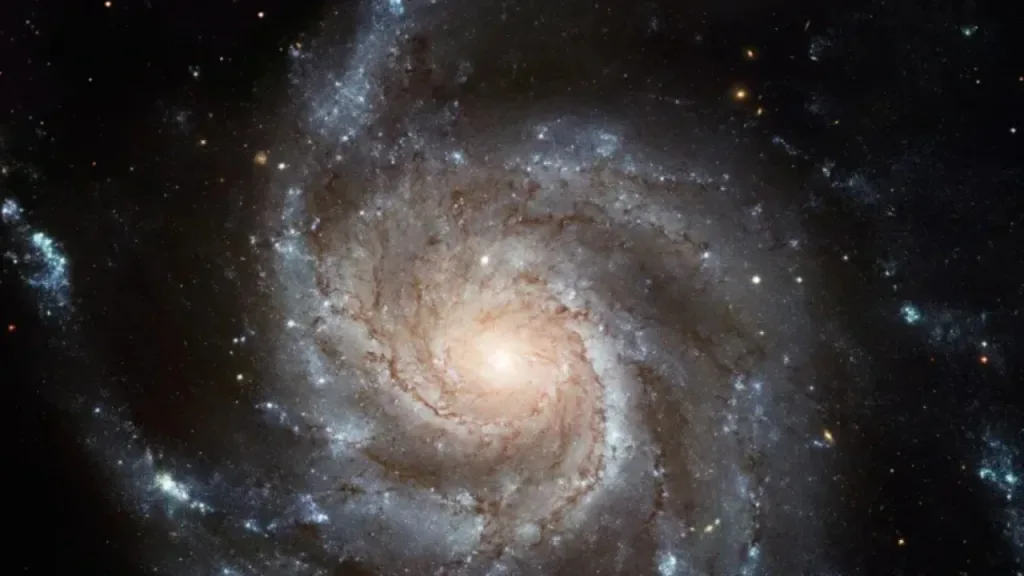
The Rare Cosmic Collision That May Explain Everything
Researchers now believe the strange behavior of this non-rotating galaxy likely resulted from an unusual galactic merger.
According to their leading theory, two large galaxies rotating in opposite directions collided and combined long ago.
The idea sounds simple, but the physics behind it is extraordinary.
When Opposite Rotations Cancel Out
Imagine two spinning wheels moving toward each other.
If both rotate at nearly equal speed but in opposite directions, their motion can partially cancel after impact.
Astronomers think something similar happened with XMM-VID1-2075.
Two massive rotating galaxies may have merged together while carrying nearly identical angular momentum in opposite directions. As the systems combined, much of their overall spin disappeared.
The merger likely scattered stars into random orbital paths rather than preserving organized galactic rotation.
That scenario could explain why astronomers observe chaotic stellar movement instead of clear spin.
A Rare Event in Cosmic History
Scientists believe this type of merger is extremely uncommon.
Galaxies collide frequently across the universe, but the conditions required to erase rotation almost perfectly are far more specific.
The two merging systems would need:
- similar mass
- opposite rotational directions
- comparable rotational strength
- precise merger geometry
Even slight differences could preserve at least some remaining spin.
That rarity explains why astronomers have discovered so few examples of massive non-rotating galaxies.
What This Means for Galaxy Evolution
The discovery could reshape how astronomers think about galaxy evolution during the early universe.
For years, many models assumed giant galaxies gradually lost rotational motion over long cosmic timescales. XMM-VID1-2075 suggests some galaxies may have transformed much faster.
Instead of evolving slowly, certain massive systems may have experienced dramatic structural changes through rare early mergers.
That possibility matters because galaxy rotation influences:
- star formation
- galactic structure
- black hole growth
- long-term evolution
If early galaxies evolved more violently than expected, astronomers may need to refine existing models of cosmic development.
JWST Continues Revealing Unexpected Structures
This discovery also highlights the growing scientific impact of the James Webb Space Telescope.
Since beginning operations, JWST has repeatedly uncovered objects that challenge earlier assumptions about the young universe.
The telescope has revealed:
- unexpectedly mature early galaxies
- giant structures forming sooner than predicted
- unusual black hole activity
- complex galactic environments
Now, the discovery of a massive non-rotating galaxy adds another surprising piece to the puzzle.
Importantly, astronomers are not saying current physics is wrong. Instead, these observations show the universe may have evolved in more diverse and chaotic ways than scientists previously understood.
A Non-Rotating Galaxy That Rewrote Expectations
The discovery of XMM-VID1-2075 may become one of the most important galaxy evolution findings of recent years.
Astronomers expected early galaxies to spin rapidly while building mass across the young universe. Instead, this giant system appears to have lost almost all rotational motion surprisingly early in cosmic history.
The leading explanation points toward a rare merger between two galaxies rotating in opposite directions. If confirmed, the event would demonstrate how dramatically galactic collisions can reshape massive cosmic structures.
More importantly, the finding shows how much remains unknown about the early universe.
As the James Webb Space Telescope continues exploring deeper regions of space, astronomers will likely uncover even more galaxies that challenge long-standing assumptions.
For now, XMM-VID1-2075 stands as a reminder that the universe still holds structures scientists never expected to see.
Main Sources:
Universe Magazine:
https://universemagazine.com/en/scientists-discover-a-galaxy-without-rotation/
Nature Astronomy:
https://www.nature.com/natastron/
James Webb Space Telescope Official Site:
https://webb.nasa.gov/
Space Daily coverage:
https://www.spacedaily.com/
ScienceDaily coverage:
https://www.sciencedaily.com/