
BY:SpaceEyeNews.
For decades, astronomers believed the universe was organized like a gigantic invisible network. Galaxies were not randomly scattered through space. Instead, they appeared to gather along enormous filaments separated by giant empty voids. Now, the clearest Cosmic Web Map ever created has finally revealed this hidden structure in extraordinary detail.
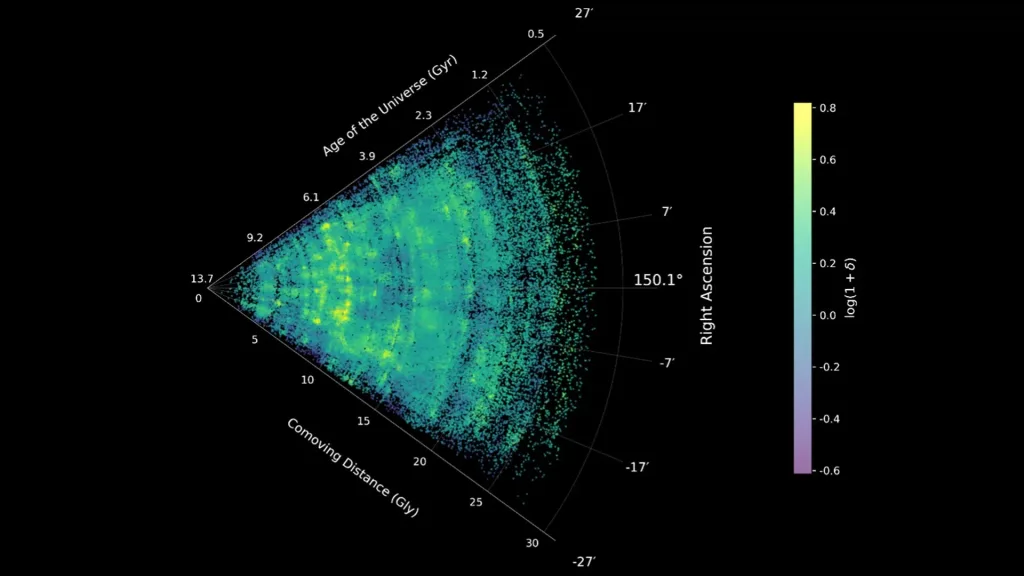
Using the James Webb Space Telescope, astronomers mapped more than 164,000 galaxies across nearly the entire history of the universe. The discovery comes from the COSMOS-Web survey, currently the largest observing program conducted with JWST.
The new Cosmic Web Map reaches back to a time when the universe was only about one billion years old. Scientists say the result offers humanity one of its sharpest looks yet at the hidden architecture shaping galaxies across cosmic time.
Researchers from the University of California, Riverside led the study, which was published in The Astrophysical Journal.
The Cosmic Web Map Finally Comes Into Focus
Astronomers have studied hints of the cosmic web for years. Earlier telescopes detected portions of this enormous structure. However, many regions appeared blurry or incomplete.
The new Cosmic Web Map changes that completely.
JWST’s infrared instruments captured faint galaxies that previous observatories could barely detect. As a result, scientists could separate structures that once appeared merged together.
Bright regions inside the map reveal dense galaxy clusters and long filaments stretching across space. Darker regions show massive cosmic voids where very few galaxies exist.
The scale is enormous.
The map spans nearly 14 billion years of cosmic history. It essentially allows astronomers to observe how the universe evolved from its early stages to the present day.
A Hidden Framework Across the Universe
The cosmic web acts like the universe’s invisible skeleton. Galaxies gather along filaments filled with dark matter and gas. Those filaments connect giant clusters across unimaginable distances.
Meanwhile, enormous empty voids separate these structures.
Scientists believe dark matter plays a major role in shaping this framework. Although dark matter cannot be observed directly, its gravitational influence helps organize galaxies into these giant patterns.
That makes the Cosmic Web Map especially important for cosmology.
Instead of only observing isolated galaxies, astronomers can now study how galaxies evolve inside a larger cosmic environment.
Why Earlier Maps Were Limited
Previous observations from the Hubble Space Telescope provided valuable information. Still, many distant structures remained difficult to resolve.
JWST dramatically improved both sensitivity and resolution.
According to researchers, structures that once looked like single formations now appear as multiple separate components. Fine details hidden for years have finally become visible.
The difference is similar to switching from a blurry photograph to ultra-high-definition imaging.
That leap in clarity is one reason this Cosmic Web Map represents such a major breakthrough.
How JWST Built the Cosmic Web Map
The success of the Cosmic Web Map depended heavily on JWST’s infrared technology.
Unlike visible-light telescopes, JWST can detect faint infrared signals from extremely distant galaxies. Those galaxies formed billions of years ago, shortly after the universe emerged from its earliest stages.
Because light takes time to travel, observing distant galaxies also means looking backward in time.
That capability allowed scientists to trace the cosmic web deep into the early universe.
The Power of the COSMOS-Web Survey
The COSMOS-Web survey became the largest General Observer program selected for JWST.
Researchers designed the project specifically to map large-scale cosmic structures. The survey covered a region of sky roughly equal to three full moons.
Although that sounds small, the survey reached astonishing depths.
Scientists collected enough information to map more than 164,000 galaxies with highly accurate distance measurements.
Each galaxy could then be placed into the correct period of cosmic history.
That process sharply improved the final Cosmic Web Map.
Why Precision Matters
Distance measurements are critical in cosmology.
If galaxy distances are inaccurate, large structures can appear distorted or misplaced. Earlier observations struggled with this limitation.
JWST solved much of that problem.
Its instruments measured galaxy distances with far greater precision. As a result, astronomers could organize galaxies into clearer slices of cosmic time.
The improvement allowed researchers to reconstruct the cosmic web with unprecedented detail.
Looking Through Cosmic Dust
Another major advantage comes from JWST’s ability to observe through cosmic dust clouds.
Dust blocks visible light. Many early galaxies therefore remained partially hidden from older telescopes.
Infrared wavelengths penetrate those dusty regions far more effectively.
That capability helped JWST uncover galaxies that were previously invisible. Those additional galaxies filled important gaps inside the Cosmic Web Map.
Consequently, astronomers gained a more complete picture of the universe’s large-scale structure.
Why the Cosmic Web Map Matters for Cosmology
The new Cosmic Web Map is more than a beautiful scientific image. It may help answer some of the biggest questions in astronomy.
Scientists still do not fully understand how galaxies formed so quickly in the early universe. They also continue investigating how dark matter influences cosmic evolution.
This new map provides a powerful tool for studying both mysteries.
Understanding Galaxy Evolution
Galaxies do not evolve in isolation.
Their environments strongly affect how they grow, form stars, and interact with nearby galaxies.
Dense regions inside the cosmic web can accelerate galaxy growth. Meanwhile, galaxies inside emptier regions may evolve differently.
The Cosmic Web Map now allows astronomers to study those environmental effects across billions of years.
That could reshape current models of galaxy evolution.
A Better View of Dark Matter
Dark matter remains one of science’s greatest mysteries.
Researchers cannot observe it directly. However, they can track its gravitational effects on visible matter.
The cosmic web itself likely formed around giant concentrations of dark matter.
By mapping galaxy distributions more precisely, scientists can indirectly study how dark matter shaped the universe.
That makes the Cosmic Web Map an important step toward understanding the hidden forces controlling cosmic structure.
Reaching Back Toward Cosmic Beginnings
One of the study’s most impressive achievements involves timing.
Researchers traced the cosmic web back to an era when the universe was only about one billion years old.
Before JWST, that period remained extremely difficult to study.
Now, astronomers can observe how large-scale structures appeared during the universe’s early growth stages.
That opens new opportunities for future discoveries.
Public Data for Future Research
The research team also released the Cosmic Web Map data publicly.
Scientists worldwide can now analyze the galaxy catalog, density maps, and visualization tools created through the project.
The release continues the COSMOS tradition of open scientific collaboration.
Future studies may use this information to test cosmological simulations, improve dark matter models, and explore galaxy evolution in far greater detail.
Artificial intelligence systems may also help researchers uncover hidden patterns inside the massive dataset.
JWST Is Changing Humanity’s View of the Universe
Since its launch, the James Webb Space Telescope has repeatedly transformed astronomy.
The telescope has revealed ancient galaxies, explored exoplanet atmospheres, and captured stunning images of star formation regions.
Now, it has delivered the clearest Cosmic Web Map ever created.
This achievement represents more than another space image. It reveals the hidden framework connecting galaxies across the cosmos.
For the first time, humanity can observe the universe’s large-scale structure with extraordinary clarity stretching across nearly all cosmic history.
Astronomers are no longer only studying individual galaxies.
They are beginning to understand the deeper cosmic network that shaped everything we see today.
The Cosmic Web Map may ultimately become one of the most important astronomical references of the JWST era.
Main Sources:
ScienceDaily:
ScienceDaily Cosmic Web Article
University of California Riverside:
UC Riverside News Release
NASA James Webb Space Telescope:
NASA JWST Official Website