
BY:SpaceEyeNews.
Earth may currently be traveling through ancient supernova debris left behind by exploding stars that died millions of years ago. Scientists recently confirmed this extraordinary idea after discovering traces of radioactive iron deep inside Antarctic ice. The finding offers new evidence that our Solar System is moving through a giant cloud of stellar material drifting between the stars.
Researchers say the discovery could transform how scientists study the local region of the Milky Way. Instead of relying only on telescopes, they can now investigate Earth itself as a cosmic archive that preserves traces of ancient stellar explosions.
The new study comes from researchers at Helmholtz-Zentrum Dresden-Rossendorf and was published in Physical Review Letters.
Ancient Supernova Debris Hidden Inside Antarctic Ice
Scientists Detected Rare Iron-60
The key to the discovery is a radioactive isotope called iron-60. Scientists know this isotope forms mainly inside massive stars. When those stars explode as supernovae, they release iron-60 into space.
Iron-60 is extremely rare on Earth. Because of that, researchers treat it as a clear signature of stellar explosions. If scientists detect iron-60 inside geological materials, they can often trace it back to nearby supernova activity.
The research team analyzed Antarctic ice cores that formed between 40,000 and 80,000 years ago. Inside those frozen layers, they found traces of iron-60 linked to ancient supernova debris. The results strongly support the idea that Earth is collecting material from a nearby interstellar cloud. That cloud likely contains leftovers from ancient exploding stars.
This was not the first detection of iron-60 on Earth. Earlier studies found traces in deep-sea sediments and younger Antarctic snow. However, scientists could not fully explain where the material came from. Some researchers believed the isotope came from older stellar explosions that slowly faded over millions of years.
The new Antarctic ice data changed that picture.
Why Antarctic Ice Matters
Antarctic ice acts like a natural time capsule. Each layer preserves environmental information from a different period in Earth’s history. Scientists use these layers to study climate changes, volcanic eruptions, and even cosmic events.
The ice cores used in this study came from the European EPICA drilling project led by the Alfred Wegener Institute. Researchers selected ice that formed during the period when the Solar System may have entered a nearby interstellar cloud.
The age of the samples proved especially important. The older ice gave scientists a clearer historical record than younger snow deposits. That helped researchers connect the iron-60 directly to ancient supernova debris surrounding the Solar System today.
The findings also showed that iron-60 levels changed significantly over time. Scientists discovered lower concentrations between 40,000 and 80,000 years ago compared to more recent measurements. This suggests the surrounding interstellar cloud contains regions with different densities and compositions.
That result helped researchers reject competing theories about the origin of the material.
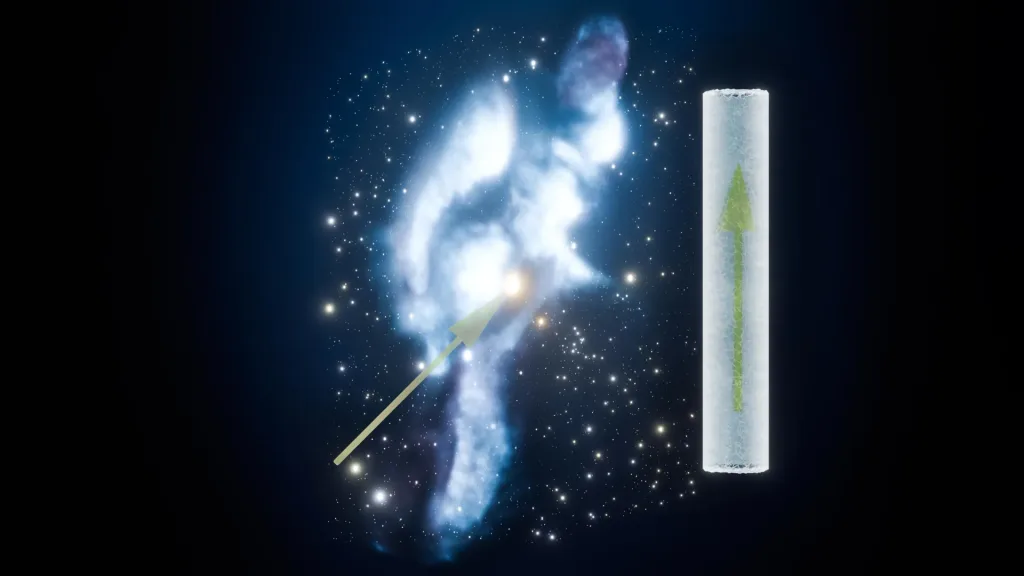
Antarctic cosmic dust proves Earth has been traversing through supernova debris for 80,000 years.
Earth Is Moving Through Ancient Supernova Debris
What Is the Local Interstellar Cloud?
Scientists believe the Solar System currently sits inside the Local Interstellar Cloud. This is a giant region of gas and dust located between nearby stars.
Researchers think one or more ancient supernova explosions helped shape this cloud long ago. The exploding stars likely pushed material into surrounding space, creating large structures filled with gas, dust, and radioactive elements.
As the Solar System moves through the Milky Way, it also travels through this cloud.
That means Earth may currently be drifting through ancient supernova debris without anyone noticing it directly.
According to the study, the Solar System probably entered the cloud tens of thousands of years ago. Scientists also estimate it could leave the cloud within the next few thousand years. Researchers believe the Solar System now sits close to the cloud’s outer edge.
A Dynamic Cosmic Environment
The study highlights how active Earth’s cosmic environment really is. Space around the Solar System is not empty. Instead, it contains changing regions filled with interstellar material.
Researchers found evidence that iron-60 levels changed relatively quickly on cosmic timescales. The isotope concentrations shifted over only tens of thousands of years.
That may sound like a long time, but in astronomy, it is relatively rapid.
Scientists say this discovery supports the idea that the Local Interstellar Cloud contains complex structures rather than evenly distributed material. Some regions appear richer in ancient supernova debris than others.
This finding matters because it gives scientists a new method for mapping the Solar System’s movement through the galaxy.
By comparing ice core records from different time periods, researchers may eventually reconstruct Earth’s recent galactic journey.
Why Scientists Care About This Discovery
The discovery does more than reveal traces of exploded stars. It also opens a new window into the history of nearby supernova events.
Supernovae are among the most powerful processes in the universe. They create heavy elements and spread them across galaxies. Many of the atoms inside planets, oceans, and living organisms originally formed inside ancient stars.
Scientists now have evidence that remnants of those explosions still surround our Solar System today.
The discovery also strengthens the connection between astronomy and Earth science. Instead of studying distant stellar explosions only through telescopes, researchers can investigate their effects using materials found on Earth itself.
That approach could help scientists better understand how nearby stellar events shaped the Milky Way over time.
How Scientists Detected Ancient Supernova Debris
Processing Hundreds of Kilograms of Ice
Finding iron-60 inside Antarctic ice required an extraordinary scientific effort.
Researchers transported around 300 kilograms of Antarctic ice from the Alfred Wegener Institute to laboratories in Dresden. After extensive chemical processing, only a few hundred milligrams of dust remained.
That tiny amount contained the evidence scientists needed.
Researchers then carefully separated iron-60 from the remaining material. This process required extreme precision because the isotope exists only in microscopic quantities.
Even small mistakes could have destroyed the evidence.
Searching for a Few Atoms
To confirm the results, scientists used the Heavy Ion Accelerator Facility at the Australian National University.
Researchers say this is currently the only facility in the world capable of detecting such tiny amounts of iron-60.
The process involved filtering atoms using electric and magnetic systems until only a few iron-60 atoms remained from samples containing roughly 10 trillion atoms.
Researcher Annabel Rolofs compared the process to searching for a needle hidden inside 50,000 football stadiums filled with hay.
The analogy highlights how difficult this detection really was.
Verifying the Measurements
Scientists also tested the samples using two other radioactive isotopes: beryllium-10 and aluminium-26.
Researchers already understand the expected levels of those isotopes in Antarctic ice. That allowed the team to verify that no iron-60 disappeared during chemical preparation.
This step proved essential because the amount of iron-60 was so small.
The successful measurements demonstrate how modern accelerator mass spectrometry can detect traces of cosmic material preserved inside Earth’s geological archives.
That capability could become increasingly important for future astronomy research.
Ancient Supernova Debris Could Rewrite Our View of the Milky Way
Earth as a Galactic Archive
One of the most exciting parts of this discovery is the idea that Earth stores records of cosmic history.
Ice cores, ocean sediments, and geological materials may preserve evidence of ancient supernova debris over long periods. Scientists can study those records to reconstruct changes in Earth’s galactic environment.
That gives researchers a completely different way to investigate nearby stellar explosions.
Instead of looking only outward into space, scientists can also look downward into Earth’s geological layers.
Future Ice Core Projects
Researchers already plan to investigate even older Antarctic ice.
The Beyond EPICA project aims to recover ice cores dating much farther into Earth’s past. Scientists hope these older samples may reveal what conditions looked like before the Solar System entered the Local Interstellar Cloud.
That could help researchers determine exactly when Earth first encountered this region of ancient supernova debris.
The results may also improve our understanding of how interstellar clouds evolve over time.
A Reminder of Earth’s Place in the Galaxy
This discovery offers a powerful reminder that Earth remains deeply connected to the larger universe.
Our planet does not travel through empty space. Instead, it moves through an active galactic environment shaped by ancient stars and cosmic events.
Tiny radioactive atoms frozen in Antarctic ice are now telling scientists the story of exploding stars that existed millions of years ago.
And remarkably, humanity may still be traveling through the lingering ashes of those ancient stellar explosions today.
Main Sources:
ScienceDaily
https://www.sciencedaily.com/releases/2026/05/260513221751.htm
Helmholtz-Zentrum Dresden-Rossendorf (HZDR)
https://www.hzdr.de
Physical Review Letters
https://journals.aps.org/prl
Alfred Wegener Institute (AWI)
https://www.awi.de
Australian National University — Heavy Ion Accelerator Facility
https://physics.anu.edu.au