BY:SpaceEyeNews.
For decades, scientists have searched for Dark Matter using massive underground detectors, particle experiments, and powerful telescopes. Yet the universe’s most abundant form of matter has remained completely invisible. Now, researchers believe the answer may not come from seeing dark matter at all. Instead, they may finally detect it by listening to the universe itself.
A new study suggests that Gravitational Waves created during black hole mergers could carry tiny distortions caused by dark matter. Those signals may eventually help scientists uncover one of the greatest mysteries in modern physics. The idea sounds almost impossible at first. However, recent advances in gravitational wave astronomy are making this possibility increasingly realistic.
The research focuses on how spinning black holes may amplify nearby dark matter clouds and leave detectable fingerprints inside gravitational waves. Scientists believe this method could open a completely new chapter in the hunt for dark matter gravitational waves.
Why Dark Matter Gravitational Waves Matter
Scientists estimate that ordinary matter makes up only a small fraction of the universe. Stars, planets, galaxies, gas clouds, and even humans account for less than 20% of the cosmos. The rest appears to be dominated by dark matter and dark energy.
Despite its enormous influence, dark matter remains invisible because it does not interact with light. Telescopes cannot directly observe it. Researchers only know dark matter exists because of its gravitational effects on galaxies and cosmic structures.
For years, scientists attempted to detect dark matter particles directly. Most experiments searched for weak interactions between dark matter and ordinary matter. Those searches produced no confirmed discoveries.
That failure forced researchers to rethink the problem.
Instead of trying to capture dark matter particles inside laboratories, some scientists began studying extreme cosmic environments. Black holes quickly became one of the most interesting targets.
The rise of gravitational wave astronomy transformed this field even further. In 2015, LIGO made history by detecting gravitational waves for the first time. Those waves emerged from two colliding black holes more than a billion light-years away.
That discovery changed astronomy forever.
Suddenly, scientists gained a new tool capable of studying invisible cosmic events. Gravitational waves can travel across the universe almost untouched. They carry information about the environments surrounding black holes, neutron stars, and other extreme objects.
Now researchers believe dark matter gravitational waves could reveal hidden structures that traditional telescopes cannot see.
Black Holes Could Stir Dark Matter Like Cosmic Butter
A Strange New Dark Matter Theory
The recent study focuses on a hypothetical form of dark matter known as “light scalar dark matter.” Scientists believe these particles would behave more like coordinated waves than individual particles.
That unusual behavior becomes important near spinning black holes.
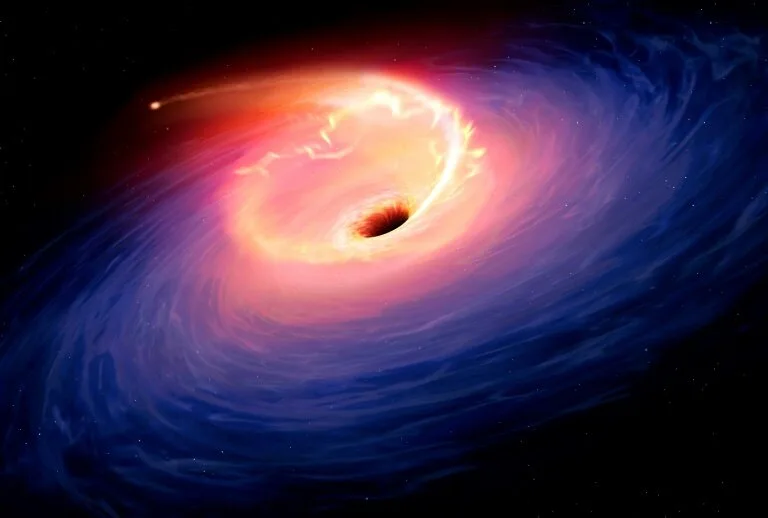
A rotating black hole contains enormous amounts of energy. According to the researchers, some of that rotational energy could transfer into nearby dark matter clouds. As energy flows into the surrounding region, the dark matter density may increase dramatically.
The researchers compare this process to churning butter.
Just as spinning paddles transform cream into butter, rotating black holes could amplify dark matter into dense clouds surrounding them. Scientists sometimes call this process “superradiance.”
The concept may sound strange, but the physics behind it follows known gravitational principles.
Dense dark matter clouds would normally remain invisible. However, they could affect gravitational waves generated during black hole mergers. Those effects might create tiny distortions inside the wave patterns traveling across space.
That possibility is what makes dark matter gravitational waves so exciting for researchers.
Detecting Tiny Distortions in Spacetime
Why This Is Extremely Difficult
Gravitational waves are already incredibly weak signals. Detecting them requires instruments capable of measuring distortions smaller than the width of an atom.
Modern observatories like:
- LIGO
- Virgo
- KAGRA
must isolate vibrations from earthquakes, traffic, weather, and even tiny ground movements.
Adding dark matter detection into the equation becomes even harder.
Researchers describe the challenge using a simple comparison. Detecting dark matter signatures inside gravitational waves would be like hearing someone cough during a massive rock concert. The signal exists, but it becomes buried beneath enormous background noise.
Even so, gravitational wave detectors continue improving every year.
Scientists now believe future upgrades may become sensitive enough to identify the subtle fingerprints created by dark matter clouds surrounding black holes.
That possibility pushed researchers to develop models predicting exactly how dark matter gravitational waves should appear inside observational data.
The Curious Signal Called GW190728
One Event Looked Different
The research team analyzed 28 strong black hole merger signals collected by international gravitational wave observatories.
Most appeared completely normal.
However, one event stood out.
The signal, known as GW190728, came from two merging black holes located around 8 billion light-years away. Together, those black holes carried roughly 20 times the mass of the sun.
Unlike the other events, GW190728 showed small anomalies that may match predictions for dark matter gravitational waves.
Researchers believe the merger may have occurred inside a region containing dense dark matter clouds. If true, the surrounding dark matter slightly altered the gravitational waves before they reached Earth.
Scientists remain extremely cautious about this interpretation.
The researchers clearly stated that GW190728 does not confirm the existence of dark matter. The signal only provides an interesting clue that deserves further investigation.
Still, the discovery matters because it offers scientists something they lacked before: a possible template for future searches.
That template could become invaluable as gravitational wave detectors continue increasing their sensitivity.
Future Observatories Could Transform Dark Matter Research
A New Era of Cosmic Listening
The next decade may become revolutionary for gravitational wave astronomy.
Future detector upgrades will dramatically improve signal quality and detection range. Researchers expect thousands of black hole mergers to become observable every year. That larger dataset may reveal whether dark matter signatures appear consistently across multiple events.
Several future observatories could play a major role in this effort.
The planned European Space Agency mission known as Laser Interferometer Space Antenna, or LISA, may detect gravitational waves from space itself. Unlike ground-based detectors, LISA would avoid many sources of Earth-based interference.
That advantage could help scientists detect weaker and more distant signals.
Researchers also believe dark matter gravitational waves may help probe scales far smaller than current dark matter experiments can study. Instead of searching for particles directly, scientists could study how dark matter behaves around extreme cosmic objects.
That shift would represent a major change in modern astrophysics.
Dark Matter Gravitational Waves Could Reshape Modern Physics
The importance of this research extends far beyond black holes.
Dark matter controls how galaxies form and evolve. It influences the structure of the universe itself. Yet scientists still do not know what dark matter actually is.
If gravitational waves can reveal dark matter signatures, physicists may finally gain direct clues about its properties.
That breakthrough could affect cosmology, quantum physics, and particle theory at the same time.
It may also deepen the growing connection between black hole physics and fundamental quantum mechanics. In recent years, black holes transformed from mysterious cosmic oddities into some of the universe’s most important scientific laboratories.
Now they may become dark matter detectors as well.
The idea remains unproven. However, many major scientific discoveries once sounded impossible before evidence finally appeared.
Gravitational waves themselves were considered undetectable for decades. Today, scientists detect them regularly.
Dark matter gravitational waves may follow a similar path.
The Invisible Universe May Finally Be Speaking
Dark matter remains one of the greatest unsolved mysteries in science. Despite decades of research, no experiment has directly identified what it is made of.
Yet this new approach introduces an entirely different strategy.
Instead of searching for dark matter particles directly, scientists may study how invisible matter changes the sound of the universe itself. Black hole mergers could become natural cosmic laboratories capable of exposing hidden structures across spacetime.
The signal detected in GW190728 does not prove dark matter exists. However, it may represent an important step toward future discoveries.
As gravitational wave observatories become more advanced, researchers may eventually uncover clear evidence hidden inside these cosmic ripples.
Humanity once explored the universe only through light. Now scientists are learning to listen as well. And somewhere inside those distant echoes, the invisible universe may finally be starting to speak.
Main Sources:
- https://www.space.com/astronomy/dark-universe/we-still-cant-see-dark-matter-but-what-if-we-can-hear-it
- https://www.ligo.caltech.edu
- https://www.virgo-gw.eu
- https://gwcenter.icrr.u-tokyo.ac.jp/en/