BY:SpaceEyeNews.
Deep beneath Antarctica’s ice, scientists have reached one of the most unstable regions on Earth. A recent mission to the massive Thwaites Glacier drilled through nearly half a mile of ice to explore a hidden ocean cavity below the glacier. What researchers discovered is raising new concerns about sea-level rise and the future of the West Antarctic Ice Sheet.
Often called the “Doomsday Glacier,” Thwaites has become one of the world’s most closely monitored glaciers. Scientists already knew warm ocean water was melting it from below. This expedition aimed to collect direct measurements from beneath the ice itself, where some of the glacier’s most important changes are happening.
The mission pushed researchers into one of the harshest environments on the planet. Teams crossed dangerous sea ice, flew helicopters onto unstable terrain, and drilled deep into Antarctica for a rare look beneath the glacier.
Now, the findings are helping scientists better understand how fast parts of Antarctica may be changing.
Why Thwaites Glacier Matters to the Entire Planet
The Thwaites Glacier covers an area roughly the size of Britain. More importantly, it acts like a natural barrier holding back large sections of the West Antarctic Ice Sheet.
Scientists often describe it as a “keystone glacier.” If it weakens significantly, surrounding glaciers could begin flowing into the ocean much faster. Over time, that process could contribute heavily to global sea-level rise.
Unlike many glaciers, Thwaites is not mainly melting from the surface. The bigger danger comes from below.
Warm Ocean Water Is Weakening the Glacier
Relatively warm currents known as Circumpolar Deep Water are reaching the underside of the glacier through hidden underwater pathways. Those currents slowly erode the ice shelf attached to Thwaites.
That floating ice shelf acts like a support system. As it weakens, the glacier behind it becomes less stable.
Satellite observations already show major retreat in parts of the glacier. Scientists believe some sections are changing faster than earlier climate models predicted.
The concern is not simply melting ice. Researchers worry about structural destabilization. Once retreat passes certain thresholds, recovery becomes far more difficult.
That is why this mission became so important.
Inside the Antarctic Drilling Expedition
The international research effort took years to organize. Scientists from South Korea and the British Antarctic Survey worked together aboard the RV Araon, a South Korean research icebreaker designed for polar missions.
Reaching the glacier was difficult from the start. Sea ice and unstable weather slowed operations around Antarctica’s coastline.
Helicopters Moved Tons of Equipment Onto the Ice
Once conditions improved, crews used helicopters to transport fuel, drilling systems, scientific instruments, and supplies onto the glacier.
Researchers established a temporary camp on the ice after carefully surveying the area for dangerous crevasses hidden beneath the snow.
Conditions remained brutal. Strong winds, freezing temperatures, and constant daylight made even routine tasks exhausting.
Still, the team had one objective: drill through the glacier and reach the hidden ocean below.
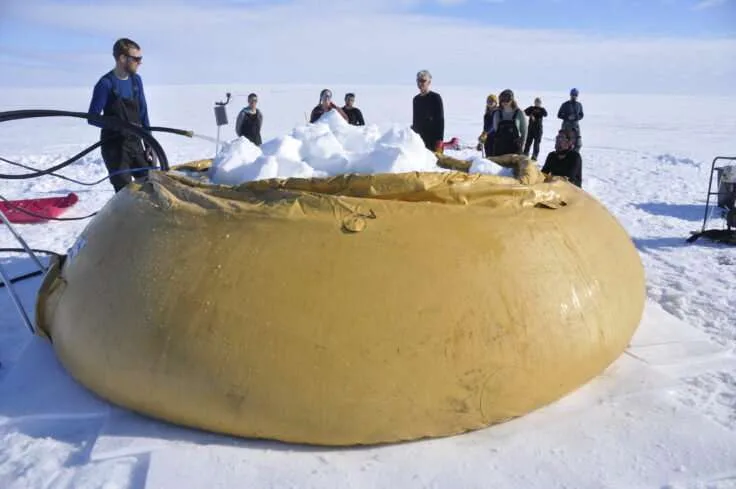
Drilling Into the Hidden Ocean Beneath Thwaites
To reach the cavity under the glacier, scientists used a hot-water drilling system. Heated water under high pressure melted a narrow shaft through nearly 800 meters of ice.
The hidden ocean beneath the glacier is one of Antarctica’s least understood environments. It is also one of the most important because that is where ocean heat directly interacts with the glacier’s base.
A Critical Moment Nearly Ended the Mission
After completing the drilling operation, researchers lowered scientific instruments into the water below the ice.
The equipment was designed to measure:
- Ocean temperature
- Salinity
- Water movement
- Melting conditions beneath the glacier
During deployment, however, scientists feared the instruments had become trapped beneath the ice.
For a moment, years of planning appeared to be at risk.
The incident highlighted the extreme difficulty of conducting science in Antarctica. Even after reaching the ocean cavity, unpredictable ice conditions remained a major threat to the mission.
Despite the challenges, the team successfully gathered valuable measurements from beneath the glacier.
What Scientists Are Learning Beneath the Ice
The data collected beneath Thwaites is helping researchers better understand how warm ocean water destabilizes Antarctic glaciers.
Scientists already suspected ocean-driven melting was accelerating ice loss. Direct measurements beneath the glacier are now giving researchers a clearer picture of how heat moves under the ice shelf.
Hidden Channels Carry Heat Under the Glacier
One major focus involves underwater channels beneath the glacier. These pathways allow warm water to travel farther inland under the ice.
As warm currents move through those channels, they weaken critical sections of the glacier from below.
Researchers are now studying whether these hidden pathways could speed up retreat faster than current models suggest.
That uncertainty matters because Thwaites already shows signs of rapid structural change.
Better Data Improves Sea-Level Forecasts
Sea-level predictions depend heavily on understanding Antarctica’s ice behavior.
Without direct observations beneath glaciers, scientists rely partly on estimates generated by computer models. Missions like this provide real-world measurements that improve those forecasts.
Researchers are trying to answer several critical questions:
- How quickly is the glacier weakening?
- Which areas are most unstable?
- Could retreat accelerate unexpectedly?
- How much could global sea levels eventually rise?
Even small improvements in prediction models are important for coastal planning around the world.
Antarctica Is Entering a New Scientific Era
The Thwaites Glacier mission reflects a broader transformation in polar science.
Modern Antarctic expeditions now combine:
- Satellite monitoring
- Underwater robotics
- Radar mapping
- Ocean sensors
- Advanced climate simulations
Scientists are exploring Antarctica with technologies once associated mainly with deep-space missions.
Large parts of the continent remain poorly understood. Researchers are racing to study these regions before climate-driven changes accelerate further.
Antarctica’s Ice Affects Coastlines Worldwide
Changes in Antarctica influence far more than the polar environment.
Shifts in ice stability affect:
- Global sea levels
- Ocean circulation
- Coastal flooding risks
- Long-term climate systems
That is why scientists worldwide continue to monitor Thwaites so closely.
The deeper researchers look beneath the glacier, the more complex the system appears.
A Small Hole With Global Consequences
The narrow shaft drilled into Antarctica’s ice may seem insignificant at first glance. In reality, it opened a direct window into processes that could shape future sea levels across the planet.
The Thwaites Glacier mission revealed how warm ocean currents, hidden channels, and weakening ice structures are interacting beneath one of Earth’s most vulnerable glaciers.
Scientists still cannot predict exactly how quickly Thwaites may retreat. Yet each new expedition provides stronger evidence that major changes are already unfolding beneath Antarctica’s ice.
And for millions of people living near coastlines, those changes could eventually become impossible to ignore.
Main Sources:
The Seattle Times
https://www.seattletimes.com/nation-world/the-hole-in-the-ice-at-the-end-of-the-earth/
British Antarctic Survey
https://www.bas.ac.uk/
International Thwaites Glacier Collaboration
https://thwaitesglacier.org/
Nature
https://www.nature.com/