BY:SpaceEyeNews.
Dark matter remains one of the biggest mysteries in modern physics. Scientists believe it makes up most of the matter in the universe. Yet nobody has directly seen it. Now, a new study suggests that black hole collisions may finally expose hidden clues about this invisible substance through something called Dark Matter Gravitational Waves.
Researchers from Massachusetts Institute of Technology and several European institutions analyzed gravitational wave data collected over multiple years. Out of 28 major black hole merger events, one signal appeared unusual. Scientists believe it may contain the first possible fingerprint of dark matter interacting with spacetime itself.
The discovery is not confirmed evidence of dark matter yet. However, researchers say it could open a completely new path for studying the hidden structure of the universe.
What Are Dark Matter Gravitational Waves?
Dark Matter Gravitational Waves are gravitational wave signals that may carry tiny distortions caused by dark matter surrounding black holes before they merge.
Gravitational waves are ripples in spacetime. They form when massive objects move through space at extreme speeds. Black hole mergers produce some of the strongest gravitational waves ever detected.
Scientists usually assume black holes merge in empty space. The new research challenges that idea.
The study suggests black holes may sometimes collide inside dense clouds of dark matter. If that happens, the invisible matter could slightly change the shape of the gravitational wave signal.
Those tiny changes may reveal where dark matter exists and how it behaves.
Why Scientists Still Cannot See Dark Matter
Dark matter does not interact with light. Telescopes cannot observe it directly. Scientists only know it exists because its gravity affects galaxies and cosmic structures.
For decades, astronomers noticed galaxies spinning faster than expected. Visible matter alone could not explain those motions.
Researchers also observed gravitational lensing. This happens when gravity bends light around galaxies and galaxy clusters. The bending appeared stronger than normal matter could produce.
These observations suggest that invisible matter surrounds galaxies across the universe.
Current estimates indicate dark matter makes up more than 85 percent of all matter in existence.
Even so, its true nature remains unknown.
How Black Hole Mergers Create Gravitational Waves
Black holes are regions where gravity becomes incredibly powerful. When two black holes orbit each other, they slowly spiral inward.
As they move closer together, they release energy in the form of gravitational waves.
Eventually, the black holes merge into a larger object. That collision creates ripples that travel across spacetime for millions or even billions of years.
Earth-based detectors can measure those ripples.
The international gravitational wave network includes:
- LIGO
- Virgo Collaboration
- KAGRA
Together, these observatories monitor distant cosmic events across the universe.
Since the first gravitational wave detection in 2015, scientists have discovered dozens of black hole mergers.
Now researchers believe those signals may contain hidden dark matter clues.
The Strange Signal Known as GW190728
The most interesting part of the new study focuses on a gravitational wave event called GW190728.
Scientists first detected this signal on July 28, 2019.
Researchers determined the event came from two black holes with a combined mass about 20 times larger than the Sun.
Most gravitational wave signals match predictions very closely. However, GW190728 looked slightly different.
That difference caught the attention of researchers studying Dark Matter Gravitational Waves.
Searching 28 Black Hole Collisions
The research team examined 28 strong gravitational wave events from the first three observing runs of the LVK collaboration.
For 27 events, the signals matched standard models of black holes merging in vacuum conditions.
GW190728 stood out.
According to the new simulations, its waveform appeared more consistent with black holes surrounded by dense dark matter.
Scientists stress that the statistical evidence remains weak. The findings do not prove dark matter exists around the black holes.
Still, researchers say the signal deserves further investigation.
Independent scientific teams will likely examine the data in the coming years.
How Dark Matter Could Surround Black Holes
One major idea behind the study involves hypothetical particles called light scalar particles.
Some theories suggest these particles can behave like waves around rapidly spinning black holes.
Under certain conditions, the black hole transfers rotational energy into nearby dark matter waves.
That process dramatically increases the density of dark matter surrounding the black hole.
Scientists call this effect “superradiance.”
The researchers compared it to whipping cream into butter. Small effects grow larger over time until they become powerful enough to influence gravitational waves.
Superradiance Could Amplify Invisible Matter
Superradiance may solve a major problem in dark matter research.
Normally, dark matter appears too weak to affect gravitational wave signals. However, superradiance could create dense clouds around spinning black holes.
If black holes merge inside those clouds, the surrounding dark matter may slightly distort the spacetime ripples produced during the collision.
Those distortions may eventually become measurable.
This idea gives scientists a new way to search for invisible matter using gravitational wave observatories instead of traditional telescopes.
That possibility excites many physicists because it opens a completely different approach to studying dark matter.
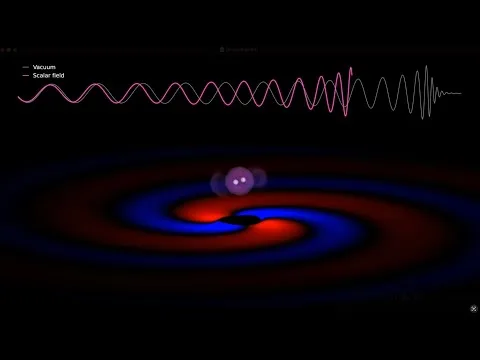
Simulating Dark Matter Gravitational Waves
To test the theory, researchers created advanced computer simulations of black hole mergers.
The simulations explored many conditions, including:
- Different black hole masses
- Different black hole sizes
- Varying dark matter densities
- Multiple dark matter cloud structures
The team then predicted how Dark Matter Gravitational Waves should appear compared to ordinary merger signals.
The simulations also accounted for how the waves changed while traveling across enormous cosmic distances before reaching Earth.
Afterward, researchers compared their predictions with real observational data from LVK detectors.
GW190728 became the strongest candidate.
Why This Discovery Matters
Dark matter remains one of the largest unsolved problems in physics.
Many experiments attempted to detect dark matter particles directly. So far, none produced confirmed results.
This new method changes the search strategy entirely.
Instead of trying to observe dark matter itself, scientists may detect how dark matter changes gravitational waves.
That distinction matters.
Black holes may act like natural amplifiers for invisible matter. Their intense gravity could make dark matter effects easier to detect.
If confirmed, Dark Matter Gravitational Waves could become one of the most important tools in astrophysics.
Future Observatories Could Reveal More Signals
The future of gravitational wave astronomy looks promising.
Current detectors continue improving their sensitivity every year. Researchers expect many more black hole merger detections in the future.
Several next-generation observatories are also under development, including:
- Einstein Telescope
- Laser Interferometer Space Antenna
These systems may detect weaker signals and more detailed waveforms.
That increased precision could help scientists identify additional dark matter signatures hidden inside gravitational waves.
The more data researchers collect, the better their chances of confirming whether GW190728 truly contains a dark matter imprint.
A New Era for Dark Matter Research
Scientists remain cautious about the findings. Nobody claims dark matter has finally been discovered.
However, the study demonstrates something important.
Gravitational waves may carry far more information than researchers originally expected.
Instead of simply revealing black hole collisions, these signals may also expose hidden environments surrounding those objects.
That possibility transforms black holes into powerful laboratories for studying invisible physics.
If future observations confirm these results, Dark Matter Gravitational Waves could reshape humanity’s understanding of the universe.
For decades, dark matter remained hidden in the cosmic shadows. Now, black hole collisions may finally provide the first real glimpse into that invisible world.
Main Sources:
https://www.sciencedaily.com/releases/2026/05/260518041429.htm
https://gwcenter.icrr.u-tokyo.ac.jp/en