
BY:SpaceEyeNews.
The James Webb Space Telescope continues to transform astronomy with discoveries that challenge old theories about the cosmos. One of its biggest surprises came when it observed galaxies from the early Universe shining far brighter than scientists expected. Those galaxies appeared less than 550 million years after the Big Bang, yet they emitted intense ultraviolet light that should have been blocked by dust.
For months, astronomers searched for answers. Some suggested unusually rapid star formation. Others proposed hidden black holes. However, a new study now offers a much simpler explanation to the early Universe dust mystery. According to researchers, the dust inside those young galaxies behaved very differently from the dust found in modern galaxies.
Instead of forming dense clouds that absorb ultraviolet radiation, the dust may have existed in large porous grains created by ancient supernova explosions. That structure allowed ultraviolet light to escape through cosmic “windows,” making galaxies appear brighter to the James Webb Space Telescope.
The discovery could reshape how scientists understand the first galaxies and may even provide clues about the Universe’s earliest stars.
Why the Early Universe Dust Mystery Confused Astronomers
Webb Saw Galaxies That Looked Impossible
Before the launch of the James Webb Space Telescope, astronomers expected the early Universe to look dark and dusty. Young galaxies should have contained large amounts of gas and dust created by exploding stars. That dust normally absorbs ultraviolet radiation and hides much of the galaxy’s light.
Instead, JWST revealed galaxies glowing with strong ultraviolet emission. Some looked far too bright compared to predictions from galaxy evolution models.
This became one of the largest puzzles in modern cosmology.
Scientists knew the galaxies contained gas and dust. Yet the ultraviolet radiation escaped almost freely. Existing models struggled to explain how this could happen so soon after the Big Bang.
Several theories quickly emerged.
Some researchers suggested those galaxies were forming stars at extraordinary rates. Others proposed active black holes might boost their brightness. A few scientists even questioned whether current models of galaxy evolution were incomplete.
However, many astronomers believed the answer likely involved dust itself.
Dust Normally Blocks Ultraviolet Light
In modern galaxies like the Milky Way, dust works like cosmic fog. Tiny grains absorb and scatter ultraviolet radiation. This process is called dust attenuation.
That is why astronomers usually see ultraviolet light weakened when observing distant galaxies.
Over billions of years, dust grains slowly grow larger by collecting metals from surrounding gas. Mature galaxies therefore contain dense and efficient ultraviolet blockers.
The early Universe operated under very different conditions.
Galaxies had little time to evolve. Heavy elements remained rare. Supernova explosions dominated the creation of dust. Researchers now believe this difference completely changed how dust behaved in those young galaxies.
That realization became the foundation of the new explanation for the early Universe dust mystery.
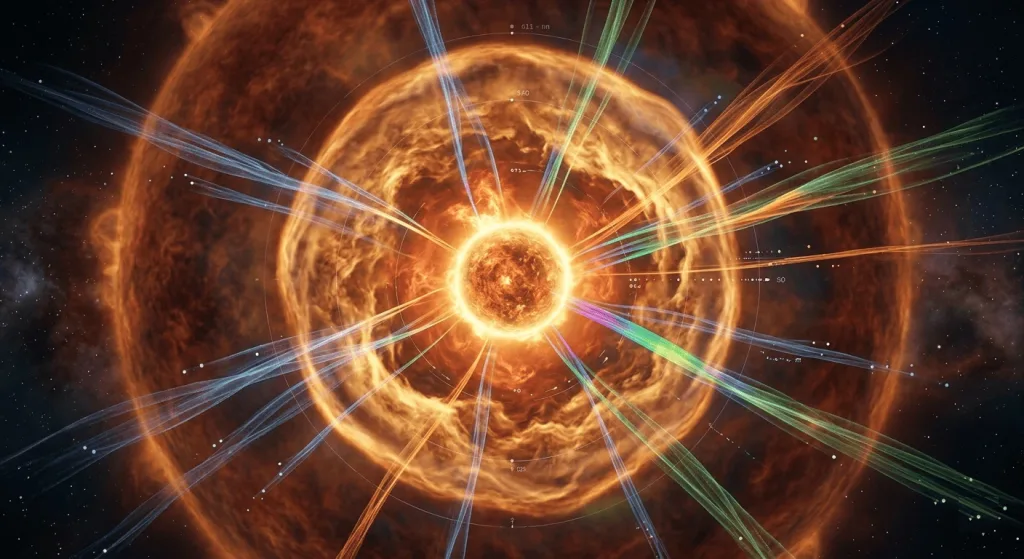
Supernova Dust May Explain the Early Universe Dust Mystery
Massive Stellar Explosions Created Unusual Dust
The new study was led by Denis Burgarella from the Marseille Astrophysics Laboratory. His team focused on how supernova explosions formed dust in the young Universe.
When massive stars explode, they eject huge amounts of material into space. Shock waves then travel through that material. Those shock waves destroy many of the smallest dust grains.
Only larger grains survive.
That detail may explain everything.
Large dust grains interact differently with ultraviolet radiation. Instead of blocking light efficiently, they allow much of it to pass through. As a result, galaxies appear brighter than expected.
Researchers say the early Universe likely contained far more of these large grains than modern galaxies do today.
This means the galaxies observed by JWST were not necessarily unusual. Their dust simply behaved differently.
Porous Dust Changed the Picture
Another key part of the model involves the structure of the dust clouds.
The researchers propose that the dust did not form smooth and dense screens. Instead, it existed in a porous and uneven arrangement.
In simple terms, the dust clouds contained many gaps.
Those gaps acted like windows through which ultraviolet light escaped. Even galaxies filled with gas and dust could still appear extremely bright.
The team successfully reproduced JWST observations using this model. Importantly, they achieved this without relying on exotic explanations or extreme physics.
That result gives astronomers greater confidence that standard models of cosmic evolution still work.
GELDA Galaxies Also Make More Sense
The study also helps explain a strange class of objects called GELDA galaxies. The name stands for Galaxies with Extremely Low Dust Attenuation.
These galaxies contain large amounts of gas but show surprisingly weak dust absorption.
Earlier theories suggested powerful explosions pushed dust completely out of the galaxies. However, that explanation created another problem. If the dust disappeared, much of the gas should have disappeared as well.
Observations did not support that scenario.
The porous supernova dust model solves the issue naturally. Gas can remain inside the galaxies while ultraviolet light still escapes through the uneven dust structure.
That makes GELDA galaxies far easier to understand.
The Early Universe Dust Mystery May Reveal the First Stars
Population III Stars Could Leave Hidden Fingerprints
One of the most exciting parts of this research involves Population III stars.
Astronomers believe these stars formed shortly after the Big Bang. They contained almost pure hydrogen and helium because heavier elements did not yet exist.
No telescope has directly observed a Population III star.
Still, scientists suspect those stars were enormous and short-lived. Their explosions likely produced the first heavy elements and the first cosmic dust.
According to the new study, the unusual dust detected by JWST could carry the chemical fingerprints of those ancient stars.
That possibility makes the discovery extremely important.
If astronomers can identify dust created by Population III supernovae, they may finally gain indirect evidence of the first stellar generation in cosmic history.
Scientists Are Searching for Ancient Dust Signatures
Researchers now plan to study several important properties inside these early galaxies.
They want to measure:
- dust grain size
- infrared radiation
- metal content
- ultraviolet attenuation patterns
Those measurements may reveal whether the dust truly originated from early supernova explosions.
The Atacama Large Millimeter/submillimeter Array will play a major role in this effort alongside the James Webb Space Telescope.
ALMA specializes in observing cold gas and dust. Combined with JWST’s infrared power, astronomers can build a clearer picture of how the first galaxies evolved.
Future observations may also help explain how the Universe became transparent after the cosmic dark ages.
Why This Discovery Matters for Cosmology
The early Universe dust mystery affects much more than galaxy brightness.
It influences how scientists estimate:
- star formation rates
- galaxy growth
- chemical evolution
- cosmic reionization
If early dust behaved differently, many existing measurements may require adjustment.
The discovery also shows how rapidly astronomy is evolving during the JWST era.
Only a few years ago, many scientists believed the early Universe followed relatively simple evolutionary patterns. JWST now reveals a far more complex picture.
Young galaxies appear capable of surprising behavior. Their dust structures, star formation activity, and chemical composition may differ dramatically from modern galaxies.
That is why this new study matters so much.
It provides a realistic explanation that fits observations without rewriting the laws of physics.
A Tiny Dust Grain May Have Solved a Giant Cosmic Puzzle
The early Universe dust mystery challenged astronomers because galaxies looked far brighter than expected shortly after the Big Bang. The observations forced scientists to question long-standing assumptions about galaxy evolution and cosmic dust.
Now, researchers believe the answer may come from the unique properties of supernova dust formed in the earliest galaxies. Large porous dust grains allowed ultraviolet light to escape through gaps instead of blocking it completely.
The idea matches JWST observations surprisingly well.
Even more exciting, the dust may contain traces of Population III stars, the first stars ever born in the Universe. If confirmed, astronomers could finally gain indirect evidence of those legendary objects.
The James Webb Space Telescope is no longer simply observing ancient galaxies. It is revealing how the young Universe truly behaved during its earliest chapters.
As future observations continue, scientists may soon uncover even deeper secrets hidden inside the first cosmic dust clouds.
Main Sources
Universe Magazine:
https://universemagazine.com/en/mystery-of-early-universe-solved-thanks-to-dust/
STFC UK Astronomy Technology Centre:
https://www.ukatc.stfc.ac.uk/Pages/James-Webb-Space-Telescope-unveils-unexpected-dust-factories-in-early-universe-galaxy.aspx
NASA Webb Telescope:
https://science.nasa.gov/mission/webb/
ALMA Observatory:
https://www.almaobservatory.org/
arXiv Research Paper Database:
https://arxiv.org/