BY:SpaceEyeNews.
For most people, Earth’s magnetic field feels permanent. It quietly protects the planet every second. It deflects harmful solar particles and helps preserve the atmosphere that supports life. Yet scientists know something surprising about this invisible shield. It has flipped completely many times throughout Earth’s history.
The phenomenon is called an Earth magnetic field reversal. Geological evidence shows that the planet’s magnetic poles have reversed at least 183 times during the last 83 million years. The last full reversal happened about 780,000 years ago. Now researchers are closely monitoring signs that Earth’s magnetic field is weakening again.
The weakening does not mean disaster is coming tomorrow. However, it does raise important scientific questions about Earth’s future, space weather, satellite safety, and atmospheric protection.
Earth Magnetic Field Reversal Is a Natural Planetary Process
The Earth magnetic field reversal process sounds dramatic, but scientists consider it a normal part of Earth’s long-term behavior.
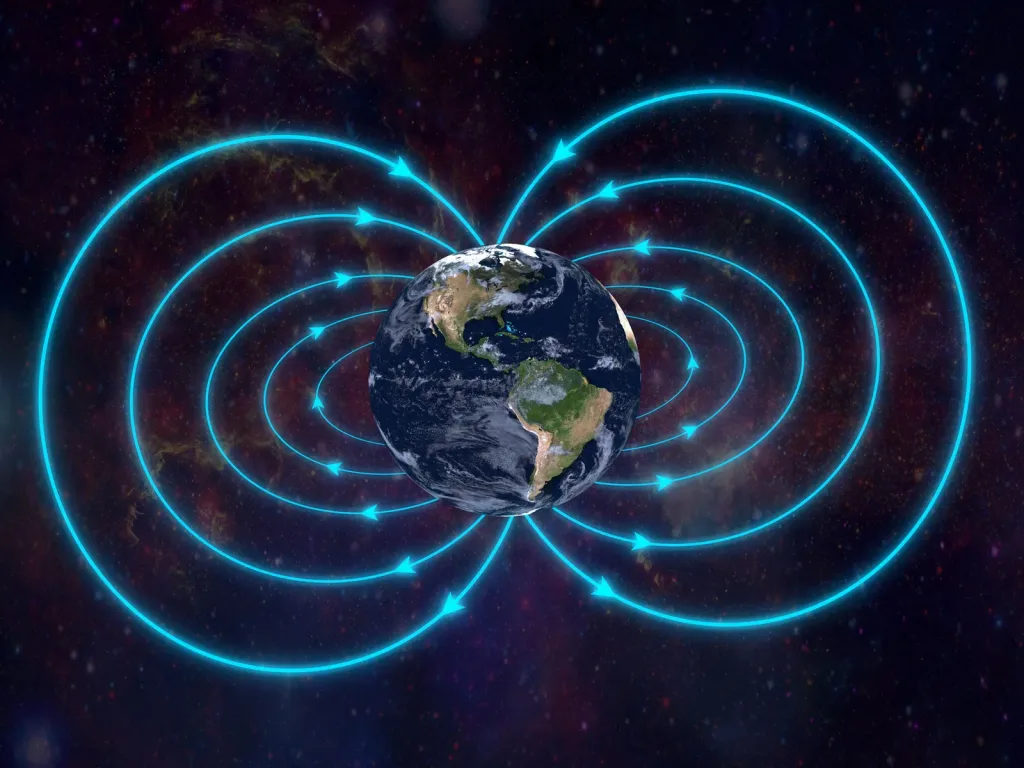
Earth’s magnetic field comes from the movement of molten iron inside the outer core. This layer sits nearly 2,900 kilometers beneath the surface. As the liquid metal moves, it generates electric currents. Those currents create the magnetic field surrounding the planet.
The field stretches far into space. It acts like a protective barrier against charged particles from the Sun. Without this shield, Earth would receive far more solar radiation.
How Rocks Preserve Magnetic History
Scientists discovered ancient reversals through rocks.
When volcanic lava cools, iron-rich minerals inside the rock align with Earth’s magnetic field. Once the rock hardens, the minerals lock into place. They preserve the magnetic direction from that exact moment in time.
Sedimentary rocks also store magnetic information. Tiny magnetic particles settle slowly in water and record the field orientation as layers build up.
By studying these rocks, geophysicists reconstructed a timeline of Earth’s magnetic history. The evidence clearly shows repeated magnetic reversals across millions of years.
Magnetic Reversals Do Not Follow a Schedule
One surprising detail stands out in the geological record. Magnetic reversals happen irregularly.
Some stable periods lasted only a few thousand years. Others continued for tens of millions of years. Scientists found no reliable pattern that predicts exactly when the next reversal will occur.
The current magnetic period has already lasted around 780,000 years. That is longer than the average interval between reversals, though not outside the historical range.
What Happens During an Earth Magnetic Field Reversal?
An Earth magnetic field reversal does not happen overnight. It unfolds slowly across thousands of years.
Research on the Brunhes–Matuyama reversal suggests the entire transition lasted between 22,000 and 30,000 years. The most intense phase likely occurred during a narrower 10,000-year period.
During this transition, the magnetic field weakens dramatically.
Why the Magnetic Field Weakens
The weakening begins when Earth’s dipole magnetic structure starts to collapse. Normally, the planet behaves like a giant bar magnet with clear north and south poles.
As the reversal develops, the field becomes unstable and disorganized. Multiple temporary magnetic poles may appear across different regions. Eventually, the magnetic structure rebuilds itself in the opposite direction.
Scientists estimate the field strength can drop to only 10 percent of its normal intensity during the weakest stages.
That matters because the magnetic field blocks much of the solar radiation reaching Earth.
Increased Radiation Exposure
A weaker field allows more charged particles to interact with the atmosphere.
Researchers studying ancient isotopes found evidence of increased atmospheric ionization during past reversals. Levels of carbon-14 and beryllium-10 changed significantly during these periods.
Scientists do not believe reversals caused mass extinctions. Life survived every known reversal event. However, the modern world depends heavily on vulnerable technology.
Satellites, communication systems, GPS networks, and electrical infrastructure could face greater exposure to solar storms during a future reversal.
Aircraft flying near polar routes could also experience higher radiation levels during intense solar activity.
Earth Magnetic Field Reversal Could Transform the Night Sky
One of the most fascinating effects of an Earth magnetic field reversal involves auroras.
Under normal conditions, auroras appear near the polar regions. Earth’s magnetic field channels charged solar particles toward the poles, where they interact with atmospheric gases.
During a reversal, that protection changes dramatically.
Auroras Could Expand Toward the Equator
As the magnetic field weakens, the auroral zones spread farther from the poles.
Solar particles gain access to lower latitudes because the weakened magnetic shield no longer concentrates them near the polar regions.
Scientists believe auroras may have appeared across middle latitudes and possibly near tropical regions during the last major reversal.
The skies above areas that never experience auroras today could glow with red, green, and purple atmospheric light.
Ancient Earth May Have Looked Very Different
Geological evidence supports this idea indirectly.
Researchers discovered signs of increased atmospheric ionization at lower latitudes during ancient magnetic transitions. Those signatures match the expected effects of expanded auroral activity.
Although nobody witnessed the Brunhes–Matuyama reversal directly, scientists can reconstruct the general atmospheric conditions from geological records.
The result is a striking picture of an ancient Earth with unusual skies and a far weaker magnetic shield.
Scientists Are Closely Monitoring Earth’s Weakening Magnetic Field
Modern measurements confirm that Earth’s magnetic field is weakening today.
Global field strength has declined by roughly 9 percent during the last 200 years. Scientists pay special attention to one unusual region called the South Atlantic Anomaly.
What Is the South Atlantic Anomaly?
The South Atlantic Anomaly is an area where Earth’s magnetic field is significantly weaker than average.
It stretches across parts of South America and the southern Atlantic Ocean. Satellites passing through this region experience higher radiation exposure because the weakened field offers less protection.
Space agencies already adjust some spacecraft operations while crossing the anomaly.
The region has expanded and shifted over recent decades. That trend has increased scientific interest in whether the weakening connects to deeper changes inside Earth’s core.
Are We Entering Another Magnetic Reversal?
Scientists remain cautious about making predictions.
Some researchers believe the current weakening could represent an early stage of a future Earth magnetic field reversal. Others argue that similar weakening events happened before without leading to a complete reversal.
Earth also experiences shorter magnetic disturbances called geomagnetic excursions. These temporary disruptions weaken the field but eventually return to normal polarity.
Right now, no scientific evidence proves a full reversal is imminent.
Most experts agree on one important point: reversals are inevitable over geological timescales. The uncertainty involves timing, not possibility.
Why an Earth Magnetic Field Reversal Matters Today
Past reversals happened long before modern civilization existed. Humanity now relies on technology that could react differently to magnetic instability.
Satellites support communication, navigation, banking systems, weather forecasting, and scientific research. A weaker magnetic field could expose those systems to stronger solar radiation.
Power grids also face risks from geomagnetic storms. Increased solar activity interacting with a weakened magnetic field could trigger larger electrical disruptions.
Modern Technology Changes the Situation
Ancient animals and ecosystems survived magnetic reversals naturally. Modern civilization introduces new vulnerabilities.
Astronauts aboard spacecraft would face greater radiation exposure during periods of weaker magnetic shielding. High-altitude aviation routes could also require new safety procedures.
Scientists continue studying Earth’s core dynamics to better understand future magnetic behavior. Space agencies also monitor solar activity carefully because strong solar storms already threaten satellites even under current magnetic conditions.
The growing concern does not mean civilization faces immediate danger. Instead, it highlights how dependent modern society has become on invisible planetary systems.
Conclusion
The Earth magnetic field reversal process is one of the planet’s most remarkable long-term cycles. Geological evidence proves that Earth’s magnetic poles have flipped many times before, and scientists expect they will flip again someday.
The last reversal occurred roughly 780,000 years ago. During that transition, Earth’s magnetic field weakened significantly, auroras likely appeared far from the poles, and the atmosphere experienced increased radiation exposure.
Today, scientists observe ongoing weakening in Earth’s magnetic field, especially around the South Atlantic Anomaly. No one can predict exactly when the next reversal will happen. It could begin thousands of years from now, or much later.
What remains clear is that Earth’s magnetic shield is not fixed or permanent. It is dynamic, constantly evolving, and deeply connected to the hidden forces moving inside our planet.
Main Sources:
NASA Earth Observatory
https://earthobservatory.nasa.gov/
NOAA Space Weather Prediction Center
https://www.swpc.noaa.gov/
U.S. Geological Survey (USGS) Geomagnetism Program
https://www.usgs.gov/programs/geomagnetism
Journal of Geophysical Research
https://agupubs.onlinelibrary.wiley.com/journal/21699356