
BY:SpaceEyeNews.
Astronomers have discovered a strange planetary system that may force scientists to rethink how worlds form across the galaxy. The system, known as LHS 1903, contains a rocky planet orbiting farther from its star than two giant gaseous planets.
That arrangement should not happen under traditional planet formation models.
For decades, astronomers believed rocky planets form close to stars while gas giants develop farther away in colder regions rich in gas. Our Solar System follows this pattern almost perfectly. Mercury, Venus, Earth, and Mars are rocky worlds near the Sun, while Jupiter and the outer planets dominate the colder edges of the system.
But LHS 1903 appears to break those rules completely.
The discovery suggests some planets may form much later than expected. It also hints that planetary systems across the universe may be far more diverse than scientists once imagined.
LHS 1903 Reveals an Unusual Planetary Layout
LHS 1903 is a small red dwarf star located beyond our Solar System. Red dwarfs are cooler and dimmer than stars like the Sun, yet they are among the most common stars in the Milky Way.
Researchers used observations from multiple telescopes to study the planets orbiting the star. Data from the CHEOPS mission helped scientists identify the system’s unusual structure.
At first, the planetary arrangement looked normal.
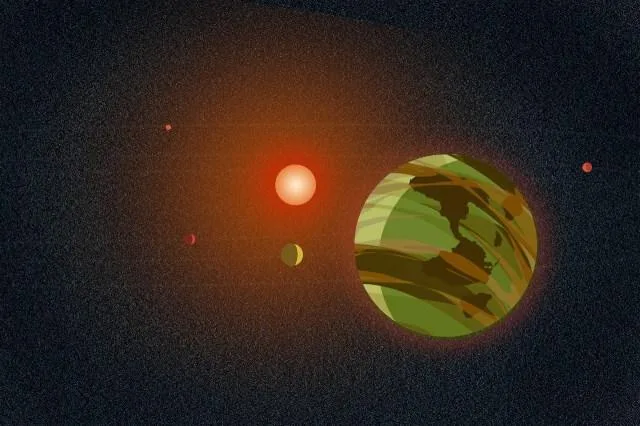
Astronomers found a rocky inner planet followed by two larger gaseous worlds. That matched the standard model of planetary evolution.
Then researchers discovered a fourth planet farther away from the star. Surprisingly, that outer world also appeared rocky.
The order of planets became:
- Rocky planet
- Gas planet
- Gas planet
- Rocky planet
That strange structure transformed LHS 1903 into what researchers call an “inside-out” system.
A Rocky World Beyond the Gas Giants
Current theories explain planetary formation through temperature differences inside massive disks of gas and dust surrounding young stars.
Close to a star, intense radiation removes lighter gases. That process leaves behind smaller rocky planets. Farther away, cooler conditions allow planets to collect thick gaseous atmospheres and grow into giant worlds.
That is why astronomers expected a gas giant in the outer region of LHS 1903.
Instead, they found a dense rocky planet.
Scientists first explored whether a major collision may have stripped away the planet’s atmosphere long after formation. They also examined whether the planets had shifted positions over time because of gravitational interactions.
Simulations ruled out both possibilities.
The outer rocky world appears to have formed naturally in its current position.
That result pushed researchers toward a more radical explanation.
Sequential Planet Formation Could Explain the Mystery
Scientists now suspect the planets around LHS 1903 may not have formed at the same time.
Under traditional models, planets emerge together inside protoplanetary disks filled with gas and dust. Planetary embryos gradually grow over millions of years into full planets.
LHS 1903 may have followed a different path.
Researchers believe the planets may have formed sequentially, one after another rather than simultaneously.
That possibility changes the timeline of planetary evolution completely.
The first planets likely formed while the system still contained large amounts of gas. Later, after much of that gas disappeared, the outer rocky world may have emerged under very different conditions.
Without enough remaining gas, the planet never developed into a giant gaseous body.
Instead, it stayed rocky.
Scientists proposed this type of planetary growth years ago, but supporting evidence remained limited. LHS 1903 may now provide one of the clearest examples yet.
A Planet Formed in a Gas-Depleted Environment
One detail makes the discovery especially important.
Researchers believe the outer rocky planet may have formed after the system lost most of its surrounding gas. That environment is known as a gas-depleted region.
Current models suggest gas plays a major role during planet formation. Giant planets require enormous amounts of hydrogen and helium to build thick atmospheres. Even rocky planets depend heavily on surrounding material during early growth stages.
Yet the outer world around LHS 1903 still formed successfully.
That finding challenges long-standing assumptions about planetary birth.
It also suggests some systems may continue producing planets long after scientists expected the formation process to end.
If confirmed, this discovery could reshape how astronomers study the evolution of planetary systems.
Why This Discovery Matters
Modern telescopes continue revealing planetary systems unlike anything found in our own cosmic neighborhood.
Some exoplanets orbit extremely close to their stars. Others follow unstable paths or possess unexpected compositions. LHS 1903 now joins the growing list of systems that challenge older theories.
Historically, astronomers built many planet formation models around our Solar System because it was the only example available for centuries.
That assumption is becoming harder to defend.
The unusual structure of LHS 1903 suggests planetary systems may develop through multiple evolutionary pathways instead of one universal process.
That shift affects several areas of astronomy, including:
- The search for Earth-like planets
- Studies of planetary atmospheres
- Understanding how habitable worlds emerge
- Models of long-term planetary evolution
Each strange system gives scientists another clue about how diverse the universe may truly be.
Our Solar System May Not Be Typical
One of the biggest implications involves our own Solar System.
For decades, astronomers treated our planetary arrangement as a standard cosmic blueprint. But discoveries like LHS 1903 suggest our system may actually be less common than once believed.
Planetary systems may vary far more dramatically than expected.
Local conditions, disk chemistry, timing, and gravitational interactions could all influence how planets emerge around stars.
That means every new discovery has the potential to reveal an entirely different planetary architecture.
LHS 1903 may represent the beginning of a much larger category of unusual systems waiting to be discovered.
Future Missions Could Discover More Strange Systems
Astronomers expect future observatories to uncover many more planetary surprises.
Advanced telescopes now detect smaller planets with far greater precision than previous generations. Missions from organizations like the European Space Agency and NASA continue expanding humanity’s understanding of exoplanets across the Milky Way.
As researchers gather more data, additional systems similar to LHS 1903 may appear.
If that happens, scientists may need to revise major parts of modern planet formation theory.
Conclusion
The inside-out planetary system discovered around LHS 1903 may become one of the most important exoplanet findings in recent years.
Astronomers found a rocky world orbiting beyond giant gaseous planets where current theories predicted the opposite arrangement should exist. After ruling out collisions and planetary migration, researchers concluded the system may have formed sequentially instead.
That possibility points toward a new understanding of planetary evolution.
Some worlds may form much later than expected and under conditions once considered impossible.
As astronomers continue exploring the galaxy, discoveries like LHS 1903 remind scientists that the universe still holds many surprises — and our Solar System may be only one version among countless planetary designs.
Main Sources:
ScienceDaily
https://www.sciencedaily.com/releases/2026/05/260520093753.htm
European Space Agency (ESA)
https://www.esa.int/Science_Exploration/Space_Science/Cheops/Cheops_discovers_late_bloomer_from_another_era
University of Bern
https://mediarelations.unibe.ch/media_releases/2026/media_releases_2026/cheops_detects_a_new_planetary_disorder/index_eng.html