
BY:SpaceEyeNews.
In December 1995, the Hubble Space Telescope pointed toward a tiny dark region of space that appeared almost completely empty. Scientists expected to see very little. Instead, the observation became one of the most important moments in modern astronomy. The image later became known as the Hubble Deep Field.
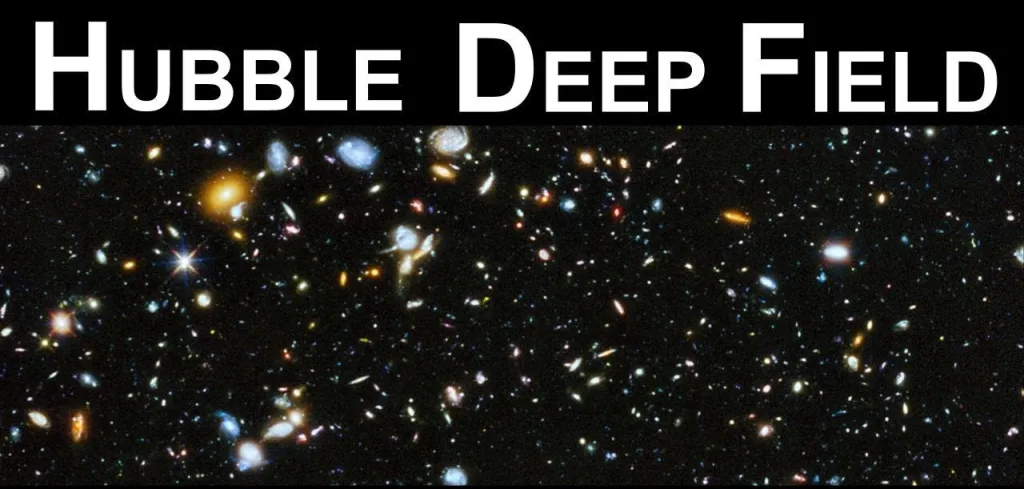
After ten straight days of observation, the telescope revealed nearly 3,000 galaxies hidden inside a tiny patch of sky. The result shocked both astronomers and the public. It also changed how scientists viewed the universe itself.
The Hubble Deep Field did more than produce a beautiful image. It proved that the cosmos contains far more galaxies than people once imagined. It also showed that even the darkest regions of space hold ancient cosmic history waiting to be discovered.
Why the Hubble Deep Field Looked Empty
The Hubble Deep Field focused on a small area inside the constellation Ursa Major. The region sits near the handle of the Big Dipper. From Earth, the area looked almost completely black.
That emptiness was intentional.
Astronomers carefully selected the field because it lacked bright nearby stars and thick clouds of dust. A crowded area would block faint distant light. Researchers wanted the cleanest possible view into deep space.
Why Scientists Avoided the Milky Way Plane
The team pointed Hubble far away from the crowded plane of the Milky Way. Our galaxy contains huge amounts of gas, dust, and stars. Those objects can hide distant galaxies behind them.
By choosing a quieter region, astronomers reduced interference. That decision allowed faint light from extremely distant galaxies to appear more clearly.
The “Nothing” Was Part of the Experiment
Many people later described the Hubble Deep Field as a lucky discovery. That description misses the real story.
Scientists did not randomly point the telescope at an empty region. They deliberately searched for a place that looked empty enough to expose the distant universe behind it.
The darkness itself became the experiment.
Instead of studying bright nearby objects, astronomers wanted to test how much hidden light existed in the background of space. The goal was simple but bold: stare long enough into apparent nothingness and see what appears.
The Risk Behind the Hubble Deep Field
The Hubble Deep Field almost never happened.
At the time, the Hubble Space Telescope still carried a damaged reputation. After its 1990 launch, scientists discovered a flaw in its primary mirror. The issue blurred images and embarrassed NASA publicly.
A later servicing mission fixed the problem using corrective optics. Even then, telescope time remained extremely valuable.
Robert Williams Approved the Gamble
Astronomer Robert Williams pushed the project forward. As director of the Space Telescope Science Institute, he controlled a special block of observation time called Director’s Discretionary Time.
Williams chose to spend a large portion of that time on the Hubble Deep Field.
That decision faced strong criticism.
Some astronomers feared the telescope would spend ten days staring into darkness and return almost nothing. Others believed the observation wasted precious resources that could support more traditional studies.
Why Some Experts Opposed the Idea
One of the project’s critics was John Bahcall, an important figure in Hubble’s development. Bahcall doubted the telescope would discover a major hidden population of galaxies.
The concern made sense at the time.
Hubble observations usually lasted only a few hours. The Hubble Deep Field demanded more than 100 hours of total exposure time. If the image failed, critics would likely blame NASA for using valuable telescope resources poorly.
Williams accepted the risk anyway.
That choice eventually became historic.
How the Hubble Deep Field Revealed Thousands of Galaxies
The Hubble Deep Field combined 342 separate exposures taken over ten consecutive days. The telescope collected faint incoming light continuously during that period.
The longer Hubble observed, the more hidden detail appeared.
Why Long Exposure Changed Everything
Distant galaxies do not suddenly appear out of nowhere. Their light already travels across space constantly. The problem is brightness.
Many galaxies remain too faint for short observations.
Long exposures solve that problem by allowing light to build gradually over time. As the signal grows stronger, extremely faint galaxies become visible.
That method transformed the Hubble Deep Field into a window toward the ancient universe.
Nearly 3,000 Galaxies Emerged
Early estimates counted around 1,500 galaxies inside the image. Later analysis raised the number closer to 3,000.
The result stunned astronomers.
The observed area covered only a tiny fraction of the sky. Yet it contained thousands of galaxies of different sizes and shapes. Some appeared as familiar spirals. Others looked irregular and distorted.
Many of those galaxies existed billions of years ago.
Scientists were not simply looking far away. They were also looking backward through time.
The Hubble Deep Field Revealed the Young Universe
Light takes time to travel across space. Because of that delay, telescopes observe distant galaxies as they existed long ago.
The Hubble Deep Field pushed that idea to remarkable limits.
Ancient Galaxies Looked Different
Many distant galaxies inside the image appeared chaotic and misshapen. They lacked the smooth structure seen in mature galaxies today.
That observation mattered greatly.
Researchers realized they were seeing galaxies during earlier stages of cosmic evolution. The strange shapes supported theories suggesting galaxies grow through collisions and mergers over billions of years.
Evidence for Galactic Growth
The Hubble Deep Field did not prove galaxy evolution by itself. However, it delivered powerful visual evidence supporting the idea.
Smaller galaxies appeared more common in the distant universe. Larger organized galaxies appeared more frequently closer to the present era.
That pattern matched long-standing scientific models.
The image therefore became more than a famous photograph. It became an important scientific dataset that helped explain how cosmic structures evolved over time.
How the Hubble Deep Field Changed Astronomy Forever
The impact of the Hubble Deep Field extended far beyond one image.
Astronomers quickly realized the method itself could transform deep-space research.
NASA Released the Data Publicly
NASA released the Hubble Deep Field data immediately to the global astronomy community. Scientists worldwide began studying the image almost at once.
That decision accelerated research dramatically.
Researchers who never participated in the original observation still produced major discoveries using the same data. The image became one of the most studied astronomical observations ever created.
Deep-Field Astronomy Became Standard
The success of the Hubble Deep Field inspired additional projects.
Scientists later created the Hubble Ultra Deep Field and several other deep-space observations. Each version looked farther into cosmic history.
Today, the James Webb Space Telescope continues the same approach using far more advanced infrared instruments.
Webb now observes galaxies that formed even closer to the beginning of the universe.
A Tiny Dark Patch Changed Human Perspective
The emotional impact of the Hubble Deep Field remains powerful today.
A region of space that once looked empty turned out to contain thousands of galaxies. Each galaxy likely contains billions of stars and countless planets.
That realization changed humanity’s understanding of the cosmos.
The universe suddenly appeared larger, older, and far more crowded than many people imagined before 1995.
The Hubble Deep Field Still Matters Today
Modern astronomy still builds upon the lessons of the Hubble Deep Field.
The image taught scientists that hidden discoveries often wait inside places that appear empty at first glance. It also proved the value of patience in observational astronomy.
Most importantly, the Hubble Deep Field reminded humanity that the universe contains far more than the human eye can see.
Even today, every dark region of the night sky may hide thousands of unseen galaxies stretching deep into cosmic history.
Main Sources:
NASA Hubble Deep Field Archive
https://hubblesite.org/contents/news-releases/1996/news-1996-01.html
NASA Science – Hubble Deep Field
https://science.nasa.gov/mission/hubble/science/explore-the-night-sky/hubble-deep-field/
European Space Agency – Hubble Deep Field
https://esahubble.org/science/deep_fields/