
BY:SpaceEyeNews.
In April 2026, engineers at NASA made another difficult decision for Voyager 1. The spacecraft lost another scientific instrument as mission controllers worked to conserve its remaining power. After operating since 1977, Voyager 1 is finally approaching the limits of its nuclear energy supply.
Yet one part of the mission still captures global attention more than any scientific instrument. The Voyager Golden Record continues drifting through interstellar space long after the spacecraft itself begins falling silent.
The famous gold-plated disk was never designed for the next decade. It was designed for deep time. Inside it sits a small collection of human voices, music, sounds, and images meant to represent life on Earth. Nearly fifty years later, the Voyager Golden Record still stands as one of humanity’s most emotional and ambitious space projects.
Voyager Golden Record Was Built as Humanity’s Cosmic Time Capsule
The Voyager Golden Record launched aboard both Voyager spacecraft in 1977. Scientists created it as a symbolic message from Earth to the cosmos.
The record itself is a 12-inch gold-plated copper disk. Engineers designed it to survive the harsh conditions of space for millions or even billions of years. NASA included instructions that explain how another civilization could play the record if it were ever discovered.
What Is Inside the Voyager Golden Record?
The contents of the Voyager Golden Record remain fascinating today because they attempt to summarize Earth in a surprisingly small package.
The disk contains:
- 115 encoded images
- Natural sounds from Earth
- 90 minutes of music
- Greetings in 55 languages
The greetings include both ancient and modern languages. Some come from civilizations that disappeared thousands of years ago. Others remain widely spoken today.
For example, the record includes:
- Akkadian
- Sumerian
- Latin
- Arabic
- Mandarin
- English
- Wu Chinese
This selection did not try to create a complete census of humanity. Instead, it aimed to show the depth and diversity of human civilization.
Carl Sagan Led the Voyager Golden Record Project
Astronomer Carl Sagan chaired the committee responsible for the Voyager Golden Record. His team had only a short period in 1977 to decide what humanity should send into deep space.
That challenge forced difficult choices.
No collection could fully represent every culture, language, or tradition on Earth. The result became less of a perfect portrait and more of a historical snapshot of humanity during the late twentieth century.
Sagan later explained that the true meaning of the project was not whether aliens would hear the record. Instead, the act of sending it revealed something hopeful about humanity itself.
That idea still shapes public fascination with the Voyager Golden Record today.
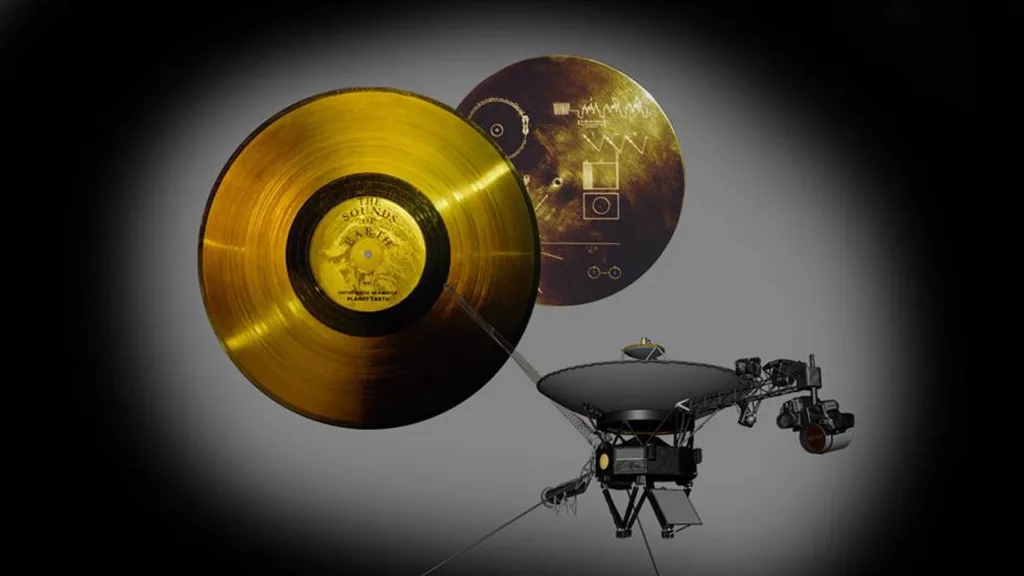
Voyager 1 Is Slowly Running Out of Power
While the Voyager Golden Record may survive for unimaginable lengths of time, the spacecraft carrying it cannot last forever.
NASA Recently Shut Down Another Voyager Instrument
In April 2026, NASA engineers powered down Voyager 1’s Low-Energy Charged Particles experiment. The instrument had operated with very few interruptions since launch.
The shutdown was necessary because Voyager 1 loses about four watts of power every year. Its radioisotope thermoelectric generators slowly weaken as their plutonium fuel decays.
Mission teams at Jet Propulsion Laboratory have spent years planning which systems to deactivate first. Their goal remains simple: keep Voyager communicating with Earth for as long as possible.
Even now, Voyager 1 continues sending scientific data from interstellar space. No other human-built spacecraft has traveled farther.
Voyager 1 Still Operates in Interstellar Space
Voyager 1 officially entered interstellar space in 2012. That milestone transformed the mission from a planetary exploration project into humanity’s first direct exploration of the space between stars.
The spacecraft currently sits more than 24 billion kilometers from Earth. Signals require nearly an entire day to travel one way between Earth and Voyager 1.
Despite its age, the spacecraft continues operating under extreme conditions. Engineers often rely on decades-old technology and creative solutions to maintain communication.
The mission has already lasted far beyond original expectations. Voyager was initially designed for a much shorter planetary mission focused mainly on Jupiter and Saturn.
Instead, it became one of the longest-running scientific missions in history.
The Voyager Mission Is Approaching Its Final Years
NASA expects both Voyager spacecraft to eventually lose enough power that communication systems will stop working entirely.
That moment could arrive sometime during the 2030s.
Once the radios fall silent, the spacecraft will continue drifting through the galaxy alone. At that stage, the Voyager Golden Record becomes the mission’s lasting legacy.
The contrast feels remarkable. The advanced electronics powering the spacecraft may fail within one human lifetime, yet the simple metal disk attached to its side could survive longer than modern civilization itself.
Will Anyone Ever Find the Voyager Golden Record?
The Voyager Golden Record often raises one major question: could another civilization ever discover it?
Scientifically, the odds remain extremely small.
Voyager 1 Will Travel Alone for Tens of Thousands of Years
Voyager 1 does not head toward a nearby planetary system. According to mission estimates, the spacecraft will not approach another star for roughly 40,000 years.
Even then, the chances of intelligent life intercepting the spacecraft remain extremely remote.
Space is unimaginably large. Voyager represents a tiny object moving through an enormous cosmic ocean.
Still, the project was never purely about probability calculations.
The Real Meaning of the Voyager Golden Record
The deeper purpose of the Voyager Golden Record was philosophical.
Humanity chose to leave evidence of its existence beyond Earth. Scientists, artists, and engineers worked together to create a message that could outlast them by millions of years.
That decision continues to resonate because it reflects a uniquely human instinct. People preserve memories, build monuments, and record stories because they want future generations to know they existed.
The Voyager Golden Record simply expanded that instinct onto a cosmic scale.
Humanity’s Most Durable Cultural Artifact
Unlike Earth, deep space contains no atmosphere, weather, or oceans capable of erasing the record.
Over immense timescales, the disk may remain largely unchanged while civilizations on Earth transform completely.
That possibility creates one of the mission’s most emotional ideas:
- Voyager’s systems will eventually stop working.
- Human institutions may rise and disappear.
- But the greetings, music, and sounds etched into the record may continue traveling silently through the galaxy.
Few human creations were designed with such timescales in mind.
Why the Voyager Golden Record Still Matters Today
The Voyager Golden Record remains powerful because it combines science with emotion.
The mission began as a planetary exploration project. It studied Jupiter, Saturn, and the outer solar system. Yet the Golden Record transformed Voyager into something larger than science alone.
It became a symbol of curiosity, optimism, and long-term thinking.
In an era dominated by short technological cycles, the Voyager Golden Record reminds people that humanity can still create projects meant to endure far beyond a single generation.
That perspective explains why the record continues attracting attention nearly fifty years after launch.
Even as Voyager 1 slowly powers down, the message attached to it continues its endless journey through interstellar darkness.
And long after the spacecraft stops speaking to Earth, the Voyager Golden Record may still carry the sound of human voices across the galaxy.
Main Sources:
NASA Voyager Mission Updates
https://science.nasa.gov/mission/voyager/
NASA Voyager Golden Record Overview
https://voyager.jpl.nasa.gov/golden-record/
Jet Propulsion Laboratory Voyager Mission
https://www.jpl.nasa.gov/missions/voyager/