
SpaceEyeNews.
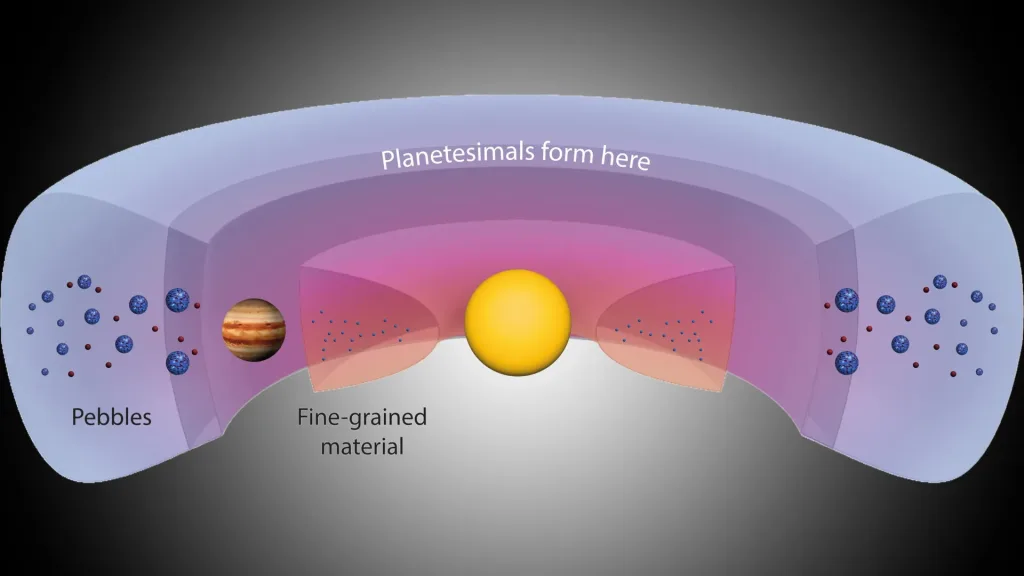
A giant cosmic construction zone may have existed just beyond Jupiter billions of years ago. Scientists now believe this region acted as a massive “planet factory” that continuously produced the building blocks of planets for millions of years.
The new discovery could reshape how researchers understand the birth of the Solar System. It may also explain the mysterious origins of several ancient meteorites found on Earth today.
Researchers from the Max Planck Institute for Solar System Research used advanced computer simulations to investigate what happened outside Jupiter’s orbit roughly 4.6 billion years ago. Their results suggest a powerful dust-trapping region formed there and became one of the Solar System’s most important planet-building zones.
The findings appeared in The Astrophysical Journal and attracted attention because they connect long-standing meteorite mysteries with modern planetary formation models.
How the Planet Factory Beyond Jupiter Formed
In the Solar System’s early days, the young Sun sat inside a giant rotating disk of gas and dust. Scientists call this a protoplanetary disk. Tiny grains inside that disk slowly collided and stuck together.
Over time, larger rocky objects formed. These objects became planetesimals, the early building blocks of planets, moons, and asteroids.
Jupiter Changed the Structure of the Young Solar System
Researchers believe Jupiter formed very early in Solar System history. As the giant planet grew, its gravity carved a large gap into the surrounding disk.
That process created something unusual just beyond Jupiter’s orbit.
A ring-shaped zone of higher gas pressure appeared outside the gap. Scientists describe this region as a “dust trap.” Instead of drifting toward the Sun, dust particles accumulated inside the ring.
This trapped material continued building up for millions of years.
According to the study, the region became an extremely efficient production zone for planetesimals. Scientists now think this may have been the Solar System’s ultimate planet factory.
Why Dust Traps Matter
Dust traps solve one of planetary science’s biggest problems.
Normally, small particles spiral inward toward the Sun before they can grow large enough to form planets. Inside a dust trap, however, material stays concentrated in one place.
That increases collisions between particles and allows larger bodies to form much faster.
Previous studies already suggested dust traps could help create planetesimals. The new simulations go much further.
Researchers discovered the Planet Factory Beyond Jupiter remained active for nearly two million years while continuously producing different generations of rocky bodies.
That finding surprised scientists because it shows one region could create multiple kinds of planetesimals over long periods of time.
Planet Factory Beyond Jupiter May Explain Ancient Meteorites
The discovery could finally explain several strange meteorites that scientists have struggled to understand for decades.
Many meteorites found on Earth formed during the Solar System’s earliest history. Some of them have barely changed since then.
These ancient rocks preserve chemical clues from billions of years ago.
Carbonaceous Chondrites Hold Ancient Clues
Researchers focused heavily on meteorites known as carbonaceous chondrites.
These meteorites contain large amounts of carbon-rich material. Scientists believe they formed beyond Jupiter during the same era explored in the new simulations.
Carbonaceous chondrites appear in several distinct groups. Some contain fragile fine-grained material. Others contain stronger rocky inclusions embedded inside dusty matter.
For years, researchers struggled to explain why these meteorites looked so different despite forming during roughly the same period.
The new study offers a possible answer.
Two Types of Material Existed Inside the Dust Trap
The simulations showed that two major types of material circulated through the region beyond Jupiter.
One type consisted of fragile dusty material. The other consisted of sturdier rocky clumps that originally formed closer to the Sun in hotter regions of the disk.
As time passed, Jupiter’s gravity affected these materials differently.
Larger rocky particles became trapped more efficiently than smaller dust grains. Meanwhile, the formation of new planetesimals steadily consumed available material inside the dust trap.
That changed the balance between both material types over millions of years.
Eventually, distinct generations of planetesimals emerged.
Some became rich in fragile dusty material. Others contained much larger amounts of stable rocky matter.
Scientists now suspect many carbonaceous chondrites found on Earth originated from these separate generations of planetesimals.
Meteorites Became a Test for the Simulations
The study achieved something researchers consider extremely important.
The computer simulations successfully reproduced patterns already observed in laboratory studies of meteorites.
That connection gives scientists stronger confidence in the new planetary formation model.
According to the research team, meteorites effectively acted as a “reality check” for the simulations.
Instead of creating purely theoretical models, researchers matched their results against actual ancient material collected on Earth.
That makes the Planet Factory Beyond Jupiter theory far more convincing.
The Discovery Could Change Planet Formation Theories
The findings may force scientists to rethink how planets form across the universe.
Older theories often treated planetary formation as a cleaner and more isolated process. Scientists usually assumed specific types of objects formed in separate regions under separate conditions.
The new study paints a much more dynamic picture.
Multiple Generations Formed in One Region
Researchers now believe several generations of planetesimals formed in the same location at different times.
That means one long-lived dust trap could continuously evolve while producing very different types of objects.
The process lasted far longer than many earlier models predicted.
The simulations tracked microscopic dust collisions along with massive movements across the entire gas disk.
Particles drifted, collided, broke apart, regrouped, and became trapped repeatedly.
That complex behavior created changing chemical environments inside the same region.
Scientists believe this explains why meteorites from similar eras can contain dramatically different compositions.
Similar Planet Factories May Exist Across the Galaxy
The implications extend far beyond our Solar System.
Modern observatories already detect giant rings and gaps inside disks surrounding young stars. Telescopes such as Atacama Large Millimeter/submillimeter Array have observed these structures in several distant planetary systems.
Many researchers suspect those rings may also contain dust traps.
If so, giant planets forming around other stars could be creating their own planet factories right now.
That possibility excites astronomers because it links our Solar System to planetary systems across the galaxy.
Instead of being unique, the process beyond Jupiter may represent a common stage of planetary evolution.
Jupiter May Have Shaped More Than Its Own Orbit
The study also reinforces Jupiter’s enormous influence on Solar System history.
Scientists already knew Jupiter affected asteroid belts and planetary migration. The new research suggests the giant planet may have controlled where and how many early planetesimals formed.
Without Jupiter, the Solar System’s architecture may have looked completely different.
The planet did more than simply form inside the disk.
It may have reorganized the entire environment around it.
Why the Planet Factory Beyond Jupiter Matters
The Planet Factory Beyond Jupiter offers a new explanation for how complex planetary systems emerge from chaotic clouds of gas and dust.
The discovery links together several mysteries at once.
It explains strange meteorites. It improves planet formation models. It also connects Solar System history with observations of distant young stars.
Scientists still need additional simulations and future observations to confirm every detail. However, the study provides one of the strongest modern explanations for how diverse planetesimals formed during the Solar System’s earliest stages.
Billions of years ago, just beyond Jupiter, a giant cosmic factory may have quietly shaped much of the Solar System we see today.
Main Sources:
ScienceDaily
https://www.sciencedaily.com/releases/2026/05/260525000455.htm
Max Planck Institute for Solar System Research
https://www.mps.mpg.de/
The Astrophysical Journal
https://iopscience.iop.org/journal/0004-637X
ALMA Observatory
https://www.almaobservatory.org/