BY:SpaceEyeNews.
Mercury Ice Mystery May Have a Surprising Solution
The Mercury Ice Mystery has puzzled planetary scientists for decades. Mercury is the closest planet to the Sun. Surface temperatures can climb above 430 degrees Celsius during the day. At first glance, it seems impossible for water ice to survive there.
Yet observations have repeatedly shown that Mercury contains significant deposits of water ice near its poles. These frozen reservoirs hide inside permanently shadowed craters that never receive direct sunlight.
Scientists have proposed several explanations over the years. Some suggested that comets delivered the water. Others argued that asteroids slowly supplied ice over millions of years.
Now, a new study offers a different answer. Researchers suggest that a single giant impact may have deposited much of Mercury’s polar ice. Even more surprising, the process may have occurred within just one Mercurian day.
If confirmed, this discovery could reshape how scientists think about water transport across the Solar System.
Mercury Ice Mystery Began With A Strange Discovery
Why Mercury Should Not Have Ice
Mercury has almost no atmosphere. Instead, it possesses an extremely thin exosphere that constantly changes under the influence of the solar wind.
Without a protective atmosphere, water molecules face intense radiation. Sunlight can break them apart through a process known as photolysis.
For many years, scientists assumed that any water reaching Mercury would quickly disappear.
That assumption made the discovery of polar ice particularly surprising.
Radar Observations Changed Everything
The first clues emerged during radar observations in the early 1990s. Scientists detected unusually bright regions near Mercury’s poles.
Later, NASA’s MESSENGER spacecraft confirmed the presence of water ice.
The findings revealed that permanently shadowed craters near both poles contained frozen deposits.
These craters act like natural freezers. Their interiors never receive direct sunlight. Temperatures remain low enough to preserve ice for extremely long periods.
The discovery solved one question but created another.
Where did all that water come from?
The Search For A Source
Several theories attempted to explain the ice.
Some researchers suggested that countless small impacts delivered water over billions of years.
Others proposed that cometary material accumulated gradually inside polar cold traps.
Although those ideas remained possible, none fully explained the observed ice distribution.
Scientists needed a mechanism capable of delivering large amounts of water efficiently.
That search led researchers to one of Mercury’s most impressive impact structures.
Mercury Ice Mystery And The Hokusai Crater Impact
A Crater With A Story To Tell
The new study focused on Hokusai Crater, a large impact structure roughly 97 kilometers wide.
Researchers investigated whether a water-rich asteroid or comet could have delivered enough material to create Mercury’s polar ice deposits.
The team built detailed computer simulations to test the idea.
Their results revealed an unexpected process.
Mercury Briefly Gained A Dense Atmosphere
Normally, Mercury possesses only a thin exosphere.
However, a massive impact changes everything.
When a large object strikes a planetary surface, it vaporizes enormous quantities of material. Water contained within the impactor can enter the surrounding environment as vapor.
According to the simulations, the collision created a temporary dense atmosphere around Mercury.
This atmosphere spread around the planet remarkably quickly.
Within roughly an hour, water vapor had expanded across much of Mercury.
That temporary atmosphere became the key to solving the Mercury Ice Mystery.
The Importance Of Self-Shielding
One major challenge involves photolysis.
Solar radiation constantly breaks apart water molecules.
Under normal conditions, most vapor would disappear before reaching the poles.
The researchers found that a dense impact-generated atmosphere behaves differently.
The outer layers absorb incoming radiation first. As a result, they protect water molecules deeper inside the atmosphere.
Scientists call this effect self-shielding.
The numbers were striking.
In a standard exosphere scenario, photolysis destroyed up to 96 percent of the water vapor.
In the impact-generated atmosphere, only about 46 percent was lost.
That difference dramatically increased the amount of water available to reach Mercury’s polar regions.
How Mercury’s Polar Ice Formed In One Mercurian Day
Water Migrated Toward Polar Cold Traps
Once protected by the temporary atmosphere, water molecules traveled across Mercury’s surface environment.
Eventually, many reached permanently shadowed craters near the poles.
These locations serve as cold traps.
Temperatures remain so low that water can freeze and remain stable for millions or even billions of years.
The simulations showed that approximately 22.4 percent of the original water mass reached these cold traps.
By comparison, only about 3.4 percent survived in models that used Mercury’s normal exosphere.
That improvement helped researchers reproduce the overall amount of ice observed today.
A Rapid Planetary Event
Another surprising result emerged from the study.
Scientists found that most of the ice deposition process could occur within a single Mercurian solar day.
A Mercurian day lasts about 176 Earth days.
From a planetary perspective, that is incredibly fast.
Previous explanations often relied on gradual accumulation over vast timescales.
The new model instead points toward a rapid and dramatic event.
If correct, a single impact may have transformed Mercury’s polar environment in a relatively short period.
Why The New Model Matters
The significance extends beyond Mercury.
Scientists want to understand how water moves through the Solar System.
Water influences planetary evolution, surface chemistry, and potentially habitability.
The new findings suggest that major impacts may play a larger role in redistributing water than previously thought.
Similar processes could have affected other airless worlds as well.
That possibility makes Mercury an important laboratory for planetary science.
One Important Question Remains Unanswered
The Ice Thickness Problem
Although the simulations successfully reproduced the total ice mass, one discrepancy remains.
The modeled ice deposits reached a thickness of only about 37 centimeters.
Observations suggest some deposits may be several meters thick.
This difference indicates that the story may not be complete.
A Larger Impactor Could Explain The Difference
Researchers believe the simulated impactor may not perfectly represent the real event.
A larger object could have delivered more water.
Likewise, a slower impact might have preserved more volatile material.
Either scenario could produce thicker deposits that better match observations.
Future studies will continue exploring these possibilities.
BepiColombo Could Provide The Final Answer
Scientists may soon gain additional evidence.
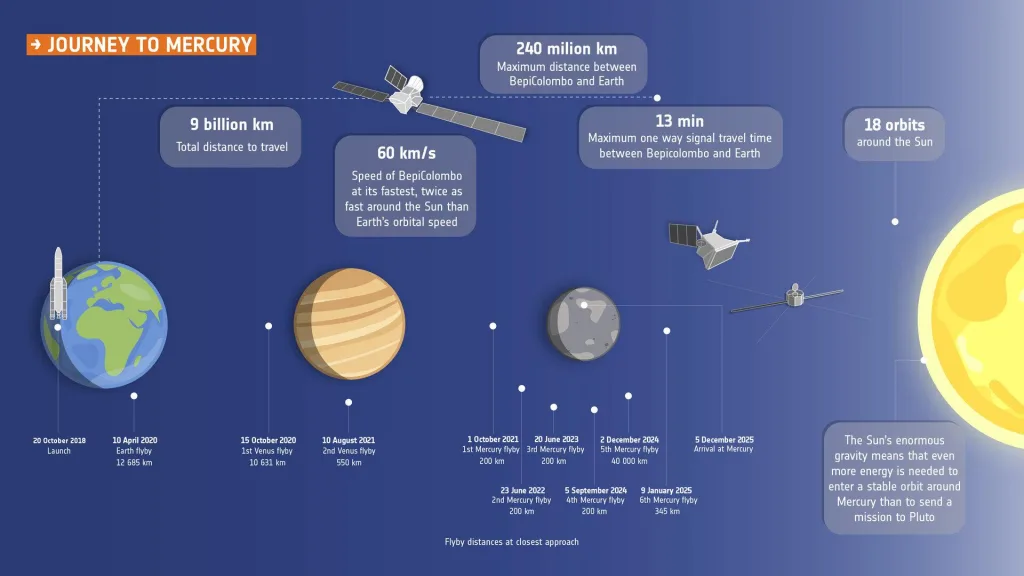
The joint European and Japanese BepiColombo mission is currently traveling toward Mercury.
Once operational around the planet, the spacecraft will perform detailed measurements of Mercury’s surface and polar regions.
Researchers hope to determine the true thickness of the ice deposits.
They also want to map their distribution with greater precision.
Those observations could confirm whether a giant impact really solved the Mercury Ice Mystery.
Conclusion: Mercury Ice Mystery May Finally Be Nearing An Answer
The Mercury Ice Mystery has challenged scientists since the discovery of frozen deposits near the planet’s poles.
A new study now presents one of the most convincing explanations yet. Instead of requiring billions of years of gradual accumulation, the research suggests that a single water-rich impact may have delivered much of Mercury’s ice.
The temporary atmosphere created by that collision protected water vapor from destruction and allowed it to migrate into permanently shadowed craters.
Important questions remain, particularly regarding ice thickness. However, upcoming observations from BepiColombo could soon provide crucial answers.
For now, Mercury continues to surprise scientists. The hottest planet in the Solar System may also preserve one of its most fascinating frozen secrets.
Main Sources:
- Universe Magazine
https://universemagazine.com/en/where-did-the-ice-on-mercury-come-from-a-new-answer/ - Journal of Geophysical Research: Planets
https://agupubs.onlinelibrary.wiley.com/journal/21699100 - Space.com
https://www.space.com/astronomy/mercury/where-did-mercury-get-its-water-ice-maybe-from-a-single-slow-asteroid-impact-in-one-mercurian-day - Phys.org
https://phys.org/news/2026-05-mercury-ice-deposited-larger-slower.html - NASA MESSENGER Mission Archive
https://www.nasa.gov/mission_pages/messenger/main/index.html - BepiColombo Mission
https://www.esa.int/Science_Exploration/Space_Science/BepiColombo