
BY:SpaceEyeNews.
For years, astronomers suspected that some young stars might absorb nearby planets during the chaotic process of planetary formation. The idea appeared in many theoretical models, yet clear observational evidence remained difficult to obtain.
Now, a new study provides some of the strongest evidence so far that red dwarf stars consume Earth-like planets. Researchers discovered unusual chemical signatures inside several young red dwarfs that point to the recent absorption of rocky planetary material.
The findings do more than support an old theory. They may also give scientists a new tool for uncovering the hidden history of planetary systems. Instead of studying only planets that survived, astronomers may now be able to identify worlds that disappeared long ago.
Red Dwarf Stars Consume Earth-Like Planets Through a Hidden Process
Young planetary systems are far from stable. During their early evolution, planets can migrate inward, change orbits, and interact with neighboring worlds.
Sometimes these interactions push planetary material toward the host star.
Astronomers have long suggested that stars may absorb nearby planets during this turbulent period. Until now, however, finding direct evidence has been challenging.
The new study focused on red dwarfs. These stars are the most common type of star in the Milky Way. They are smaller and cooler than the Sun. Despite their cooler surfaces, their interiors become hot enough to destroy certain fragile chemical elements.
That characteristic became the key to this discovery.
Why Scientists Focused on Red Dwarfs
Red dwarfs offer a unique advantage.
Shortly after formation, their interiors destroy nearly all of their original lithium through nuclear reactions. As a result, astronomers expect mature red dwarfs to contain very little lithium in their outer layers.
If lithium appears later, something unusual must have happened.
That makes red dwarfs ideal laboratories for investigating planetary accretion events.
The Lithium Clue That Changed Everything
Researchers from the University of Cologne and the University of Exeter analyzed data collected from thousands of stars.
Their goal was to search for unusual chemical patterns.
Instead, they found something unexpected.
Several red dwarfs contained significantly more lithium than other stars of similar age and type.
Why Lithium Should Not Be There
Lithium is relatively fragile inside stars.
As stellar interiors heat up, lithium atoms break down and disappear. For red dwarfs, this process happens early in their lives.
Consequently, finding large amounts of lithium in young red dwarfs raises an important question.
Where did the lithium come from?
Scientists believe the most likely answer involves planetary material.
Rocky planets and planetary building blocks can contain lithium. If a star absorbs that material, the element temporarily appears in the stellar atmosphere.
Researchers describe this as a chemical fingerprint left behind after a planetary engulfment event.
A Chemical Crime Scene
Lead author Professor Robin Jeffries explained that lithium acts almost like forensic evidence.
Because red dwarfs should have destroyed their original lithium, any fresh lithium stands out clearly.
In simple terms, astronomers are not observing the planets directly.
Instead, they are detecting the chemical remains of worlds that may no longer exist.
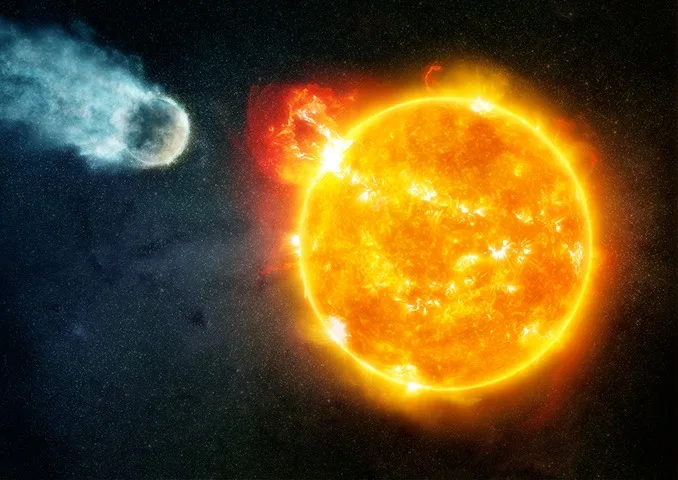
How Researchers Found Evidence That Red Dwarf Stars Consume Earth-Like Planets
The team relied on data from the Gaia-ESO spectroscopic survey.
Spectroscopy allows scientists to study how materials interact with light. Different elements leave unique patterns in a star’s spectrum.
By analyzing those patterns, astronomers can determine the chemical composition of stellar atmospheres.
Thousands of Stars Examined
The survey included thousands of stars located in young stellar clusters.
These clusters offer a major advantage.
Most stars within a cluster formed at roughly the same time and from similar material. This makes unusual chemical differences easier to identify.
Among the large sample, researchers identified six red dwarfs in three separate clusters that contained unusually high lithium abundances.
Those stars stood out immediately.
Comparing Stellar Siblings
Scientists compared each lithium-rich star with neighboring stars of the same type.
The differences were significant.
Most cluster members showed the expected low lithium levels. The six unusual stars displayed much higher concentrations.
That pattern strongly suggests an external source of lithium.
Researchers concluded that planetary accretion provides the most convincing explanation.
How Much Planetary Material Was Consumed?
According to the study, the stars may have absorbed between three and ten Earth masses of rocky material.
That estimate does not necessarily mean a single Earth-sized planet disappeared.
Several scenarios remain possible.
More Than One Lost World
The consumed material may have come from:
- Multiple rocky planets
- Large planetary embryos
- Massive asteroid-like bodies
- Unfinished terrestrial planets
In many young systems, planet formation remains incomplete for millions of years.
As a result, stars may absorb a mixture of developing worlds and leftover building material.
A Common Outcome of Planet Formation
Theoretical models have predicted such events for decades.
During planetary migration, gravitational interactions can move worlds inward.
Some planets stabilize in new orbits.
Others approach the host star and eventually merge with it.
The new evidence suggests that these events may be more common than previously believed.
Why Planetary Systems May Be More Chaotic Than We Thought
The discovery highlights a reality often overlooked in discussions about exoplanets.
Not every planet survives.
Astronomers usually focus on worlds that remain visible today. Yet many planetary systems may have lost planets during their earliest stages.
A Hidden Population of Lost Planets
If planetary engulfment occurs frequently, the number of planets originally formed around stars could be much larger than current observations suggest.
Some planets may never survive long enough to become stable worlds.
Others may disappear before scientists ever have a chance to detect them.
This possibility changes how researchers think about planetary evolution.
The Missing Chapters of Planetary History
Modern telescopes reveal planets that exist today.
Chemical evidence can reveal planets that existed in the past.
Together, these approaches provide a more complete picture of how planetary systems develop over time.
Could Our Solar System Have Experienced Something Similar?
Scientists cannot say for certain.
However, some models of Solar System formation suggest that material may have fallen into the young Sun during its early history.
Such events would have occurred billions of years ago.
The new research does not prove that Earth’s Solar System experienced planetary engulfment.
Nevertheless, it strengthens the idea that stellar consumption of planetary material may be a natural part of planetary formation.
Future studies could help determine how common these events really are.
What This Discovery Means for Future Exoplanet Research
The most exciting aspect of this work may be its long-term scientific potential.
Researchers now have a possible method for identifying ancient planetary engulfment events.
Instead of searching only for surviving planets, astronomers can examine stellar chemistry for evidence of vanished worlds.
Reading the History Written Inside Stars
Every unusual chemical signature tells part of a story.
Lithium-rich red dwarfs may preserve records of dramatic events that happened millions of years earlier.
As larger surveys become available, scientists may discover many more examples.
That could reveal how often stars absorb planets and when those events typically occur.
A New Window Into Planetary Evolution
For decades, planetary science focused mainly on detecting planets.
Now researchers may be entering a new era.
By studying stellar chemistry, astronomers can investigate worlds that no longer exist.
That approach could transform our understanding of planetary formation across the Milky Way.
Conclusion
The discovery that red dwarf stars consume Earth-like planets represents one of the most intriguing findings in recent planetary science. By identifying unexpected lithium signatures in six young red dwarfs, astronomers may have uncovered direct evidence that stars can absorb rocky planetary material during the early stages of system formation. More importantly, the research opens a new way to study planets that vanished long before modern telescopes could observe them. In the future, the chemical fingerprints hidden inside stars may reveal countless lost worlds scattered throughout our galaxy.
Main Sources:
- Universe Magazine
https://universemagazine.com/en/red-dwarfs-consume-earth-like-planets/ - Royal Astronomical Society
https://ras.ac.uk/news-and-press/research-highlights/red-dwarf-stars-detected-eating-earth-planets - University of Exeter
https://news.exeter.ac.uk/faculty-of-environment-science-and-economy/astronomers-find-evidence-red-dwarf-stars-swallowing-planets/ - Monthly Notices of the Royal Astronomical Society (Research Paper)
https://academic.oup.com/mnras