
BY:SpaceEyeNews.
The Biggest Planet Hunt Ever Attempted
For more than three decades, astronomers have searched for planets beyond our Solar System. That effort has produced over 6,000 confirmed exoplanets and transformed our understanding of the universe. Yet despite that progress, scientists have explored only a small portion of our galaxy.
NASA’s upcoming Nancy Grace Roman Space Telescope aims to change that. The observatory will investigate regions of the Milky Way that previous planet-hunting missions largely overlooked. During its mission, Roman could discover as many as 100,000 new worlds, potentially increasing the known exoplanet population by an extraordinary margin.
Unlike missions that focused on stars relatively close to Earth, Roman will look deep into the crowded center of the Milky Way. There, astronomers hope to answer a fundamental question: Are planetary systems like our own common throughout the galaxy, or have we been studying only a small and unusual sample?
Exploring the Milky Way’s Hidden Planetary Frontier
Most known exoplanets orbit stars located within a few thousand light-years of Earth. These discoveries have provided remarkable insights, but they represent only one corner of a vast galaxy.
Roman will push much farther.
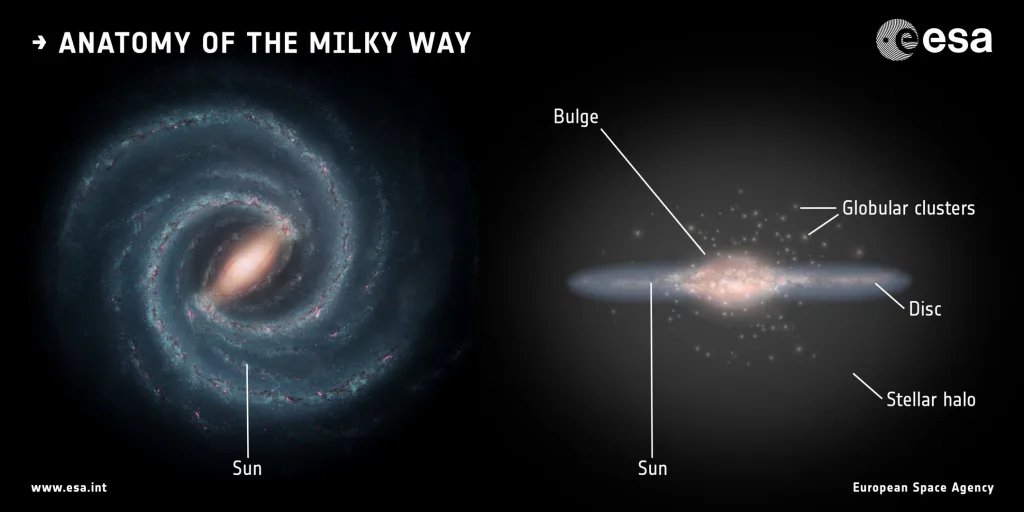
Its primary survey targets the Galactic Bulge, the dense central region of the Milky Way. This area contains huge numbers of stars packed into a relatively small volume of space. Many of those stars formed billions of years ago and evolved under different conditions than stars near the Sun.
Why the Galactic Bulge Matters
The Galactic Bulge offers a unique laboratory for studying planetary formation.
Many stars there contain different proportions of key elements such as oxygen, silicon, and magnesium. Since planets form from the same material as their parent stars, these chemical differences may influence the types of worlds that emerge.
Some planetary systems may resemble our own. Others could look completely unfamiliar.
By surveying this region, Roman will help scientists determine whether planetary architectures vary across different parts of the galaxy.
Beyond the Reach of Earlier Missions
NASA’s Kepler mission revolutionized exoplanet science, while TESS expanded the search around nearby stars. Roman takes a different approach.
Instead of concentrating on the Solar neighborhood, it will examine stars near the galactic center and beyond. Some targets lie roughly 26,000 light-years away.
This wider perspective could reveal whether the planets we have discovered so far represent the true diversity of worlds in the Milky Way.
Two Powerful Techniques for Finding New Worlds
One of Roman’s greatest strengths is its ability to combine multiple detection methods.
Each technique uncovers different types of planets. Together, they provide a more complete picture of planetary populations.
Detecting Planetary Transits
The first method is the transit technique.
When a planet passes in front of its star, the star’s brightness drops slightly. By measuring that change, astronomers can estimate a planet’s size and orbit.
This approach helped discover thousands of known exoplanets. It works particularly well for large planets orbiting close to their stars.
As Roman monitors millions of stars, it is expected to identify an enormous number of transiting worlds.
The Microlensing Advantage
The telescope’s most distinctive capability comes from gravitational microlensing.
This phenomenon occurs when a foreground star passes between Earth and a more distant star. The foreground star’s gravity bends and magnifies the background star’s light.
If planets orbit the foreground star, they leave detectable signatures within that brief amplification event.
Microlensing allows astronomers to find planets that other techniques often miss.
Discovering Hidden Planet Populations
Many detection methods favor large planets located close to their stars. Microlensing opens a window to a very different population.
Roman is expected to detect worlds with wider orbits, including planets that resemble those found in our own Solar System. The observatory may also identify Earth-sized planets, Mars-sized objects, and even rogue planets drifting through interstellar space without a host star.
These discoveries could fill major gaps in current planetary catalogs and provide a more balanced picture of planetary systems across the galaxy.
Mapping Alien Atmospheres on an Unprecedented Scale
Finding planets is only part of Roman’s mission.
The telescope will also help scientists study planetary atmospheres and climate behavior across thousands of worlds.
Infrared Vision Reveals New Details
Roman operates primarily in infrared wavelengths. This capability allows it to detect heat emitted by distant planets.
Infrared observations provide valuable information about temperature patterns, atmospheric circulation, and planetary environments that cannot be observed easily in visible light.
A Statistical View of Planetary Climates
The James Webb Space Telescope specializes in detailed investigations of individual planets. Webb can analyze atmospheric chemistry with remarkable precision.
Roman serves a different role.
Rather than focusing on a small number of targets, it will gather information from thousands of planetary systems. This broad dataset will allow researchers to identify large-scale trends and compare planetary climates across many different environments.
The result will be one of the most comprehensive studies of planetary atmospheres ever conducted.
Hot Jupiters as Natural Laboratories
Among Roman’s key targets are hot Jupiters.
These giant planets orbit extremely close to their stars and reach very high temperatures. Because they emit substantial infrared radiation, they provide ideal opportunities for atmospheric studies.
By measuring subtle changes in brightness as these planets move around their stars, scientists can estimate temperature differences between their day and night sides. Those observations may also reveal how efficiently heat moves through alien atmospheres.
Such measurements offer valuable clues about weather patterns and atmospheric circulation under conditions far more extreme than anything found in our Solar System.
Building the First Galactic Census of Planetary Systems
The true significance of Roman lies in its scale.
No previous mission has attempted a survey of planetary systems across such a large portion of the Milky Way.
A Mission Built for Massive Discovery
During its planned five-year mission, Roman will observe billions of celestial objects and generate an unprecedented amount of scientific data.
Among those observations could be tens of thousands of previously unknown planets.
If current projections hold, the mission could reshape exoplanet science within a single decade.
Are We Typical or Exceptional?
One of astronomy’s most important unanswered questions concerns the nature of our own Solar System.
Is it a common outcome of planetary formation, or is it unusual?
Current discoveries cannot fully answer that question because they come from a relatively limited region of the galaxy.
Roman changes the equation.
Its observations will allow astronomers to compare planetary systems formed in very different environments and determine whether certain types of worlds appear more frequently in specific regions.
Connecting Planet Formation Across the Galaxy
Researchers also hope to uncover links between stellar chemistry and planetary architecture.
By comparing planets around stars of different ages and compositions, scientists may gain new insights into how planetary systems evolve over time.
Those findings could help explain why some regions produce certain types of planets while others do not.
A Telescope That Could Redefine Exoplanet Science
The Nancy Grace Roman Space Telescope represents a major step forward in humanity’s search for other worlds.
Rather than examining isolated planetary systems, Roman will provide a galaxy-wide perspective. Its discoveries may reveal thousands of previously unseen planets, uncover rare planetary environments, and offer new clues about the processes that shape planetary systems.
Most importantly, the mission could finally show whether our Solar System is typical of the Milky Way or simply one outcome among countless possibilities.
By the end of the decade, Roman may transform exoplanet research from the study of a few thousand nearby worlds into the study of an entire galaxy filled with planets waiting to be explored.
Main Sources:
- NASA Roman Space Telescope
https://science.nasa.gov/mission/roman-space-telescope/ - NASA Roman Mission Update
https://www.nasa.gov/image-article/nasa-targets-early-september-for-roman-space-telescope-launch/ - Roman Space Telescope Science Center
https://roman.ipac.caltech.edu - Universe Magazine Article
https://universemagazine.com/en/roman-telescope-will-observe-an-unexplored-part-of-the-milky-way/ - NASA Exoplanet Exploration Program
https://exoplanets.nasa.gov