BY:SpaceEyeNews.
NASA is approaching one of the most important moments in modern aviation. The agency’s experimental X-59 aircraft is preparing for its first flight faster than the speed of sound. This milestone marks a major step in the broader effort to prove that high-speed air travel does not have to produce disruptive sonic booms.
The upcoming X-59 quiet supersonic flight campaign is not simply about speed. NASA wants to demonstrate that future aircraft can travel faster than sound while generating far less noise for people on the ground. If successful, the project could influence future aviation regulations and open the door to a new generation of commercial supersonic aircraft.
For decades, noise restrictions have limited the growth of supersonic passenger travel. NASA believes the X-59 may finally offer a practical solution. The coming tests will determine whether years of engineering work can deliver the results researchers have predicted.
Why the X-59 Quiet Supersonic Flight Matters
The X-59 exists for a single purpose. It aims to reduce the impact of sonic booms.
Traditional supersonic aircraft create powerful shock waves. When those waves reach the ground, they produce the loud sonic boom familiar from military aircraft and past supersonic programs. That noise became one of the biggest obstacles to routine supersonic travel over populated areas.
As a result, many countries introduced restrictions on overland supersonic operations. While aircraft such as Concorde demonstrated impressive speed, noise concerns prevented wider adoption.
NASA’s Quesst Mission focuses on solving this challenge.
Instead of creating a sharp sonic boom, the X-59 is designed to generate a softer sound often described as a “sonic thump.” The difference may seem small, but it could completely change how regulators view future supersonic aircraft.
A Different Aircraft Design
The X-59 looks unlike any commercial aircraft currently flying.
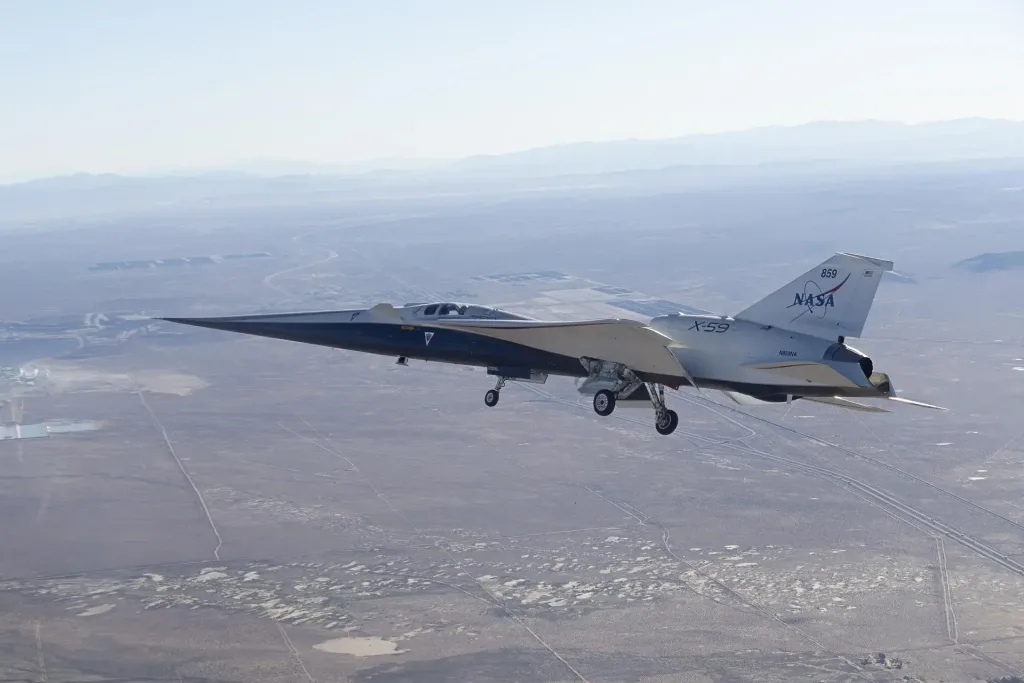
Its most recognizable feature is its extremely long and narrow nose. Engineers designed the aircraft’s shape to spread shock waves in a way that reduces their impact before they reach the ground.
Every major component contributes to that goal.
The wings, fuselage, and engine placement all help manage airflow around the aircraft. Rather than focusing solely on speed, NASA built the entire platform around noise reduction.
That design philosophy separates the X-59 from previous supersonic aircraft.
More Than a Technology Demonstrator
NASA views the aircraft as more than an experimental platform.
The agency hopes the project will generate data that regulators can use when evaluating future supersonic travel rules. Success could eventually support faster commercial flights over land without creating significant noise disturbances for communities below.
That possibility explains why the X-59 has attracted attention across the aviation industry.
The Long Road to the First X-59 Quiet Supersonic Flight
The upcoming milestone follows years of development and testing.
NASA completed the aircraft’s first flight in October 2025. After a scheduled maintenance period, testing resumed in March 2026.
Since then, engineers have gradually expanded the aircraft’s flight envelope.
Fifteen Flights Built Confidence
The X-59 team has completed fifteen developmental flights.
Each mission focused on gathering data and validating critical systems. Engineers increased altitude and speed step by step. This careful approach reduced risk and allowed teams to monitor aircraft performance under a variety of conditions.
One notable achievement involved the first retraction of the landing gear during flight. This allowed engineers to study the aircraft in a cleaner aerodynamic configuration.
The aircraft also climbed to approximately 43,000 feet and approached Mach 0.95. That speed placed it just below the sound barrier.
Every successful test provided new information that helped prepare the aircraft for supersonic operations.
Advanced Systems Under Evaluation
The X-59 incorporates several unique technologies.
Among the most important is the eXternal Vision System.
Because the aircraft’s elongated nose prevents a traditional forward cockpit view, pilots rely on cameras and high-resolution displays instead of a conventional windshield.
This system gives pilots a clear picture of the environment ahead while maintaining the aircraft’s specialized shape.
Engineers have also monitored hydraulic systems, fuel management systems, environmental controls, and structural sensors throughout the flight campaign.
These systems must perform reliably before NASA can move into more demanding test conditions.
Expanding the Flight Envelope
Every developmental flight served a specific purpose.
Engineers gradually increased altitude, speed, and aircraft complexity. Teams collected aerodynamic data while evaluating how the aircraft responded to changing conditions.
This process is known as flight envelope expansion.
The strategy ensures that researchers understand aircraft behavior before pushing performance limits. The upcoming supersonic tests represent the next major phase of that expansion effort.
What NASA Will Test During the Upcoming Flights
The next series of missions will push the aircraft beyond previous limits.
For the first time, the X-59 will officially fly faster than sound.
NASA expects the aircraft to exceed 630 mph at approximately 43,000 feet. After that milestone, the team plans to conduct a mission-conditions flight at Mach 1.4, or roughly 925 mph, near 55,000 feet.
These conditions match the environment NASA eventually plans to use during community overflight studies.
Measuring Shock Waves in Real Conditions
The early supersonic flights focus on data collection.
NASA is not yet attempting to prove the aircraft’s quiet-boom performance. Instead, engineers want to understand how shock waves behave under real operational conditions.
To achieve that goal, one of NASA’s F-15 research aircraft will fly nearby carrying specialized measurement equipment.
The collected information will help researchers compare real-world results with computer models developed during the design process.
Accurate measurements are essential because future testing depends on understanding how the aircraft’s shock waves travel through the atmosphere.
Reaching Higher Speeds
The X-59 program still has additional performance goals ahead.
NASA plans to eventually push the aircraft to its maximum design speed of Mach 1.6. That equals approximately 1,218 mph.
Engineers also intend to reach altitudes near 60,000 feet.
Achieving those targets will provide a complete picture of aircraft behavior throughout its operating range.
The resulting data will guide future phases of the mission.
How the X-59 Quiet Supersonic Flight Could Change Commercial Aviation
The ultimate objective extends beyond NASA research.
The agency wants to provide evidence that quiet supersonic travel is possible.
Current restrictions stem largely from concerns about sonic booms. If the X-59 demonstrates a dramatically quieter acoustic signature, policymakers could eventually review existing rules.
That process will not happen overnight.
However, reliable scientific data is the first requirement for any future regulatory changes.
Phase 2 Will Be the Real Test
The current flights belong to Phase 1 of the Quesst Mission.
This phase focuses on aircraft safety, performance, and airworthiness.
Once NASA completes those objectives, the program will move into Phase 2.
That stage will focus directly on acoustics.
Researchers will measure the aircraft’s sound signature and evaluate whether it truly produces the quiet sonic thump predicted by years of simulations.
Community response studies will also become an important part of the mission.
The results could influence future discussions about commercial supersonic travel.
A Future Beyond Today’s Airliners
Many aviation experts see quiet supersonic technology as one of the industry’s most promising long-term developments.
Future passenger aircraft could potentially reduce travel times on long routes while minimizing community noise concerns.
The X-59 is not designed to become a commercial airliner itself.
Instead, it serves as a research platform intended to provide the knowledge needed for future aircraft programs.
Its success could shape aviation design decisions for decades.
Conclusion
The upcoming X-59 quiet supersonic flight represents far more than another aircraft test. It marks the beginning of NASA’s effort to validate a concept that could reshape the future of air travel.
After fifteen developmental flights and years of engineering work, the aircraft is finally approaching the conditions it was built to achieve. The next phase will determine whether the X-59 can deliver on its promise of reducing the disruptive effects of sonic booms while maintaining supersonic performance.
Much work remains ahead. Acoustic validation, community testing, and regulatory evaluation will all play important roles. Yet every successful milestone moves the project closer to proving that faster-than-sound travel and public acceptance can coexist.
If that vision becomes reality, the X-59 quiet supersonic flight program may be remembered as the moment a new era of commercial aviation truly began.
Main Sources:
NASA – X-59 Prepares for First Supersonic Flight
https://www.nasa.gov/centers-and-facilities/armstrong/nasas-x-59-prepares-for-first-supersonic-flight/
NASA Quesst Mission
https://www.nasa.gov/mission/quesst/
Daily Galaxy – NASA’s X-59 Readies for Its First Supersonic Flight as the Quesst Mission Reaches a Turning Point
https://dailygalaxy.com/2026/05/nasas-x-59-readies-first-supersonic-flight/