
BY:SpaceEyeNews.
Did a Lost Planet Change the Early Solar System?
The Lost Planet Early Solar System theory has gained new attention thanks to a recent study published in Icarus. Researchers used advanced computer simulations to investigate one of the biggest mysteries in planetary science: how the giant planets reached their current positions while many of their moons survived.
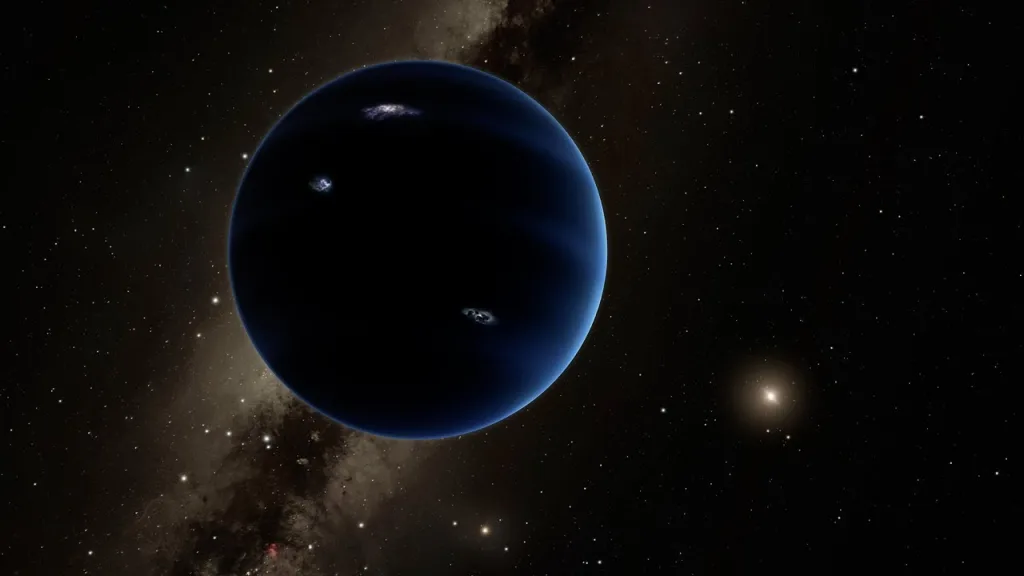
The results point toward a surprising possibility. Billions of years ago, the Solar System may have contained an additional ice giant planet. That world no longer exists here today. Scientists believe gravitational interactions may have ejected it into interstellar space.
Its departure may have triggered a period of instability that reshaped the outer Solar System. During that era, giant planets shifted their orbits, moons experienced major disruptions, and some satellites may have formed again from debris.
The findings offer a new perspective on how our planetary neighborhood evolved into the system we see today.
Lost Planet Early Solar System and the Nice Model
The study builds on the famous Nice Model, one of the leading explanations for Solar System evolution.
According to this model, Jupiter, Saturn, Uranus, and Neptune did not always orbit where they do today. Instead, they formed in a tighter configuration shortly after the Sun emerged.
Over time, gravitational interactions between the giant planets and a vast disk of icy objects altered their paths. Those interactions eventually pushed the planets into new positions.
Why Scientists Suspect an Extra Planet
Previous simulations have often struggled to reproduce the modern Solar System perfectly.
Researchers discovered that many simulations work better when an extra ice giant is added. This hypothetical planet likely resembled Uranus or Neptune in size and composition.
As the planets interacted, one giant world may have received a gravitational kick strong enough to escape the Solar System entirely.
That scenario helps explain several features of today’s planetary arrangement.
A Chaotic Transition
The transition was not gentle.
As the planets moved, their gravity influenced everything around them. Small bodies changed course. Asteroids scattered across space. Moon systems experienced repeated disturbances.
The new study suggests that these events may have been even more dramatic than scientists previously thought.
Uranus May Have Been the Biggest Victim
Among all the giant planets, Uranus appears to have suffered the greatest consequences.
Scientists already know that Uranus is unusual. Unlike the other major planets, it rotates almost on its side.
Its axis tilts by roughly 98 degrees. Researchers have long suspected that a giant impact caused this extreme orientation.
The new simulations suggest that Uranus may have faced another major challenge later in its history.
Close Encounters With Giant Planets
Researchers analyzed thousands of simulations and selected 122 scenarios that closely matched the modern Solar System.
In many of those simulations, other giant planets passed close to Uranus during the instability period.
Each close encounter altered the gravitational environment around the planet.
The effects on its moon system were significant.
Moon Survival Became Unlikely
The study found that the chances of preserving Uranus’s original moons were surprisingly low.
When giant planets approached Uranus, their gravity disturbed the orbits of nearby satellites.
Instead of remaining stable, many moons moved into crossing paths.
Those altered trajectories increased the likelihood of collisions.
Scientists discovered that very few simulations preserved both the planetary system and the original moon system at the same time.
This result suggests that major changes likely occurred around Uranus during the Solar System’s early history.
How Ancient Moon Collisions Could Have Reshaped Uranus
The simulations reveal a fascinating possibility.
Rather than simply ejecting moons into space, gravitational disturbances may have pushed them into one another.
These collisions could have produced enormous clouds of icy debris.
Over time, that material would have gathered together again through gravity.
The result may have been an entirely new generation of moons.
A Cycle of Destruction and Rebuilding
Planetary scientists often describe moon formation as a gradual process. However, the early Solar System may have experienced repeated cycles of disruption and rebuilding.
The new research supports that possibility.
Large debris disks can form after collisions. Those disks may eventually create new moons.
Such events would dramatically alter the appearance and structure of a planetary system.
Evidence From Modern Uranus
Today’s Uranian moon system may still contain clues from that ancient era.
Several moons display unusual characteristics that scientists continue to investigate.
Among them, Miranda stands out as one of the most intriguing objects in the Solar System.
Miranda May Hold the Secret
Miranda is one of Uranus’s most unusual moons.
Images captured by Voyager 2 revealed a strange landscape unlike anything seen elsewhere.
The surface contains giant cliffs, fractured terrain, and regions that appear stitched together from different geological histories.
For decades, scientists have debated how such a strange world formed.
A Moon With a Violent Past
Many researchers suspect that Miranda experienced major disruptions during its history.
One possibility is that the moon shattered and later reassembled.
Another theory suggests intense geological activity reshaped its surface.
The new study adds another explanation.
If Uranus’s moons collided during the instability era, Miranda may have formed from the resulting debris.
Why Miranda Matters
Understanding Miranda could help scientists reconstruct events that occurred more than four billion years ago.
The moon may preserve evidence of processes that no longer operate today.
Future missions to Uranus could provide critical data about its structure, composition, and origin.
That information may help confirm whether the moon truly emerged from an ancient debris field.
What the Lost Planet Early Solar System Theory Means
The implications extend far beyond Uranus.
The Lost Planet Early Solar System scenario suggests that planetary systems can experience dramatic changes long after formation.
Many astronomers now study exoplanets around other stars. Those observations reveal that planetary systems often look very different from our own.
Some contain giant planets extremely close to their stars. Others show unusual orbital arrangements.
The new research suggests that instability and planetary migration may be common throughout the galaxy.
A More Dynamic Solar System
For many years, scientists viewed the Solar System as relatively stable after its formation.
Modern simulations paint a different picture.
The early Solar System appears to have been a dynamic environment shaped by migration, gravitational encounters, and repeated restructuring.
Many objects we see today may represent survivors rather than originals.
Lessons for Exoplanet Research
Understanding our own history helps researchers interpret distant planetary systems.
If giant planets commonly migrate and eject neighboring worlds, then missing planets may be a common feature across the galaxy.
The processes observed in the Lost Planet Early Solar System study may not be unique.
Instead, they could represent a normal stage of planetary evolution.
Conclusion: A Missing World That Changed Everything
The Lost Planet Early Solar System study presents a compelling new view of our cosmic history.
Researchers suggest that an additional ice giant may once have orbited the Sun alongside Jupiter, Saturn, Uranus, and Neptune.
Its eventual ejection may have triggered a period of instability that transformed the outer Solar System.
The simulations indicate that Uranus’s moons faced major disruptions during this era. Some may have collided and reformed. Others may have disappeared entirely.
Although many questions remain, the research highlights an important reality. The Solar System we see today may be the result of billions of years of change, migration, and reconstruction.
Somewhere in that story, a lost planet may have played a crucial role in shaping the worlds we know today.
Main Sources:
- Universe Magazine:
https://universemagazine.com/en/an-unknown-planet-in-the-solar-system-triggered-an-era-of-collisions/ - Icarus Journal Study:
https://www.sciencedirect.com/journal/icarus - arXiv Research Paper:
https://arxiv.org/abs/2603.21750 - Nice Model Background:
https://en.wikipedia.org/wiki/Nice_model - Five-Planet Nice Model:
https://en.wikipedia.org/wiki/Five-planet_Nice_model