BY:SpaceEyeNews.
The Sun has delivered one of its most active performances of 2026. In less than 24 hours, Sunspot Region 4455 produced three major solar flares, including a powerful X-class eruption. The activity triggered radio blackouts across multiple regions of Earth and may send several coronal mass ejections, or CMEs, toward our planet.
For scientists, this event is important because it highlights the growing intensity of Solar Cycle 25. For skywatchers, it could bring some of the brightest aurora displays seen this year. The recent Sunspot Region 4455 solar flares have also renewed attention on a solar region that continues to increase in complexity while facing Earth.
As forecasters analyze incoming solar material, many are asking the same question: Is this simply a brief burst of activity, or the beginning of a much larger space weather event?
Why Sunspot Region 4455 Solar Flares Are Drawing Attention
Solar activity has remained elevated throughout Solar Cycle 25. However, the speed and intensity of the recent eruptions from Region 4455 surprised many observers.
Within a single day, the region produced an M9.3 flare, an M7.9 flare, and an X1 flare. The X1 event marked the strongest category of solar flare currently used by scientists.
A Rapid Escalation
The sequence began with the M9.3 flare. Shortly afterward, another strong M-class eruption followed. Less than ten hours later, the active region crossed into X-class territory.
This progression matters because it demonstrates how quickly solar conditions can change. A region that already appeared unstable suddenly became one of the most watched locations on the solar surface.
Researchers monitoring solar activity had already identified Region 4455 as an area of concern. The latest eruptions confirmed those concerns.
Growing Magnetic Complexity
Sunspots become more dangerous when their magnetic fields grow tangled and complex.
Region 4455 has shown exactly that behavior. As magnetic structures become more complicated, they store larger amounts of energy. Eventually, that energy can be released through powerful solar flares.
Several space weather specialists noted that Region 4455 continues to evolve. As a result, the probability of additional strong flares remains elevated.
The Region Is Still Facing Earth
Perhaps the most important detail is that Region 4455 remains positioned toward Earth.
This means any future eruptions have a greater chance of affecting our planet. While not every flare produces an Earth-directed CME, the orientation of the region increases the possibility of additional impacts during the coming days.
For forecasters, Region 4455 remains the main area to watch.
Sun erupts with 3 colossal solar flares in less than 24 hours, boosting chances for northern lights.
How the Sunspot Region 4455 Solar Flares Affected Earth
The effects of the eruptions began almost immediately.
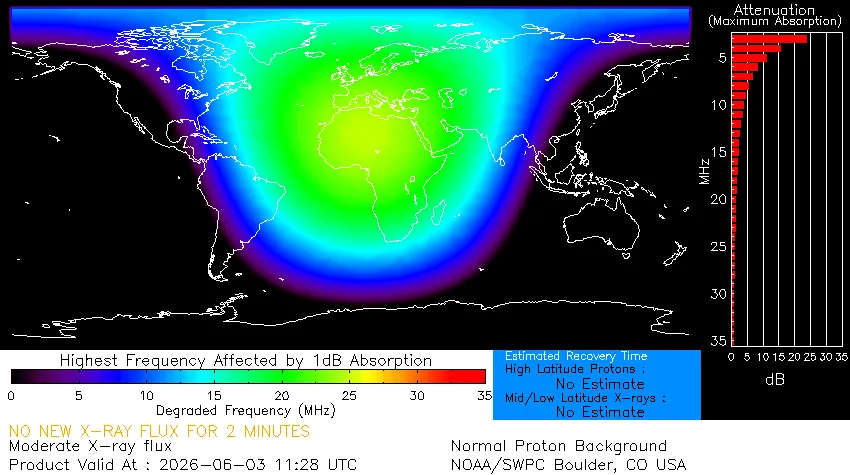
Although solar particles require time to travel through space, the radiation produced by solar flares reaches Earth in roughly eight minutes. That radiation can interfere with radio communications and navigation systems.
Radio Blackouts Across Multiple Continents
The first M9.3 flare generated a moderate R2 radio blackout affecting parts of Asia and Australia.
Later, the M7.9 flare caused another R2 blackout across portions of Europe and Africa.
The strongest impact arrived with the X1 flare. That eruption triggered an R3 radio blackout across parts of Europe and Asia.
These disruptions mainly affected high-frequency radio communications. Aviation operators, maritime services, and some emergency communication networks can experience temporary interruptions during such events.
Multiple CMEs May Be Heading Toward Earth
The larger concern involves several possible Earth-directed CMEs associated with the eruptions.
A CME is a massive cloud of magnetized solar plasma released into space. When directed toward Earth, it can interact with our planet’s magnetic field.
Early analysis suggests that at least one CME is definitely moving toward Earth. Scientists are also examining two additional eruptions that may have launched Earth-directed plasma clouds.
The exact trajectories remain under investigation. Small changes in direction can significantly alter the final impact.
Why Scientists Are Watching CME Interactions
One CME can produce geomagnetic activity.
Several CMEs arriving close together can create a much more complex situation.
When multiple solar storms interact during their journey through space, they can combine and strengthen geomagnetic effects. This possibility is one reason why forecasters remain cautious despite ongoing analysis.
The timing of arrival may prove just as important as the strength of the original eruptions.
Could Sunspot Region 4455 Solar Flares Produce Major Auroras?
For many people, the most exciting part of this event involves the possibility of widespread aurora displays.
Geomagnetic storms often create spectacular northern and southern lights. Strong storms can push auroras far beyond their usual polar locations.
A G3 Geomagnetic Storm Watch
Space weather agencies have issued a G3 geomagnetic storm watch.
A G3 storm falls into the strong category on NOAA’s geomagnetic scale.
Forecasters expect conditions ranging from G1 to G3 levels during the forecast period. They have also noted a small possibility of isolated G4 conditions if the incoming CMEs produce stronger-than-expected effects.
Such forecasts naturally attract attention from aurora photographers and skywatchers around the world.
Why Aurora Visibility Could Expand
Auroras occur when charged solar particles interact with Earth’s magnetic field and atmosphere.
Stronger geomagnetic storms allow these displays to spread farther from the poles.
As a result, regions that rarely experience visible auroras may have an opportunity to see them if storm conditions intensify.
Many skywatchers are already monitoring forecasts closely.
The Critical Role of Magnetic Orientation
Not every CME produces the same result.
The magnetic orientation of incoming solar material plays a major role in determining storm intensity.
Scientists often cannot accurately predict the strongest effects until the CME reaches spacecraft positioned between Earth and the Sun.
This uncertainty explains why aurora forecasts sometimes change dramatically within a matter of hours.
Solar Cycle 25 Continues to Surprise
The recent activity serves as another reminder that Solar Cycle 25 remains highly active.
During the past two years, the Sun has repeatedly exceeded expectations. Major flares, powerful geomagnetic storms, and impressive aurora displays have become increasingly common.
The Sunspot Region 4455 solar flares fit into this broader pattern.
However, the combination of three major eruptions in less than 24 hours makes this event especially noteworthy.
What Happens Next?
Scientists will continue tracking Region 4455 as it rotates across the Earth-facing side of the Sun.
The active region still possesses the potential to produce additional strong eruptions.
Meanwhile, forecasters are carefully monitoring incoming CMEs to determine their exact arrival times and expected impacts.
The next several days will reveal whether the recent activity represents a brief outburst or the beginning of a more sustained period of enhanced solar activity.
Either way, Sunspot Region 4455 has already delivered one of the most significant space weather stories of the year.
Conclusion
The recent Sunspot Region 4455 solar flares demonstrate how quickly conditions on the Sun can change. Three major eruptions in less than 24 hours triggered radio blackouts across multiple continents and launched potential Earth-directed CMEs into space. As those solar storms approach Earth, scientists continue evaluating their likely impacts. Aurora enthusiasts may benefit from the resulting geomagnetic activity, but the bigger story is the continued evolution of Region 4455 itself. With the active region still facing Earth and showing signs of ongoing instability, the Sun may not be finished putting on a show just yet.
Main Sources:
NOAA Space Weather Prediction Center:
https://www.swpc.noaa.gov
UK Met Office Space Weather:
https://www.metoffice.gov.uk/weather/specialist-forecasts/space-weather
NASA Solar Dynamics Observatory:
https://sdo.gsfc.nasa.gov
NOAA Space Weather Scales:
https://www.swpc.noaa.gov/noaa-scales-explanation